
John Ternus Bets Apple's AI on the Device
On this page 10 sections
AI-generated editorial illustration.
On October 28, Apple introduced a MacBook Pro with touch and placed Siri AI beside Spotlight and Live Activities in the computer’s new Dynamic Island. That arrangement, described in Apple’s product release, puts two interface bets in the same visible strip: a person touching an app directly and an assistant that can act through software. The laptop was available for preorder, with general availability scheduled for November 6. Its launch is evidence of Apple’s design choice, not evidence that the assistant reliably completes a user’s work.
Two days later, in Steven Levy’s interview for WIRED, new chief executive John Ternus resisted the idea that AI should replace the product. He said Apple did not want to ship AI for its own sake and that people should care whether a product works for them, rather than which technology made it work. When Levy raised the possibility that prompt-created agents might swallow conventional apps, Ternus defended the human work of making products. Those are his public positions in another publication’s interview, not a conversation with this site.
Ternus became CEO on September 1 under Apple’s announced succession plan. The October laptop is one of his first prominent releases in the role. It gives a concrete form to his answer about AI: the assistant is inside a designed device and software system, alongside a screen, keyboard, apps and a person deciding what to do. Yet a launch can show where an assistant appears without resolving who controls an action when the assistant crosses from one app to another. That is the decision on which Ternus’s product view can be judged.
A product chief inherits an unfinished assistant
Apple’s April succession announcement identified Ternus as its next CEO and Tim Cook as executive chairman. Cook’s tenure had already made the company a vast hardware, services and developer platform. The move did not hand Ternus a small software experiment. It handed him the obligation to make a new interface useful across a system that people use for messages, work, purchases and private records. Each of those uses raises a different question about access and confirmation.
Levy’s WIRED account describes Ternus as a long-serving Apple product executive and reports that the company’s hardware engineering and technology organizations have been combined, with chip leader Johny Srouji reporting to him. The organizational detail is reported by WIRED; Apple has not published in the cited succession release a measured effect of that structure on AI quality. It does, however, make the chain of product accountability clearer. If the assistant depends on device memory, chips, operating-system permissions and app behavior, coordination across those groups is an operating task for the CEO.
The inheritance also includes Siri’s earlier delay. AP’s June 2026 reporting described Apple’s effort to remake an assistant that had fallen behind the expectations set by newer conversational products. Apple’s own June architecture announcement set out a new on-device model, Private Cloud Compute and system orchestration. An announced architecture is a plan and a technical description. It is not a published distribution of task success, error rates or customer retention.
Ternus therefore has a narrower and more useful test than whether Apple can attach AI to every device. Can a person ask for a real task, see what information and app permissions it requires, and get a result whose limits are clear? A product chief can choose the place and form of those interactions. He cannot make the assistant trustworthy merely by placing it beside a familiar icon.
What actually shipped in September
On September 14, Apple said Siri AI began rolling out in beta in English, with additional languages promised for a later update. Ars Technica’s October 26 report confirms that version 27.2 added French, Japanese, Korean, Portuguese and Spanish in beta; its published update notes say Siri AI remained unavailable in the EU and mainland China. Language support therefore changed after the September announcement, while regional availability still constrains any general claim about reach. Apple’s September release described personal-context retrieval across messages, email and photos; onscreen awareness; conversational answers; and more systemwide actions. Those are Apple descriptions of a beta release, with particular examples. They should not be read as evidence that every supported app, language, region or account receives the same action coverage.
Apple’s own examples are informative because they expose the dependencies hidden in the word assistant. One example asks Siri to find a family activity mentioned in messages, retrieve instructions from an email and put ingredients in Reminders. Another asks it to draft email or edit and share photos. The first requires accurate identification of a person and relevant messages, correct extraction from a separate source, and a useful list operation. A mistake at any step can leave a plausible-looking result that does not match the user’s request. The second crosses from generation into a potentially consequential send or share action.
In the same September release, Apple says users already can perform some actions in third-party apps, including messaging in WhatsApp and playing an Audible book, while additional Outlook, Notability and Tripsy examples were described as coming soon. That wording matters. A named future example is not a verified generally available capability on November 1. A developer looking at the platform needs a compatibility matrix by app, operating-system version, language and action, rather than a single list of logos.
Apple also says the new Siri can be invoked through the iPhone side button, integrated into Spotlight on Mac and iPad, and used through a dedicated app that syncs conversation history with iCloud. These routes matter because each makes a different promise about context. A user entering from a visible document may expect Siri to understand that document. A user entering from a blank conversation may expect broader search. A person moving between devices may assume the same past exchange is available and that the system remembers which files and services were authorized. Apple’s release describes these surfaces, but it does not document how each expectation is resolved when permissions differ between devices or when an app is absent. The distinction is operational, not merely a detail of visual design.
There is independent, limited hands-on evidence. In a June WIRED developer-beta test, Reece Rogers reported that Siri found relevant old photos and helped prepare a message, but it also retrieved unrelated images and required several tries to compose the intended text. On one attempt, the assistant proposed an extra recipient. Rogers tested a particular phone and early software, not a representative sample of the public September release. His account nevertheless illustrates why a successful demo and a safe everyday messaging flow are separate claims. In a September follow-up, Rogers said his own use tapered off after an initially promising period. That is one reporter’s continued use, not adoption data, but it tests the value proposition more directly than a launch example.
The beta label is a reasonable way to make a product available while work continues. It also limits what can be claimed about the release. Apple has supplied use cases and product statements, not an independent benchmark of multi-app task completion. AP’s earlier coverage supplies a reason to watch execution, while WIRED’s bounded hands-on tests show specific strengths and errors without measuring this September build at scale. A careful assessment will hold those two records apart: a shipped beta exists; reliable completion at scale remains to be demonstrated.
Touch and voice meet on the Mac
The October MacBook Pro is a useful product choice for studying Ternus because it does not make the assistant the only way to operate the machine. Apple’s release introduces the first touch-enabled MacBook Pro, while retaining keyboard and trackpad interaction. It says the Dynamic Island on Mac houses Spotlight, Live Activities and Siri AI. In that design, a user can point at a visible object, search, or ask for a task. The assistant shares space with established methods rather than replacing them by proclamation.
Apple says macOS automatically maps touches to clicks in many existing apps and provides gesture APIs for developers who want a more tailored touch experience. That is a practical admission that software ecosystems do not change all at once. An app may function under a compatibility layer before its creator adopts a new interaction pattern. Siri actions face a comparable migration: a system promise needs app developers to expose capabilities in ways the assistant can discover and invoke safely.
Touch also gives the user a fallback when language is imprecise. Someone working with a timeline, design layer or spreadsheet may know exactly which item to select but struggle to specify it verbally. Apple markets touch for such direct manipulation. A good assistant could reduce steps around those tasks, for example finding a file or preparing a draft, while leaving detailed inspection and final choice on the screen. That is an editorial inference from the interface design, not a tested outcome of the new laptop.
The new Mac starts shipping on November 6, so on November 1 there is no public installed-base evidence for this exact hardware. Early launch demonstrations can show the intended ergonomics and compatibility approach; they cannot establish repeated, accessible use across occupations. It would be premature to call this a successful AI distribution channel. The measurable question is whether the extra path helps people finish tasks faster and with fewer reversals, including when they choose not to use Siri.
Apps remain the economic boundary
An assistant that can read context and take action threatens to move the user’s first decision from an app to the operating system. That does not automatically erase apps. It can make the app’s role less visible while increasing the value of reliable, permissioned capabilities behind it. Ternus’s resistance to an agent-only world in WIRED’s interview is consistent with Apple’s business as a distributor of software and devices, but it is also a product claim with consequences for developers.
Apple’s June developer announcement says updates to App Intents make app content and actions more discoverable to Siri AI, including uses of personal context and onscreen awareness. It also introduces a native Swift model API with on-device and server options, along with tools for custom skills. In Apple’s account, developers supply the functions and the system provides a route for a user to reach them. The developer still has to decide which actions can be exposed and how to handle an incomplete or ambiguous request.
A developer considering the framework should ask a concrete question before implementation: which part of the experience will the user recognize as the app’s own work? If Siri drafts a summary using system context but the app commits a payment, the app’s error handling and confirmation remain critical. If the platform cannot tell the developer why its action was chosen or passed over, improving the action may be difficult. Those are analytical implications of an assistant-mediated interface, not documented claims about Apple’s current selection algorithm.
That arrangement creates an allocation problem. If an assistant selects which app capability to call, the platform can influence discovery even when the action occurs inside a third-party product. A small developer needs to know how its feature is represented, how a user learns which app performed the action, and whether the resulting traffic or purchase remains attributable. Apple’s announcement explains access to frameworks; it does not publish rules for ranking competing app actions in every Siri request. Those rules would affect both developer incentives and user trust.
There is a second boundary in the opposite direction. Developers can use Apple’s models or other providers in their own apps, according to the same June announcement. Apple says eligible small-business developers below its specified download threshold can use its cloud foundation models without a cloud API charge. That is a vendor offer, not a calculation of an individual app’s total cost, latency or data handling. It could lower one barrier to experimentation. Whether it yields better apps depends on actual terms, quality and the developer’s ability to preserve a useful product identity.
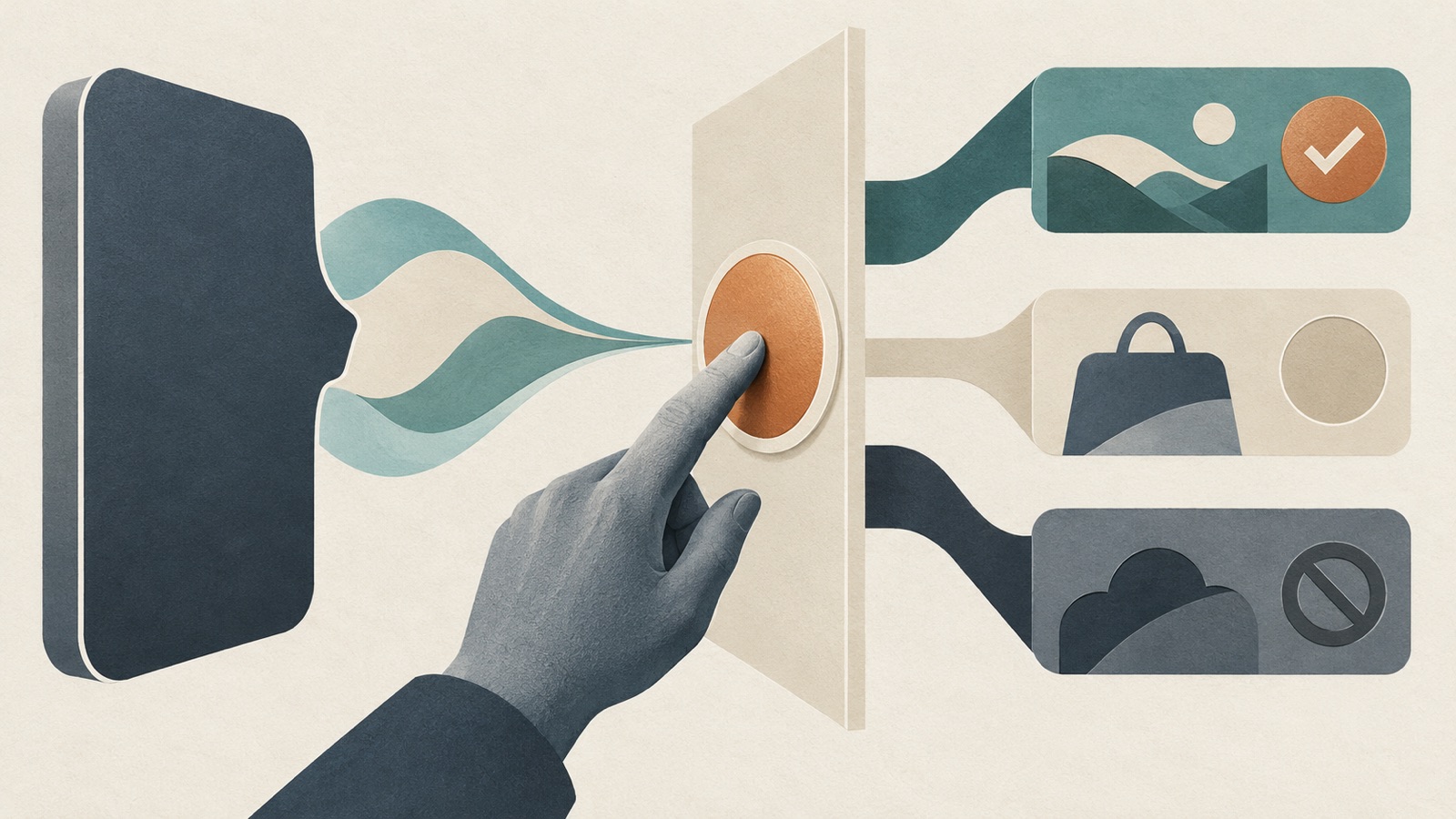
AI-generated editorial illustration. The boundary represents a user’s decision before an assistant acts through a service.
A request is not permission to act
Apple’s September Siri examples often begin with a harmless-looking request and end with a change to another app. Finding a detail in an email is different from sending one. Reading a restaurant suggestion is different from creating a booking or sharing a location. The product has to make that shift understandable at the moment it occurs. A person needs to know what source was consulted, what destination will receive information and what action will be difficult to reverse.
One useful product rule follows from this difference in stakes: the assistant should distinguish information gathering, preparation and commitment. Retrieving a suggested restaurant can be corrected in the answer. Drafting a message can be inspected before it leaves the device. Sending it creates an external record. If an interface treats all three as one continuous gesture, a user may miss the moment a tentative suggestion becomes an instruction to another service. Apple’s examples make this progression easy to see, even though the company has not published a task-level audit of its confirmation behavior across apps.
The company’s June Siri architecture description describes orchestration between local and cloud resources. Its Private Cloud Compute account sets out a security model for requests that need server capacity. Those documents address how Apple proposes to process information. They do not by themselves answer how a person understands permission for a particular cross-app task, or whether the assistant picked the right contact, account or file.
A user needs control before and after the action. WIRED’s July public-beta guide described a setting for keeping Siri conversations for 30 days, a year or indefinitely, and noted that the assistant could be turned off. These are concrete controls, though the guide describes the beta software available at that time rather than auditing every later version. Retention of a conversation log is also a different question from whether an app action shared data with another service. A user may shorten the log and still need to understand what a message or booking sent elsewhere contains. Good product design should make those two decisions legible separately.
A useful evaluation would separate at least four events: interpretation of the request, choice of data, selection of the app action and confirmation of the result. If a mistake occurs, the user should be able to identify which step failed and recover without guessing. That is especially important for a system advertised as disappearing into ordinary product use. An invisible system can save attention when it works; it can also hide the point where an error entered the workflow.
Ternus told WIRED that Apple focuses on secure, safe products and protecting user information. That is a statement of priority, not a record of this beta’s incident rate. The strongest product version of his claim would make the boundary visible when stakes rise and quiet when a reversible low-risk step succeeds. The exact policy, interface and user controls have to be observed in shipping software, not inferred from a CEO’s interview.
Local computing is a design choice, not a privacy result
Apple repeatedly links its AI direction to on-device processing. The June developer release describes a local Core AI framework and model options, while its foundation-model research post explains its third-generation model family. The company also describes Private Cloud Compute for larger requests. These are different execution locations with different implications for speed, capability and disclosure. A slogan about local AI cannot stand in for a task-by-task account of where information goes.
Apple says its June framework exposes both local and server model options through a native API. A developer may therefore decide whether a given feature fits a smaller local model, a cloud model or another provider. The existence of a choice does not imply that every app will make the same choice, or that a user can infer the route from the app’s appearance. App makers may also change routes as models, pricing and device capabilities change. That is why provenance at the action level would be more durable than a broad claim that the platform is private by design.
The device can make some operations available with less network dependence and may keep more inputs close to the user. A cloud model can bring different capacity to a hard request. Neither fact proves that a particular app action is private. A workflow might move information from a local model into a third-party app or a web service as part of the user’s requested task. The important unit of analysis is the entire action, including its destination and records, rather than the first model to read the prompt.
Apple’s security material describes technical controls on server processing, and those controls deserve evaluation on their own terms. But readers should distinguish a published design from independently observed compliance and from the user’s understanding of a decision. Independent audit, clear documentation and visible controls would make the claim easier to test. No cited source supplies a comparative leakage rate for the newly released Siri beta, so this article cannot claim one.
That distinction matters to the CEO’s product argument. If AI is meant to fade into a useful feature, a user may stop asking which model ran. They should still be able to ask which data moved and which app acted. Product simplicity should reduce routine friction without making material data flows unknowable. That is a standard the September examples invite, but their existence alone does not prove Apple has met it.
Hardware integration does not settle software quality
Apple’s new laptop also includes a display, touch sensor, chips and thermal design. The October release makes performance and battery claims for the system. Hardware integration can affect the cost and responsiveness of local inference, and it can give designers more control over how an assistant is invoked. It cannot, by itself, resolve whether a generated answer is correct, whether an app exposes the requested action or whether a user understands a confirmation prompt.
WIRED reports that Srouji’s technology organization now works in a combined structure under Ternus. The reporting suggests a way to align chip and product work, but a reporting line is an input, not a measured user outcome. It would be easy to turn this into a biography of a hardware executive finally making software work. The public evidence supports a narrower story: Apple has placed a product-oriented CEO over a set of interdependent groups at the moment it is extending an assistant across devices and apps.
A hardware advantage may be most valuable when it removes a specific bottleneck. If local processing makes a frequently used, privacy-sensitive task fast and dependable, the benefit can be observed. If a task still needs cloud reasoning, a developer’s app implementation and user confirmation, the silicon contributes only one part of the experience. The right evidence would be repeated task-level tests on supported hardware, with clear failure categories and version information.
The new Mac is a visible marker of this integration strategy. It is not an independent benchmark of Siri. That leaves Ternus with a management problem that cannot be solved by a launch slide: maintain the quality of the entire path from request to completed action while different teams own different parts of that path.
Continuity is a choice with a cost
Ternus’s answers to WIRED emphasize working with Apple’s existing people and products. Levy describes the CEO’s presentation as continuity rather than a break with Cook. A company with a large installed base has good reasons to protect familiar workflows. People expect their apps, purchases, files and habits to survive a new interface. A radical change to how actions are selected could create distrust even if it made a demo look dramatic.
Continuity can also slow correction. Siri’s prior delays, reported by AP, mean that a product-first narrative must eventually be matched by dependable behavior. A beta can reveal gaps and attract developers, but its continued status should not become a substitute for reporting what works. Apple can preserve existing apps while changing the terms by which an assistant finds and invokes their functions. That change is substantial even if the home screen remains familiar.
The platform’s decisions have commercial effects. If app creators must adapt to new frameworks, they will weigh implementation costs against the chance of being selected in an assistant-mediated flow. If Apple reserves the most natural system pathways for its own software, the user and developer experience could diverge. The cited releases do not establish that such favoritism is occurring. They show why transparent selection and attribution would matter if Siri becomes a common starting point.
A careful reader can therefore accept Ternus’s preference for a designed product without accepting continuity as proof of success. His position is testable. It would be strengthened by broad third-party action support, intelligible permission prompts, reliable completion and a credible way for developers to see how their products participate. It would weaken if the assistant remained useful mainly for carefully chosen examples or if users could not tell which app had done the work.
A serious test would measure repeated work
Apple’s launch material lists compelling tasks, but the most useful evidence would describe repeated attempts under specified conditions. An evaluation could report completion by task and app, language, region, operating-system version, device class and permission state. The October 27.2 update makes region and language more than theoretical footnotes: support expanded, yet the release notes cited by Ars Technica still excluded two major markets. It would count wrong-recipient actions separately from harmless answer errors. It would record cancellations, reversals and cases where the user finishes manually after the assistant begins. Average speed alone could hide a small number of expensive mistakes.
The measurement should also include people who do not choose voice. The October MacBook design offers touch, keyboard, trackpad, Spotlight and Siri together. A comparison should ask whether Siri helps on tasks where those existing routes work well, not just whether it can perform a task in isolation. It should show how often the user can inspect an intermediate step and how often the assistant asks for clarification before acting. Such measures would connect Ternus’s claim about useful products to observable behavior.
Developers have their own test. They need to know which actions can be exposed through App Intents, what context the system supplies, how an action is chosen among alternatives and what happens when an app changes its schema. The June framework announcement provides the starting tools. It does not publish a longitudinal outcome series for third-party apps. Documentation and sample code can establish capability; adoption and successful use require separate observation.
Privacy assessment should follow the whole task. A request can use local inference, server processing and a third-party destination in sequence. A product report that only labels one step on-device would miss the transfer the user cares about. Apple’s published Private Cloud Compute design is relevant to the server step, but an assessor would also inspect permissions, action logs, retention and recovery. These are proposed tests, not results this article has performed.
The first operating decision to watch
The next concrete test is the combination of the September Siri beta with the Mac that begins shipping on November 6. A buyer should be able to find which Siri actions actually work on that device and in the buyer’s language, including which third-party actions are available now rather than promised. They should be able to see the intended data source before an action sends or changes information. If an action fails, the machine should leave a clear path back to the app.
For Apple, the operating decision is whether to publish a precise account of those boundaries and improve them as the beta expands. Ternus has said that people should judge the product they get, not the AI label on it. On that standard, a smooth answer in a launch video is a beginning. The harder evidence will come from ordinary, repeated work: a message found correctly, a draft sent to the intended person, an app action attributed to the right developer, and a user who can stop the process before a mistaken change becomes permanent.
The October Mac gives that work a new surface. Ternus’s responsibility is to make the assistant’s passage through it understandable and dependable. Until independent task-level results and fuller app coverage are visible, the strongest defensible conclusion is limited: Apple has put a beta assistant into an ambitious device-and-app design, and its new CEO has chosen product integration as the argument. Its next credible proof will be a repeatable task in supported markets, with the app destination, consent and failure path plain to the person using it. The outcome of that choice remains open.