
Edward Johns Tests the One-Demonstration Robot
On this page 11 sections
AI-generated editorial illustration.
On October 27, Edward Johns’s company published a packaging-line demonstration with three bimanual robots that it said it had taught in two minutes. Each robot had a different gripper, camera arrangement and teaching method. The same pretrained model ran on all three. Machenta’s technical launch page presents the line as an example of instant robot learning: show a task once, then let the machine perform it without another round of model training. The videos are company demonstrations. No independent factory acceptance test accompanies them.
The distinction matters because a two-minute lesson is a powerful sales argument only if the lesson lasts. A plant manager needs to know what happens after an object arrives in a slightly different position, a camera shifts, a gripper misses, or a worker interrupts the sequence. Machenta shows examples of reaction and recovery. It does not publish a broad distribution of outcomes across customer production lines. A robot that is easy to teach can still be hard to operate.
Johns is a professor of robot learning at Imperial College London and the chief executive and co-founder of Machenta, according to the company team page. The London startup announced a $40 million seed round on October 27, co-led by Creandum and Union Square Ventures. The money is meant to scale a model trained entirely in simulated environments. Investors are financing a particular technical wager: that a robot can learn how to learn before it ever sees a real training image, and that one human example at deployment can then supply the task.
That is a research story with a manufacturing test attached. The recent video is the public trigger, but the evidence is spread across three different kinds of record: older peer-reviewed methods, Machenta’s new self-reported results and competitors’ own accounts of what one-shot learning can do. None is interchangeable with a measured customer deployment.
Two minutes on a small line
Machenta’s October 27 launch describes a vision-demo-action model. It takes an example of a task and a continuing camera feed, then predicts actions in a closed loop. The company says one pretrained model works across six robots and four teaching methods in the videos on its site. A three-robot packaging line compresses that breadth into one visible example. Different hardware participates, but the task is selected by the team and the line is an early demonstration rather than a documented production shift.
The number two minutes is also narrower than a factory installation schedule. Machenta says it took that long to teach the three robots the demonstrated packaging sequence. It does not say the robots, workcells, safety systems, parts supply and operators were commissioned from scratch in two minutes. A buyer would still need to mount equipment, validate cameras, specify acceptable failures and fit the line to an actual production process. Treating teaching time as total deployment time would erase the work the video cannot show.
The video has a useful feature that many launch clips lack. Machenta says its examples are uncut demonstrations followed immediately by robot rollouts, with the objects rearranged before execution. That presentation lets a reader inspect whether the model is merely replaying a memorized path. It cannot establish how often a randomly selected new task succeeds, because a page of selected videos is not a sampling protocol. Nor does a successful manipulation of one class of objects establish behavior across all object materials, weights and tolerances.
Johns’s decision is to make the human example the interface. Traditional programming asks an engineer to specify motions, states and exception rules. Task-specific model training asks for enough demonstrations to update model weights. Machenta proposes a third path: do the heavy learning in simulation, then supply a live example as context without changing the weights. The move could reduce a bottleneck for high-mix production, where a line changes often and repeated engineering work is expensive. That economic implication remains a hypothesis until someone measures it against the full labor of integration and supervision.
Six years of narrower questions
The new company did not appear with an isolated video. Johns’s lab biography says he founded Imperial’s Robot Learning Lab after joining the faculty in 2018. Machenta’s team account dates the group’s one-shot research focus to 2020 and names former doctoral student Vitalis Vosylius as co-founder and chief technology officer. The company credits Vosylius with building early generalist in-context models. This is a team program, even when the public founder is the person explaining the wager.
A 2023 CoRL paper by Vosylius and Johns framed a narrow version of the problem as aligning parts of novel objects. Given a few examples, the system inferred how one object should move relative to another. The lab reported real-world experiments on six everyday tasks. Its achievement was immediate adaptation without training a fresh task model, within a specified experimental setup. It did not establish that one universal model could run an arbitrary factory line.
The 2025 ICLR Instant Policy work, again by Vosylius and Johns, changed the representation. It expressed demonstrations, observations and candidate actions as a graph and used a diffusion process to generate actions. Simulated pseudo-demonstrations supplied training data. The published account describes real and simulated experiments in which one or two demonstrations could teach various everyday manipulation tasks. It also shows a failed box-opening case that improved when the model received more examples of different box shapes. The failure is instructive: a demonstration can be ambiguous, and a second example can be information rather than a defeat of the method.
Another 2025 paper, published in Science Robotics, took a different route. Kamil Dreczkowski and Pietro Vitiello were joint first authors, with Vosylius and Johns. Their Multi-Task Trajectory Transfer method separated a manipulation into alignment and interaction phases and retrieved relevant demonstrations. The team reported 3,450 real-world rollouts for design comparisons and 2,200 further evaluations, including 100 unseen tasks. The lab says a demonstrator supplied 1,000 distinct task examples in 17 hours. Those figures describe that paper’s dataset and experimental method. They are not success rates for Machenta’s newer foundation model.
The lab’s published experiment account says the 1,000 examples covered 31 broader skill families and 402 objects. It tested both taught and 100 untaught tasks with distractor objects and changed lighting or backgrounds. That breadth makes the paper more informative than a handful of clips, though it answers a different question: whether retrieval and decomposition make many demonstrations efficient to collect and use. Machenta’s launch asks whether a newly trained model can interpret one example immediately across machines. A reader who adds the paper’s 2,200 evaluations to the launch page’s 251 simple repeat trials would be combining separate systems and protocols.
The papers do not describe a single unchanged algorithm. They track a stubborn question: how few human examples can teach a new physical task? Johns and colleagues tried object alignment, graph-based in-context imitation and decomposition with retrieval. Machenta carries that research direction into a startup claim about one shared model. The seed round buys a program of experiments. Its size cannot certify an appliance for every plant.
A demonstration as input
The practical appeal of a demonstration is its density. A person can show where to grip a part, how to move it around an obstruction and where to leave it. A short sentence might name the desired final state while omitting those motions. Machenta’s launch explanation argues that a demonstration conveys the physical behavior a language instruction cannot fully specify. This is the company’s rationale for a vision-demo-action model instead of a language-first robot controller.
The teacher can leave a crucial part out. If someone places a blue block in a black box, the robot must decide whether color, size, the box opening or simply the act of placement defines the task. Machenta’s page shows a case in which another demonstration clarifies an ambiguous instruction. It describes stitching several sub-demonstrations together for a longer job. An operator can therefore refine a lesson. That is useful, although the final task may require more than the one example in the headline claim. The relevant measure would count every extra example and every failed attempt before the task works.
The demonstration itself is real-world data. Machenta’s claim concerns pretraining: no real-world training images enter that stage. At deployment, a person supplies a real example and the robot reads a continuing stream of real camera images. Calling the entire process “simulation-only” would conceal the worker’s teaching time, the camera setup and the work of checking what the machine learned. Those inputs belong in any honest deployment-cost calculation.
A physical prompt has consequences that a text prompt usually does not. A robot can dent a part, drop an object or move into a worker’s space. Machenta shows recovery when an object is moved during execution and when an item is pulled from a gripper. Those are useful demonstrations of feedback, yet they do not specify the safeguards around a collaborative workcell. The operational threshold is higher than “the robot tried the intended motion.” A buyer needs the miss, stop and recovery conditions as well as the successful path.
Why the model learned in simulation
Johns’s team is trying to avoid a data bottleneck. A physical robot needs time, space, maintenance and human supervision to collect demonstrations. A simulator can vary objects, viewpoints, tasks and environments more quickly. In the Machenta launch account, the company says it generated broad synthetic experience so the model learned a task-learning function rather than a list of task-specific motions. At deployment, the human example and live camera images are both from the real environment.
A bent carton, a reflective wrapper, an unexpected patch of friction: none has to obey a simulator. Machenta’s proposed answer to this sim-to-real gap is breadth. Train across many randomized virtual worlds so the model learns to infer what matters from the real demonstration, rather than memorize one simulated object’s physics. The mechanism is intelligible. Its transfer rate remains an empirical question. A task-by-task independent benchmark of the new model would show how often the hypothesis survives outside the team’s selected examples.
The Instant Policy paper is stronger evidence for a narrower claim. It describes a reproducible research setup, simulated pseudo-demonstrations and experiments with real robots. The newer Machenta model is described in a detailed company post, but that post is not a peer-reviewed evaluation of the product. Readers should not import a conference paper’s credibility, or its task counts, into a different model without a documented bridge.
There is another distinction in the training argument. Synthetic data can create variety faster than a lab can physically reset a robot, yet it can also create variation that matters little to a real task. Machenta’s site says it randomizes objects, configurations, environments, demonstrations and embodiments. A useful independent test would change one factor at a time in a real workcell: the object, then the camera view, then the way the operator teaches. A failure after a camera shift tells an engineer something different from a failure when a deformable object bends. One aggregate success figure would hide those diagnoses.
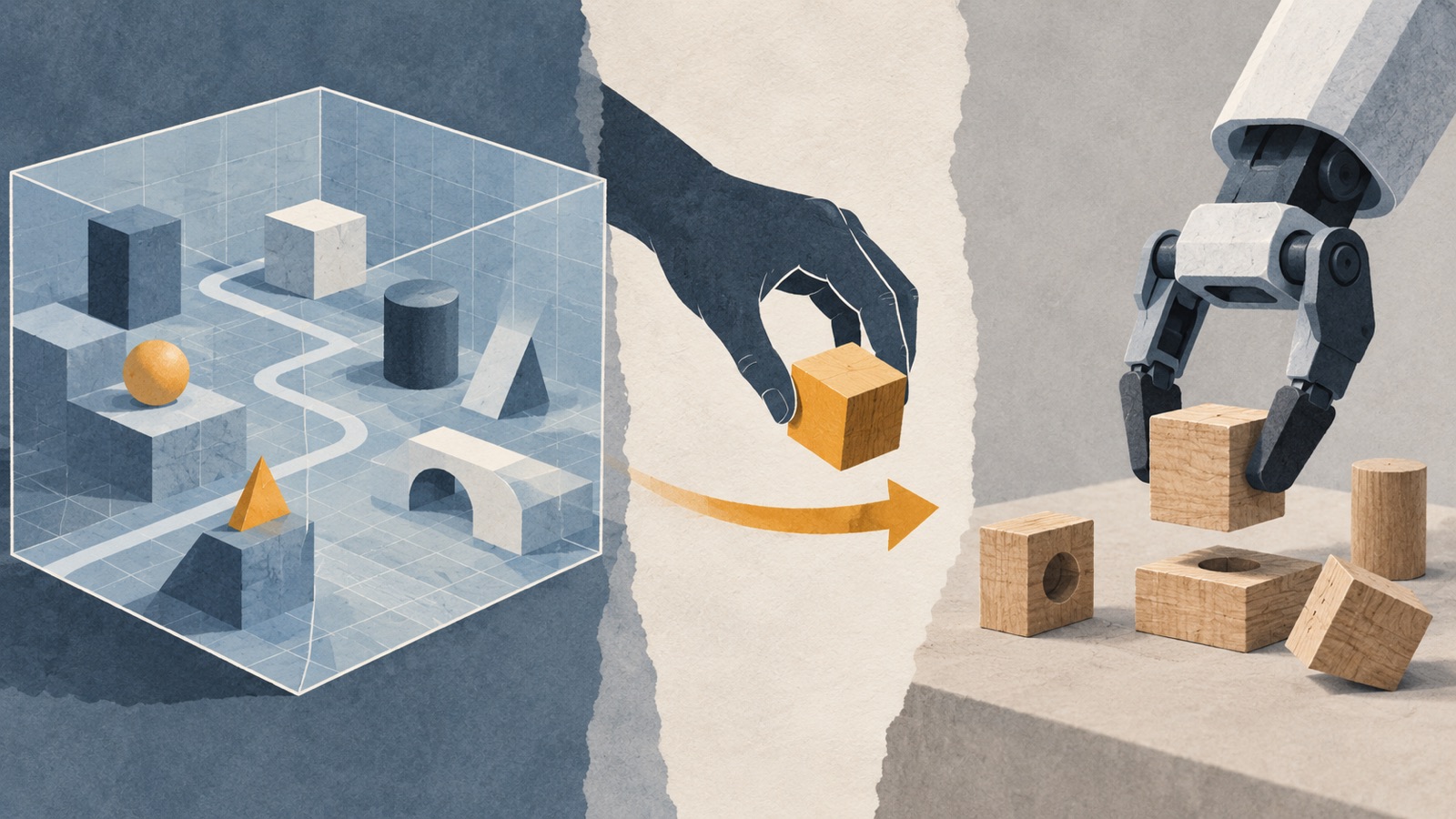
AI-generated editorial illustration. The simulated preparation and real trial represent distinct evidence stages.
The economics of simulation are conditional too. Generating varied virtual tasks costs compute and engineering; it does not make data free. The $40 million seed round pays for more model training and a larger team, according to reporting on the launch. The company has not published a cost comparison that includes simulation development, robotics hardware, human teaching, debugging and maintenance per accepted task. If its approach lowers the cost of a new task but leaves uptime or quality-control costs unchanged, a plant’s total return may still depend on its product mix.
A single model across machines
Machenta says the same pretrained model appears in its videos across six robots and four teaching modes. That is a meaningful design target. A model tied to one robot arm or camera layout would force buyers to duplicate work as their equipment changes. A shared policy could make a process portable, especially when the line contains machines bought at different times.
“The same model” still sits inside different machines. Grippers vary in reach, strength and failure modes. Cameras need calibration and clear views. A demonstration made with a VR controller may specify motion differently from one made by moving the robot directly. A manufacturing engineer would ask which adapters, robot-specific controls and safety limits surround the shared policy. Machenta has shown variety, but no independently audited inventory of every configuration needed to reproduce its clips.
The three-robot line is helpful precisely because it asks for coordination, not only a single pick-and-place. But the public materials do not report the accepted output rate of a customer line, its scrap rate or the fraction of interruptions requiring a person. They also do not state what happens if one of the three robots falls behind while the other two continue. A production line is a queue of dependencies. Teaching each station quickly does not automatically schedule the whole queue.
This is where an earlier paper can inform, without proving, the current bet. The 2025 MT3 work breaks a motion into approaching an object and interacting with it. The authors report different failure modes for retrieval and behavioral cloning, including pose-estimation and trajectory-selection errors for their retrieval method. Those are examples of how a successful high-level task can fail at a lower-level step. Machenta’s current model is different, but any buyer still needs failure categories rather than only an aggregate count.
Three self-tests and their denominator
Machenta did publish one set of repeated trials. In its October 27 technical post, the team says it left self-resetting tasks running for an hour each and observed 74 successes in 74 block placements, 78 in 78 screwdriver handovers and 97 in 99 bottle-uprighting attempts. The post says the two bottle failures occurred at 0:46 and 0:52 in the video and involved a possible collision and kinematic limits. Those are exact company-reported outcomes for selected, relatively simple tasks.
The numbers are more useful than a perfect montage, because they expose a denominator and two failures. They are also easy to overread. The trials were chosen and run by the team. They do not give confidence intervals over a representative set of unseen factory jobs, different operators or long shifts. A repeated bottle task may become reliable after the workcell is already arranged for it; that is different from a random customer’s new assembly step succeeding on the first try.
The word “attempt” needs an operating definition before the result can travel. Did a human reset the scene between tries, or did the machine recover without help? Were failed grasps followed by another grasp inside the same counted attempt? Was the system timed against the line’s required cycle? Machenta’s post describes self-resetting tasks and hour-long runs, which are useful details, but does not answer every production question. Reporting the number of human touches per accepted unit would reveal whether an apparent model success requires a quiet assistant standing beside the workcell.
Seventy-four of seventy-four is not a guarantee of perfect operation. Even without calculating a statistical interval, the logic is plain: observing no failure in 74 attempts does not rule out a failure on attempt 75. The 97/99 result makes the operational issue visible. In a line with multiple dependent steps, even a small per-step failure rate can generate more human interventions than the teaching video suggests. How often a failure is recoverable matters as much as whether it occurs.
The company describes an early research product. The Next Web reported that Machenta had 11 employees and no near-term plan to sell the technology; more precise tasks and complex movements remained difficult. Forbes’s direct account says Johns had previously characterized the lab’s precision as roughly half a centimeter for tasks such as placing objects and opening drawers. That was a description of the earlier lab stage, not a measured specification for every October Machenta demo. It helps locate the kind of performance the team was working to improve.
Other teams are teaching from examples
Machenta shares the one-example goal with other labs. In August, Generalist described GEN-1.5 as learning a simple task from one example in a 30-second context window. Its own account reports a 59% average one-shot success rate across diverse short tasks and calls the performance modest. The number comes from a company evaluation, but it exposes a failure rate that the phrase “one-shot” cannot convey on its own.
Skild AI wrote in September that its S1 model can use a single video demonstration as a prompt without changing model weights. Its founders, Deepak Pathak and Abhinav Gupta, also argued that public robot demos can hide a much harder deployment problem: a system with a compelling clip may still fail half the time. Skild has a commercial interest in that claim, yet the distinction between a demonstration culture and a deployment culture applies to its own technology as well as Machenta’s.
These methods have different inputs, training sources, tasks and reported protocols. Generalist’s 59% cannot be ranked directly against Machenta’s 97/99 bottle trial or Skild’s commercial claim. A fair comparison would control hardware, objects, demonstrations, reset conditions, task selection and human help. Without that shared test, “one demonstration” names an interface pattern, not a uniform level of capability.
There is a counterargument to Johns’s simulation bet. Real-world-data firms contend that contact, wear, lighting and the oddities of actual homes and plants will remain necessary for training and testing. Forbes reported Maxinsights chief executive Yuguang Yuan saying demand for real-world data was rising and that robots must be tested in real environments before people trust them. That is a competitor’s view, not an independent verdict. It identifies the strongest unresolved test for Machenta: whether synthetic pretraining reduces the needed training data without compromising real-world validation.
A factory counts more than teaching minutes
Industrial robots are already common. The International Federation of Robotics reported more than 600,000 factory installations worldwide in 2025 and an operational stock of about five million. Those are broad industry counts, not evidence that the installed robots can learn tasks from one example. Most factory automation still depends on careful integration, repeatable parts and established safety procedures.
For a manufacturer, the financial question is not how quickly a researcher can teach a selected task. It is how long it takes a new task to reach accepted yield with tolerable intervention. The work starts with identifying a repetitive operation and its quality criteria. It continues through fixture design, robot placement, camera and gripper setup, safety review, training, pilot output, troubleshooting and operator handover. Some of those tasks might shrink if Machenta’s model generalizes. Others are physical and organizational rather than model-training problems.
The value also depends on the production mix. A line that repeats the same motion for years can spread a long programming and integration effort across many units. A small manufacturer changing products every week has fewer units over which to recover that fixed cost. Johns’s approach is most interesting where the task changes often enough that conventional programming or post-training becomes the constraint. If the limiting factor is a slow gripper, material feed or inspection station, teaching the model faster will not raise line throughput. A buyer should identify the bottleneck before pricing the proposed shortcut.
Consider a product change on a packing line. If a box changes size, a technician might show the new placement once. That would be a meaningful gain if the robot then handles the expected range of carton positions, weights and deformations at line speed. If someone has to re-teach it every shift, rescue frequent jams or inspect every unit, the saving in model training could vanish into supervision. This is an illustrative decision test, not a reported Machenta customer case.
The comparison should include human work honestly. A worker can learn a new packing variation quickly, but human work has labor, training, ergonomic and scheduling costs. A robot might bring consistency or run at times when staffing is difficult, yet require a technician for exceptions. After the demo ends, a plant still has to assign those exceptions. Who resets the station, checks a doubtful unit and decides when the robot needs another lesson? Those hours belong in the economic comparison alongside the initial teaching minutes.
Who made the technical wager
Johns’s role in the story is clear but bounded. He built a lab around efficient robot learning and co-founded a startup to scale it. Machenta says Vosylius developed its earlier in-context methods; the lab’s major papers name multiple researchers, including Dreczkowski and Vitiello. Their contributions should not be collapsed into one founder’s biography. Johns appears to own the strategic choice to make quick adaptation the company’s center of gravity, while the public record does not allocate every architectural decision to him personally.
The funding account also has interested voices. Union Square Ventures managing partner Rebecca Kaden says the firm invested because a robot that learns quickly could open uses that fixed-skill automation misses. That is an investor thesis, not a customer outcome. The seed size tells us how much capital backers committed, not how many factory buyers have accepted the model. The Next Web’s report says the startup had no near-term sales plan at launch, a useful brake on treating the financing as market adoption.
Johns’s March remarks to Forbes supply a clearer personal decision than a generalized founder origin story. He argued that robotics faces a data chicken-and-egg problem: broad real-world data is hard to gather before useful robots are deployed, and deployment is hard before robots learn well. The October launch is one answer. Train the learning process with synthetic variety, then ask a person for the one real example needed at the edge.
Tests for an outside buyer
The evidence should advance in stages. The 2023 and 2025 papers show prior methods under specified experimental protocols. The October Machenta page shows a newer model in selected clips and three self-run repeated tasks. An outside replication would ask another team to teach a random task under predeclared conditions. A production pilot would then measure whether the method fits a real workflow over time. Each step answers a different question.
| Evidence stage | What is visible now | What would change the decision |
|---|---|---|
| Research antecedent | Peer-reviewed CoRL, ICLR and Science Robotics methods on defined tasks | A documented link from those methods to the current model and its evaluation protocol |
| Startup demonstration | Company videos across several robots and teaching modes | Predeclared task selection, unedited failures and reproducible setup details |
| Repeated task trial | Company-reported 74/74, 78/78 and 97/99 on three simple tasks | More tasks, operators, materials, shifts and a reported intervention rate |
| Independent replication | No outside replication of the new model located | A third party repeats the one-example result on unseen workcells |
| Factory acceptance | No customer yield, uptime or unit-economics record located | Accepted units per hour, scrap, labor hours and safety incidents against a baseline |
This is an editorial framework for comparing evidence; it is not a reported buyer test. A company video can demonstrate a technical possibility while leaving frequency unresolved. A peer-reviewed paper can establish its own method’s performance while leaving the newer model unmeasured. The next informative release would put a failure denominator beside a task the team did not choose in advance.
A lesson outside the launch video
Machenta can make a stronger case without promising a universal robot. It could publish the current model’s task set, selection rules, real-world success rates, time to teach, number of attempts, intervention categories and the hardware changes required for each robot. It could let an outside lab run a blinded set of unfamiliar objects. Later, a factory pilot could report accepted output, not only completed motions. Those measurements would connect the speed of the first lesson to the cost of the thousandth unit.
Johns has put a specific method against a real constraint. A robot trained on simulation and taught by one example could be useful without handling every object or every shift. At the October launch, three robots follow a brief lesson in a selected sequence. The next result will be more informative if someone outside Machenta chooses the objects, the sequence and the teacher. For now, the two-minute clock starts with a trained model and prepared robots already on the line. A factory’s clock starts earlier and stops later.