
Jeff Clarke and the Long Road From AI Order to Working Rack
On this page 7 sections
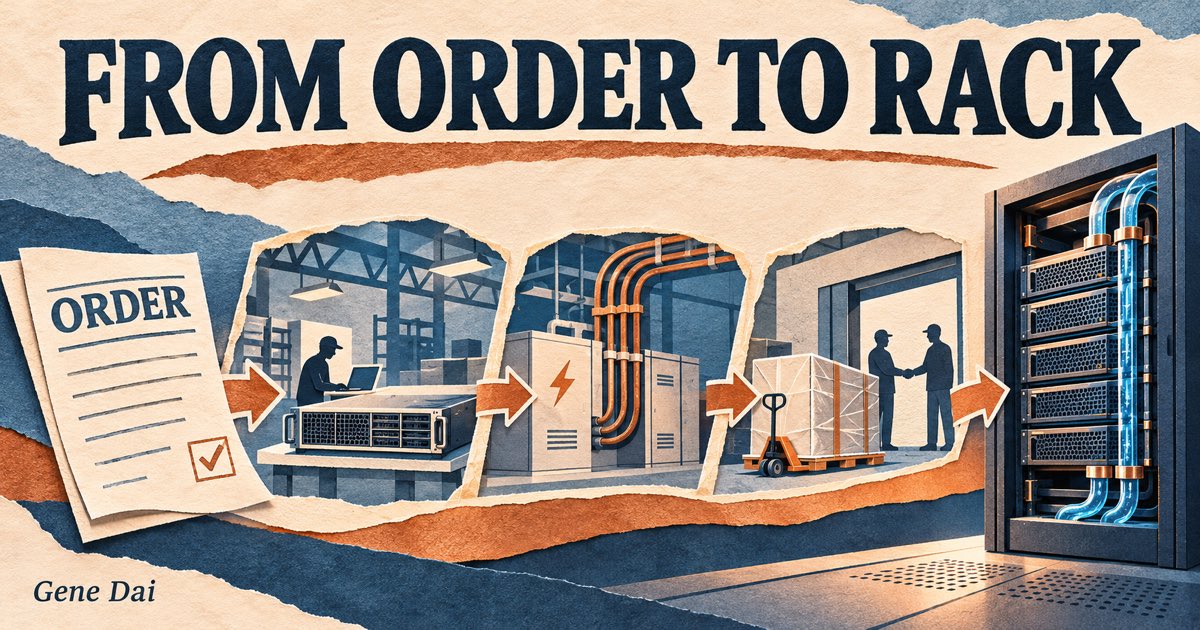
AI-generated editorial illustration.
On November 24, Jeff Clarke gave Dell investors three numbers for the quarter that ended October 30. The company had taken $60.2 billion in AI server orders. It had recognized $22.0 billion in AI server revenue. It finished with $132.3 billion of AI server backlog. Orders are commitments received during a period. Revenue records equipment sold under Dell’s accounting rules. Backlog is the remaining order book. A customer still needs a site and a functioning cluster before the hardware can earn its keep.
Clarke, Dell’s vice chairman and chief operating officer, told analysts that the backlog had been checked for customer capital, end-user quality, export compliance, land and power. Asked directly about data center delays, he added a more physical list: completed buildings, installed cooling, memory, CPUs and optical transceivers. His account was unusually specific about the distance between a purchase order and a functioning cluster. It was also Dell’s account, offered on an earnings call. The company did not disclose a site-by-site delivery schedule or an independent measure of how often its six-hour rack setup claim holds.
Dell has become a test case for the infrastructure boom. Its fiscal third-quarter filing puts Infrastructure Solutions Group revenue at $42.0 billion, almost three times the figure a year earlier, while its PC-oriented Client Solutions Group brought in $12.9 billion. Reuters reported Dell’s third raise to its annual outlook. Clarke’s next test is less photogenic than an earnings headline: keeping a large, multi-quarter book of bespoke systems aligned with the buildings, chips, contracts and cash that let those systems run.
An order book with several clocks
The company’s performance review plots orders, revenue and backlog separately. That is the right way to read the quarter. The $60.2 billion order figure measures new AI server business booked during the three months. The $22.0 billion revenue figure is equipment recognized in that quarter. The $132.3 billion backlog is an ending balance, spread over more than one quarter. Dividing backlog by one quarter’s revenue produces a rough six-quarter comparison, but it does not reveal Dell’s contracted shipment timing. Product mix, prices, cancellations and production rates can all change before the order book clears.
The earnings transcript gives a more useful operational picture. Clarke said the backlog extends across nearly 100 sites globally, with about as many outside the United States as inside. He would not allocate it by quarter. Dell’s prepared remarks said a majority of its new orders are based on Nvidia’s Vera Rubin NVL72 system. That indicates a next-generation platform in the order mix. It does not state what share of current backlog will ship as Rubin, how many racks are ready, or when a customer’s building can accept one.
Vera Rubin also changes the significance of a delivery date. A purchase order for a future platform may be placed before all of its components are in a supplier’s factory. Clarke said Dell had priced those systems against the expected availability of buildings and power. The public transcript gives no customer contract, deposit schedule or cancellation clause for a Rubin rack. A buyer evaluating that order must distinguish a reserved place in a manufacturing plan from hardware already built and tested. For Dell, a later component release can force the other parts of the installation to move in step. This is an inference from the disclosed order and site dependencies, not a claim that Dell’s particular Rubin orders have slipped.
Orders have grown faster than recognized sales. Dell’s deck shows $95.0 billion of AI server backlog at the end of the previous quarter and $132.3 billion at the end of this one. Its latest quarter added $60.2 billion in orders and recognized $22.0 billion in revenue. The simple roll-forward, $95.0 billion plus $60.2 billion minus $22.0 billion, is $133.2 billion, close to but not identical to the reported ending balance. The difference is a warning against treating this simplified arithmetic as the company’s contract ledger. Changes in timing, scope or other accounting items cannot be assigned from the public figures alone.
Clarke also said Dell had received roughly $180 billion of AI orders over four quarters. That is a flow over a year, not another balance to add to the $132.3 billion backlog. A buyer choosing between vendors needs the same separation. An announced order says that someone has committed to purchase. A shipment or recognized sale says that a supplier has delivered enough to record revenue. A live cluster requires site acceptance, power, networking, software integration and operational readiness. Those stages can happen at very different times, especially for a large liquid-cooled installation.
Dell’s annual guidance now calls for $78 billion of AI-optimized server revenue in fiscal 2027, up from its previous $74 billion forecast, within $202 billion of total company revenue. Guidance is management’s forecast, not a delivered outcome. The quarter’s $22.0 billion of AI server sales is a result. If Dell reaches its guide, it will still leave questions about the timing and quality of the remaining backlog. The point of the order book is visibility; the burden of Clarke’s role is conversion.
The operator behind the numbers
Clarke joined Dell in 1987 as a quality engineer, according to the company’s executive biography. Before that he worked in reliability and product engineering at Motorola. Dell appointed him chief operating officer and vice chairman in 2019, expanding a remit that already covered products and operations. His present brief spans Infrastructure Solutions Group, Client Solutions Group, manufacturing, procurement and the supply chain. The history does not explain his private motivation. It does explain why investors put fulfillment questions to him rather than treating AI demand as a sales team’s abstract pipeline.
The old Dell model was built around matching components and customer orders with speed. An AI rack is a less forgiving object than a commodity desktop. Clarke describes designs that iterate with a customer over power, cooling, networking and software, then move into factory testing before shipment. Dell says it tests a complete rack at what it calls L11 and beyond, including power-up, thermal compliance and network validation. That is a claim about its process, made in the November 24 transcript. The public materials do not provide independent failure rates, comparative test conditions or a customer sample for the claimed speed.
Clarke told investors Dell’s deployment team can stand up a rack within six hours of delivery, and that its method can bring time to first token four to six weeks ahead of competitors on large projects. Those are commercial performance claims. A customer cannot infer that a whole data center will be ready six hours after trucks arrive. The site needs electricity and cooling, connections across racks, security review, software and end-user workloads. Dell’s claim concerns the rack step in a longer chain; the comparator and measurement method for the four-to-six-week estimate were not disclosed on the call.
The definition of that six-hour interval matters. Does it begin when a truck reaches the site, when the rack is on the floor, or after the site’s power and cooling are ready? Does it end when the hardware turns on, when a network test passes, or when a customer job produces its first token? Dell’s release uses the rack-standup figure and Clarke separately uses time to first token. They are not interchangeable milestones. The company did not publish a distribution of customer setup times or explain which site preparations were complete before the clock started. A customer could test the claim against a written acceptance plan. A reader cannot test it against the earnings statement alone.
The factory and the customer can also use different definitions of a working rack. Dell’s L11 process, as Clarke described it, checks an assembled system before it leaves the factory. A receiving team still has to confirm that the delivered configuration matches its order and works with the site’s power, liquid cooling, network fabric and software. Those checks are especially consequential for a cluster assembled from many racks: one rack may boot while the intended workload remains unable to run across the whole system. The public call gives no acceptance failure rate and no rule for when a delayed site becomes a delayed customer payment. For a buyer comparing Dell’s speed claim with another vendor’s, the relevant unit of comparison is the same configured cluster under the same site assumptions, from factory sign-off to the first workload the customer actually needs. That is a proposed evaluation standard, not a result Dell reported.
His management task also changed with the product mix. Clarke said Infrastructure Solutions Group contributed 38% of company revenue in fiscal 2024, when Dell began selling AI servers, and 68% over the latest four quarters. He described a similar rise in its share of operating income, from 54% to 83%. The figures are Dell’s chosen period comparison; they should not be read as a forecast that every future quarter will grow at the same pace. The company still sells PCs and traditional servers, and the latter had an unusually strong quarter of its own.
The filed results show $15.0 billion in traditional server and networking revenue, up 235% year over year, and $4.9 billion of storage revenue, up 24%. Those categories matter to Clarke’s argument. AI deployments require CPU-based systems for data preparation and inference support; enterprise refresh cycles need storage and conventional compute. Dell can earn money from more than the GPU rack. At the same time, the company did not separate the profit of AI-optimized servers from all the other sources of Infrastructure Solutions Group operating income. A higher segment margin cannot, by itself, prove that the AI rack is becoming more profitable.
Power is a term in the purchase order
The most revealing exchange on the earnings call came when Bank of America analyst Wamsi Mohan asked who carries inventory and repricing risk if data centers are late. Clarke did not offer a contractual answer covering every customer. He described a checklist: whether a building exists and will be completed, whether power and cooling are installed, whether the site can receive equipment, and whether Dell can align CPUs, memory and even optical components with that date. He said no customers had rescheduled business. The statement is management’s report as of November 24; it is not an outside audit of every project.
Dell says it vets each AI order for access to land and power, as well as capital and end-customer quality. That is sensible because a rack ordered for a proposed facility is not the same as a rack whose receiving dock, electrical system and chilled-water loop are ready. Site readiness can shift while suppliers are buying components. A supplier may prefer to start production after sufficient certainty about the installation date. A customer may want to lock in scarce components long before the building is finished. Those incentives collide inside the backlog.
Clarke said the book covers nearly 100 sites, with roughly equal counts inside and outside the United States. A site count does not reveal the dollar distribution. A few large clusters could still dominate the book; the company did not disclose the size of the largest customer or project on this call. Nor did it provide a schedule showing when each site’s power connection becomes operational. Dell’s statement that the backlog is diversified geographically is a geographic description, not proof that construction and grid risk have been eliminated.
The financial release adds another hard boundary: forecasts are subject to component-supplier relationships, customer access to capital, contract performance and other risks. Those risk factors are broad. The call supplied the operational detail that makes them concrete. A delay in an optical transceiver or a utility connection may leave a planned cluster short of the ability to run, even if the accelerator itself has arrived.
The consequence for an AI buyer is practical. A procurement team should request a schedule with separate dates for component allocation, factory acceptance, shipment, site acceptance and the start of paid workload. It should identify who owns hardware in transit, what triggers payment, and what happens if the site is ready before the rack or the rack before the site. Those are analytical questions derived from the public record, not terms that Dell disclosed for all customers. Clarke’s broad promise of a vetted backlog cannot answer them without the customer’s actual contract.

AI-generated editorial illustration. The conceptual scene separates a hardware order from a site ready to operate.
When the price changes after the signature
Supply risk can reach the customer before a rack is delivered. The Irish Times reported in June that XTX Finland had sued an Irish Dell entity over an order of 1,680 servers for a Finnish data center. XTX said the agreed price was about $549 million and that it paid an additional $5 million to avoid later increases. Dell sought another $62 million to $70 million, according to the court report, citing higher component costs. Dell disputed XTX’s account of the contract. The litigation concerns that transaction; it is not evidence that Dell reprices every AI customer or that the disputed machines sit in this particular AI backlog.
The dispute matters to Clarke’s current claim because it exposes a question inside any long delivery interval: who absorbs a change in the cost of memory and other parts after an order is signed? A customer thinks it has locked a budget. A manufacturer may face a later bill from suppliers. The Irish case has not settled that allocation, and its December court schedule was reported months before the November earnings call. It should be read as a live dispute, not a finding that either side breached the agreement.
The case also shows why a headline backlog cannot tell a reader how much pricing risk Dell has retained. A fixed-price contract, a component-index adjustment and a fresh quote after a design change allocate that risk differently. The earnings materials report an aggregate backlog; they do not break it into these contract types or disclose how deposits, change orders and acceptance terms vary among large buyers. Clarke said Dell had considered component inflation when it priced the future-platform orders, but the statement does not establish that every supplier cost will stay within that allowance. A careful customer would seek the actual price-adjustment trigger and the exact configuration it covers. For investors, a later increase in revenue with weaker margin could be consistent with costly inputs, but it would not prove a specific customer contract was repriced. The public record supports the risk question, not a verdict on the entire book.
The component pressure has not vanished. In the November call, UBS analyst David Vogt asked what would happen if prices for DRAM and NAND stopped rising so quickly. Clarke said a slower rate of inflation would still mean higher prices, and he did not expect enterprise memory price declines into 2027. He argued that memory capacity diverted toward high-bandwidth memory for GPUs tightens other categories. This is Dell management’s supply outlook. It is not a verified price schedule for an individual customer or a guarantee about next year’s market.
Tom’s Hardware summarized the Financial Times’ November reporting on server repricing and unnamed trading-firm buyers. Those anonymous accounts belong to the FT’s reporting; they are not interviews by this publication. The independently reported Irish court case is the named example with identifiable parties and a stated dispute. It does not provide a template for the terms of Dell’s other contracts.
Clarke’s answer on the call was that customers are still buying servers. He said some are postponing PC refreshes to spend on infrastructure. That is a useful observation from a supplier with broad orders, but Dell has a commercial interest in presenting demand as resilient. The filed Client Solutions Group results show consumer revenue down 15% year over year and segment operating income down 6%, while commercial revenue grew. The result supports a shift in Dell’s own mix. It does not identify how much of every customer’s PC budget was transferred to AI equipment.
A rack is a financing decision too
Dell Chief Financial Officer David Kennedy described a second check on backlog that goes beyond Clarke’s factory. Dell examines a customer’s finances and underlying end-user contracts when it accepts a purchase order, then repeats that diligence before production. Kennedy said the company asks to see large customers’ end-user agreements without redactions and discusses forward cash collections by week. These are management descriptions of an internal control. The public cannot inspect every contract or see a third-party conclusion that the process predicts all future payments.
The filed balance sheet gives a second way to watch that conversion. Dell reported $29.4 billion of inventory at October 30, compared with $10.4 billion at the start of its fiscal year. Accounts receivable rose from $17.6 billion to $28.9 billion over the same interval, and accounts payable from $33.6 billion to $57.8 billion. These are whole-company balances; the filing does not label each dollar as AI hardware. An inventory increase can reflect preparation for valid future deliveries. It can also tie up cash if a customer site slips. The next filing will show whether the larger working-capital position accompanied shipments and collections or continued to expand.
Cash flow adds another measure, but it requires the same care. Dell reported $4.46 billion in quarterly cash from operations and $3.47 billion in free cash flow, using its stated definition after capital spending. Those are actual company-level cash measures for the quarter, not a cash receipt matched solely to the $22.0 billion of AI server revenue. The cash figure offers a counterweight to a discussion built entirely around orders. It cannot establish that every large neocloud customer has paid or that Dell has no exposure through financing and inventory. Kennedy’s repeated diligence checks are more credible as a process when the balances that process manages are visible.
The balance-sheet changes point in more than one direction. Inventory rose by about $19.0 billion from the fiscal-year opening balance, while accounts payable rose by about $24.2 billion. Supplier credit may cover part of a production surge for a period, but the two changes are not a measure of AI-only funding. Receivables also climbed by about $11.3 billion. These balances are reported at a point in time, whereas operating cash flow covers a quarter; subtracting one from another would mix scopes and periods. What matters for the next check is whether inventory turns into accepted shipments, whether invoices are collected on schedule, and whether payables normalize without transferring a large timing problem to the next quarter. Dell has not published a contract-by-contract bridge for those steps.
This check is especially relevant for a neocloud. Such a buyer may order hardware for a future customer contract, build a data center around it, and expect rent from that customer to finance the equipment. If the end-user deal is weaker than stated, Dell’s receivable and the buyer’s installation plan can both come under pressure. Dell says it is selective about which neocloud partners it serves. The company also serves sovereign and enterprise buyers, and says it now has more than 7,500 Dell AI Factory customers. That customer count is Dell’s definition; it is not a count of 7,500 identical high-density clusters or independent proof of profitable use.
Kennedy said Dell Financial Services financing for AI deals is selective and short term, bridging the period from purchase order to cluster go-live. He cited a $500 million quarter-on-quarter increase in financing receivables while Dell recognized $22 billion of AI server revenue. The comparison suggests Dell did not simply finance an amount equal to its AI sales in that quarter. It does not show the full credit exposure of Dell, its customers, leasing partners or banks across the sector. The company’s financial disclosures are the place to test the balance-sheet part of this story, not a single ratio from an earnings call.
Money flows through several checkpoints. A customer may reserve a rack, secure a building, draw financing, accept delivery, connect the cluster, and only then bill its own customers. Dell can recognize revenue at a different point from the operator’s first cash receipt. A fully vetted purchase order reduces some known risks at the time Dell reviews it. It cannot make the end user’s demand permanent or finish an unfinished power plant. Kennedy’s promise to recheck before production implicitly acknowledges that conditions can change while an order waits.
Share price is a poor operational meter. Dell’s results beat expectations and it raised guidance, yet a daily stock move mixes rate expectations, investor positioning and many other judgments. It cannot verify that a specific rack shipped. For Clarke, the useful evidence is the conversion of the order book into shipped systems and collected revenue without an accumulation of costly disputes.
The margin question under the AI headline
The filed quarter gave Dell a 17% Infrastructure Solutions Group operating margin, up from 12.4% a year earlier. CFO Kennedy attributed the improvement mainly to scale, and also described a contribution from Dell’s own storage products and cost control. That segment includes AI servers, traditional servers, networking and storage. Dell did not publish an operating-margin line for AI servers alone. A reader cannot calculate it by dividing the group’s operating income by AI server revenue.
Dell’s $22.0 billion AI server quarter occurred alongside $15.0 billion of traditional server and networking sales and $4.9 billion of storage revenue. Dell describes storage as a richer-margin business. The strength of those adjacent categories may help the overall segment even if AI hardware remains a competitive assembly market. Kennedy said the group’s margin would moderate sequentially as a favorable North American mix normalizes. A single 17% quarter cannot supply next year’s AI server margin.
Clarke’s strategy is to increase what Dell sells around a rack. He discussed networking and storage attachment, new liquid-cooled designs, and CPU systems for inference. When an analyst asked how Nvidia’s Vera Rubin generation would affect Dell’s economics, Clarke said the company had priced orders against expected delivery dates and site readiness, and that selling networking and storage alongside compute was a margin opportunity. He did not provide a Rubin-only unit margin, customer-level attach rate or benchmark against competitors. The direction is a strategy; the mix and profit outcome remain to be shown.
There is a less visible labor component. Dell says its engineers use prior design knowledge and AI tools to move through rack design iterations faster. A bespoke installation still requires engineering, procurement, factory validation and site support. The first cost of complexity may be paid in design work before any revenue appears. The company has not broken out how many engineering hours a new rack generation requires, or how many are saved by AI-assisted design. The profile of Clarke as an operator lies in this tension: speed is an advantage only if the validation and customer handoff survive the faster schedule.
Dell’s growth could continue even if the headline AI backlog grows more slowly. Clarke told the call that traditional CPU-based servers for inference and related workloads had roughly twice the average selling price of an ordinary enterprise server. That was his comparison, not a published category-wide sample. The company also sees demand for storage and conventional server refreshes. An investor who treats every infrastructure dollar as the same GPU economics misses the different products and margin paths that Clarke is trying to combine.
What a later quarter can settle
The next useful report will not merely ask whether Dell found another large order. It will ask how much of the $132.3 billion backlog became recognized revenue, whether the backlog remained multi-quarter without surprise rescheduling, and whether inventory and financing receivables grew faster than completed shipments. The November release and performance review provide a starting series for orders, revenue, backlog, segment operating income and cash flow. They do not give the customer-level timeline that would settle every doubt.
A later investor can compare those measures on the same fiscal basis. If orders remain high but revenue conversion slows while inventory rises, the question shifts toward production and customer readiness. If revenue grows and operating cash follows without an unusual rise in financing receivables, Dell will have stronger evidence for its conversion claim. Either pattern needs context: a new product generation, a large quarter-end shipment or the normal seasonality of the PC business could affect one report. The financial series can test Clarke’s operating story over time; it cannot identify the individual project that caused a change without more disclosure.
Clarke says Dell’s current order book has been vetted and no customer has rescheduled. That statement comes from the executive responsible for procurement and operations, and it has a date: November 24. Later shipment, revenue, cash and customer-dispute records will test it. The Irish case shows how a signed order can still carry a contested price. The earnings call lists the physical pieces a planned data center needs before a rack can do any work. Dell has booked the orders; their conversion remains Clarke’s operating problem.
For a customer placing a large AI hardware order now, the consequential questions sit in the handoff. Which rack configuration is reserved? What components can be repriced? What happens when a utility connection moves? Who pays while the equipment waits? When is a cluster accepted, and when can its operator bill the first user? Dell’s public figures cannot answer those questions for a particular contract. They do explain why Clarke, a former quality engineer running a company with a $132.3 billion AI server backlog, is being judged on the months between a signature and a powered rack.