
Colette Kress Faces Nvidia's $118 Billion Guarantee Test
On this page 7 sections

AI-generated editorial illustration.
On November 17, Colette Kress had two jobs at once. Nvidia’s board filing had named its longtime finance chief interim chief executive six days earlier, while leaving her in the CFO role. She signed the company’s earnings materials, then led the first investor call after Jensen Huang’s resignation. The financial results were for a quarter that ended October 25, before she took the interim job. The forward commitments in the materials, however, will outlast any single quarter and possibly her temporary appointment.
One number in Kress’s signed commentary needs a contract attached to it: $118 billion in guarantees at the end of the fiscal third quarter. That is a stated maximum across arrangements that may require Nvidia to pay if partners default. No document says Nvidia spent that amount or owes it today. Within the total, as much as $105 billion backs an Ohio data-center campus, with support activating building by building. Nvidia separately reported $390 billion in supply commitments, $102 billion in cloud and uncommenced lease commitments, and $32 billion in conditional agreements with AI-cloud providers. Those amounts have different counterparties and clocks. A single debt total assembled from them would conceal the point at which each promise becomes an obligation.
Kress told investors the company would be selective about support for the AI infrastructure market. In the same earnings call, she said a newly explicit condition for neocloud commitments clarified an existing practice, rather than changing the terms. That is a more useful starting point than declaring a sudden retreat from financing. Her immediate test is to explain how Nvidia can keep securing memory, capacity and customers without obscuring the risks it takes on to make those sales possible.
The question grew sharper on November 20, when Reuters reported, citing two people briefed on the matter, that US securities regulators were examining potential accounting issues at Nvidia. Reuters could not determine when the inquiry began or which accounting issues were under review; the SEC declined comment, and Nvidia did not immediately respond to the publication. An inquiry is not a finding of wrongdoing. It does put the clarity of the company’s disclosures under a brighter light. Kress, the person who signed the financial commentary and still holds the CFO title, is the executive who must make the categories legible while the board searches for a permanent CEO.
Kress kept the CFO title
The November 12 company announcement set out a limited governance arrangement. Kress would serve as interim CEO while remaining executive vice president and CFO. The board would search internally and externally for a permanent successor. Harvey Jones became chair. The company described continuity in its operations, customer commitments and product roadmap as its immediate aim. Those are statements of intent from Nvidia, not evidence that the transition is already complete.
Kress is not a newcomer parachuted into the finance office. The same announcement says she joined Nvidia as CFO in September 2013 after finance roles at Cisco and Microsoft. Those dates matter here because the financing architecture is not a balance sheet she discovered on November 11. As CFO, she was part of the organization that reported its commitments before she became interim CEO. A profile that makes her a passive heir to those obligations would miss her existing remit; one that credits her with an October quarter’s revenue would confuse the reporting period with her new office.
The formal record is unusually crisp on the division of responsibility. The SEC filing says the board accepted Huang’s resignation effective November 11, appointed Kress to lead temporarily, and retained her in the CFO position. It does not say the board has chosen her permanently, transferred its authority over succession, or approved a new financing policy. On the November 17 call, Jones told analysts the search would consider both internal and external candidates. Reuters reported his separate statement that the board did not intend to reinstate Huang. The search and the daily business now run on different clocks.
For Kress, the separation creates a practical constraint. A temporary CEO can speak for current management, set operating priorities within delegated authority and explain the company’s financial position. She cannot, by herself, resolve the board’s succession decision or turn a conditional contract into a realized sale. Her first public presentation as CEO was therefore about continuity and explanation. Reuters described the call as a test of her ability to reassure suppliers, workers and investors. That is Reuters’ account of the event; the call transcript supplies the narrower evidence of what she actually said.
Kress told an analyst that employees, customers, suppliers and leadership remained engaged, and described the business as operating normally. She said TSMC leadership had visited Nvidia’s offices that week. The transcript records what she told investors. It does not contain an employee survey or a verified supplier delivery schedule. During a leadership change, the interim CEO chose to emphasize manufacturing capacity and customer continuity, the two relationships on which a $390 billion supply plan depends.
That emphasis is inseparable from the quarter she reported. Nvidia said third-quarter fiscal 2027 revenue was $115.8 billion, up 20% from the previous quarter and 103% from a year earlier. Data Center revenue was $107.6 billion, up 110% year on year. The quarter ended October 25. Those figures show the size and concentration of the business she is overseeing, but they are not a score for her first week as CEO. Her choices become visible in how the company allocates capacity, discloses exposure and responds to the questions now arriving from investors and Washington.
Four numbers that cannot be added together
The first task for a reader of Nvidia’s November materials is classification. Its CFO commentary lists obligations and potential exposures across different contract types. A supply purchase commitment is not the same thing as a data-center lease that has not started. A contingent promise to help a neocloud is not a guarantee payment already made. The categories also span different years. Treating all headline values as one current liability would make the risk harder to understand.
| Disclosed category at October 25, 2026 | Reported amount | What it describes | Main condition or timing |
|---|---|---|---|
| Supply and capacity commitments | $390 billion | Future procurement, largely memory and other production inputs | Scheduled across fiscal years; $203 billion sits in fiscal 2028 in the commentary table |
| Cloud service agreements and data-center leases not commenced | $102 billion combined | $28 billion of cloud services and $74 billion of future lease payments | Leases begin between fiscal 2027 and fiscal 2033; terms can reach 20 years |
| Equity investment commitments | $20 billion | Planned investments in frontier labs, infrastructure financiers and other private firms | Subject to contingencies described by the company |
| Neocloud agreements | $32 billion maximum | Support linked to customers buying and operating Nvidia infrastructure | Financing, deployment, operation and Nvidia acceptance must occur |
| Guarantees | $118 billion total | Potential credit support if partners default | Includes up to $105 billion for the PORTS-Pike campus, activated in phases |
All five rows come from the company’s signed financial commentary, which was furnished as an exhibit to a November 17 8-K. The table is an interpretive guide, not an attempt to calculate a total exposure. Some categories can interact commercially: a supplier commitment helps deliver products that a neocloud buys; a guarantee might help fund a facility that houses those products. Interaction does not make the amounts interchangeable. Nor can every future amount be read as cash due on the date of the earnings call.
The largest purchase number climbed from $279 billion in the prior quarter to $390 billion at October 25. Kress’s commentary attributes the increase mainly to multiyear memory procurement. The company was securing the inputs to meet its expected AI-system demand. This can be rational if orders materialize and supply remains scarce. It also means management has made a larger future bet on components and production capacity. Readers need to watch inventory, customer delivery and terms, rather than treating a supply commitment alone as proof of eventual demand.
Nvidia also described $102 billion in cloud-service agreements and leases for data centers that had not commenced, up from $74 billion a quarter earlier. The commentary says those resources support research and development across chips, systems, open models and autonomous software. Its table breaks the amount into $28 billion for cloud services and $74 billion for future leases. A lease not commenced is different from a current rent expense; the company says commencement can occur from fiscal 2027 through fiscal 2033. It may assign some leases to third parties. That possibility is a management option, not evidence that a buyer has taken the obligation.
The $20 billion equity-commitment line sits on another branch of the decision tree. It represents planned investment, subject to conditions, in parts of the AI ecosystem. Equity can give Nvidia financial upside and access to emerging customers, but its value can change. The commentary separately reported a $1.8 billion impairment in non-marketable equity securities during the quarter. That is a realized accounting signal within the investment portfolio, not a measure of the future return on the entire commitment line. The right question is which commitments become investments, at what price, and with what concentration.
The company’s working-capital data sharpen that question. At October 25, it reported $81.0 billion in accounts receivable, with days sales outstanding rising from 60 to 64 sequentially. Nvidia attributed the change to the timing of Rubin shipments and extended payment terms on certain large, multiquarter deals with investment-grade customers. Inventory rose from $31.6 billion to $39.7 billion to support the product ramp. Neither increase demonstrates a customer default. Both give future filings a measurable starting point: whether deliveries become cash, and whether reserved components become systems customers take.
Nvidia said it expected to file its full quarterly 10-Q in the following weeks and supplied interim financial information in the meantime. The 8-K identifies the earnings release, Kress’s commentary and supplemental tables as furnished exhibits. That legal distinction does not make the numbers optional reading. It does mean analysts should keep the present disclosure set and the later full quarterly filing in their own dates and categories, rather than quietly treating the latter as already available.
The neocloud condition Kress said was already there
A neocloud buys Nvidia systems, builds or leases infrastructure, and sells computing access to model developers and other customers. Its financing can be less established than that of a large hyperscale cloud. Nvidia’s commentary says its $32 billion maximum in neocloud agreements would take effect only after the provider secures financing to buy the products and the related capacity is deployed, operating and accepted by Nvidia. Certain commitments could shrink or disappear if those steps fail. The company would earn revenue on the upfront infrastructure sale and could share in rental revenue above a minimum under some agreements. The earlier fiscal Q2 10-Q called these AI-cloud agreements and put the maximum at $36 billion on July 26. The $4 billion decline is a change in the disclosed maximum, not proof that Kress canceled $4 billion of deals in her first week.
That structure makes both sides of the arrangement visible. Nvidia benefits if a provider can finance a facility and place its chips with customers. It may also have an interest in supporting the provider’s ability to make that purchase. A customer that cannot finance or operate a facility does not create the same revenue opportunity as one with funded capacity and tenants. The condition therefore matters to anyone trying to distinguish booked sales, future customer demand and contingent corporate support. The commentary does not provide a project-by-project list of which neocloud commitments have crossed every threshold.
Analyst Stacy Rasgon noticed that the condition was spelled out more explicitly in the November materials. During the earnings call, he asked whether it reflected a change in how Nvidia dealt with neoclouds or a clearer explanation of existing practice. Kress answered that the company had not changed the arrangement; it wanted the condition to be clearer. That answer limits any claim that she had immediately rewritten the financing policy after becoming CEO. Her separate promise to evaluate future support more rigorously may shape upcoming deals, but the public call did not document a completed reversal of existing contracts.
Axios reported the pledge as a more selective posture. Reuters reported investor concern that withdrawing support could hurt debt-dependent neoclouds. Those accounts convey the market’s interpretation and concern. They should sit beside Kress’s own answer on contract terms, not replace it. The evidence today supports a communication change and a stated decision rule for future commitments. It does not show how many deals she has rejected or how much balance-sheet support will actually fall.
The company commentary breaks the $118 billion guarantee maximum into three parts: $3.5 billion for neocloud land, power and shell; $9.5 billion of power and systems credit support; and up to $105 billion for approximately 4.25 gigawatts across nine buildings at the PORTS-Pike campus in Ohio, developed with SB Energy. Nvidia may have to pay third parties under these arrangements if certain partners default. The company says it had made no guarantee payments as of the report.
The Ohio campus has its own timetable. Nvidia says it will host the company’s infrastructure under 20-year leases to OpenAI, subject to exceptions. The related guarantees activate building by building, only when each is ready for service. The first was expected in fiscal 2029. Maximum exposure builds as buildings come online, then declines as OpenAI makes lease payments.
The prior fiscal Q2 filing listed $108.5 billion of maximum gross guarantee exposure on July 26: the same $105 billion Ohio cap plus $3.5 billion for AI-cloud land and shell. The additional $9.5 billion line in the October commentary therefore needs its own contract explanation. It cannot be read as a $9.5 billion loss, and the reported total does not say which support has become effective at a given site. A reader can now ask a sharper question of the next filing: what financing does the new power-and-systems category back, and which counterparties must perform before Nvidia’s payment obligation can arise?
An active guarantee could require a payment after a partner default. The disclosed phase conditions mean the full $105 billion cannot be treated as a current payment, and the nine buildings cannot be assumed occupied. Each phase calls for a counterparty, an activation milestone, a customer lease and a default scenario. Without those details, the maximum figure gives a ceiling but little sense of when cash might move.
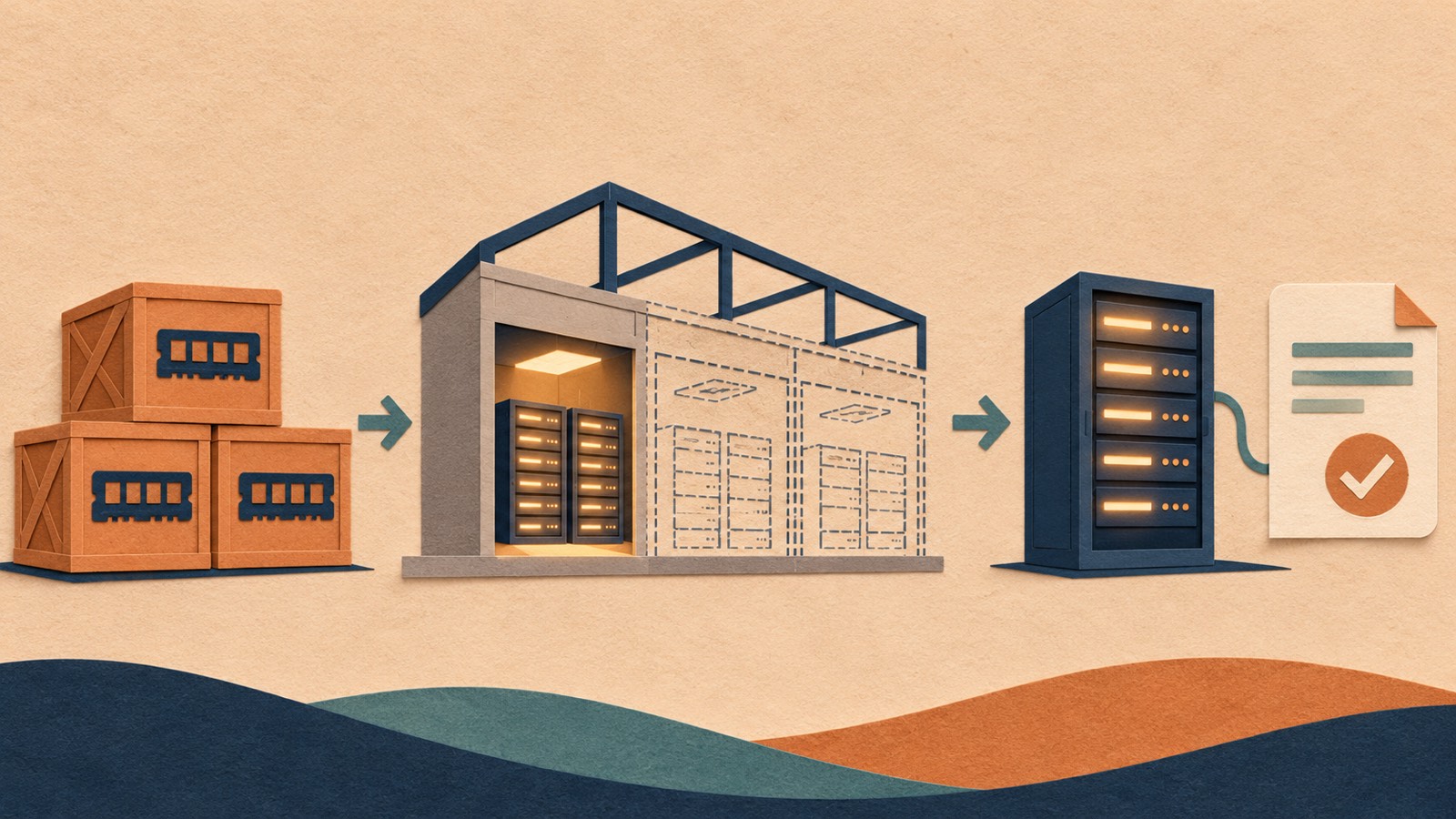
AI-generated editorial illustration. The stages are conceptual, not a depiction of a specific contract or site.
Sales arrived before the new CEO
The interim CEO’s capital choices take place against genuine reported sales growth. Nvidia’s third-quarter release says total revenue reached $115.8 billion, with Data Center contributing $107.6 billion. Its Data Center revenue rose from $51.2 billion a year earlier and $89.0 billion in the prior quarter. The company’s fiscal calendar matters: this was the quarter ended October 25, not the three calendar months ending in November. Reporting it as Kress’s first-quarter performance would attach results to a CEO tenure that had not yet begun.
Kress’s commentary splits Data Center demand further. Hyperscale revenue was $60.1 billion, up 71% year on year. AI Clouds, Industrial, and Enterprise revenue was $47.5 billion, up 195% year on year from a smaller base. Those lines matter to the financing story because different customers have different balance sheets. A large hyperscaler can pay for capacity from an established financing base. A newer AI-cloud provider may need credit support, customer prepayments or construction financing to put the same chips to work. The reported revenue mix does not, by itself, state how much of any category depended on Nvidia support.
The company forecast fourth-quarter fiscal 2027 revenue of about $130 billion, plus or minus 3%. That quarter contains an additional week. The release said its outlook assumed no Data Center compute revenue from China. On the call, Kress also raised the company’s fiscal 2028 growth expectation to roughly 75% year on year, saying her assessment combined continuing demand and additional supply. These are management forecasts. They are not orders already fulfilled, and a longer quarter cannot be compared casually with a standard one.
Supply presents its own bottleneck. In the call, Kress said Nvidia had secured memory and advanced packaging and named additional substrate and packaging partners. The company says demand still outstrips supply. A procurement commitment therefore has an operational purpose: without reserved components and manufacturing capacity, promised systems cannot ship on schedule. At the same time, locking in more supply makes a forecast error expensive. The test is not whether a company should ever commit to memory ahead of sales; it is whether its contracts, inventory and customers continue to fit when the market changes.
The distinction reaches Nvidia’s product claims. The release says Vera Rubin NVL72 had shipped. The call transcript discusses new system partnerships and performance claims, including a company benchmark comparing tokens per watt. A platform shipment is a verifiable commercial milestone in a company release; a particular efficiency result is a vendor measurement under selected conditions. Neither proves that every customer will achieve the same utilization or return on capital. A buyer planning a facility has to model workload, power, networking, financing and software costs, not simply multiply the company’s benchmark by rack count.
Memory orders precede the systems that use them. Early supply and site reservations can preserve delivery capacity if demand persists. If a customer’s financing falters, a machine order, a lease and a guarantee can become related problems at different stages. The larger Nvidia makes those commitments, the more its forecast assumptions matter.
Nvidia’s prior 10-Q described memoranda with capital providers intended to mobilize more than $500 billion of third-party funding over time. It warned that preliminary arrangements might never become definitive agreements. That potential funding is a separate category, not Nvidia cash or an executed loan. The public disclosures give readers contract types and some triggers. They do not provide an independent, customer-level audit of returns across the neocloud market.
Export oversight enters the CEO’s reporting line
The financing questions are only half of Kress’s new job. On November 17, Nvidia’s board announced a standing National Security and Export Control Oversight Committee. Director Suzanne Nora Johnson chairs it, with Stephen Neal and John Dabiri also serving. The company’s national security and global trade compliance teams are to report both to the committee and directly to Kress on day-to-day operations. The committee is scheduled to meet at least quarterly and retain outside specialists. This is a governance design, not proof that its controls have already prevented a violation.
The design puts a finance executive at the intersection of sales, customer financing and trade restrictions. A chip supplier can have a legal sale, a licensed sale, a customer that uses compute through a third-country facility, or a deal that does not proceed. Those are not the same event. The November 17 earnings release excluded China Data Center compute revenue from its forward outlook. The call transcript said fiscal Q3 included $2.4 billion in sales of licensed Hopper Data Center products to China and that Nvidia was no longer shipping licensed Hopper products there. The reported past sale and the forecast assumption refer to different periods.
Washington’s attention has a near date. In a November 18 letter, House Energy and Commerce chairman Brett Guthrie asked Kress for a briefing by December 2 about Nvidia’s export-compliance controls. The letter cites reported concerns involving the former CEO and asks how the company will respond. It is a request for information, not a regulator’s finding that Kress or Nvidia broke the law. An article can state the request and its deadline without adopting every allegation recited in the letter as fact.
The policy environment is still moving. AP reported on November 20 that Treasury Secretary Scott Bessent said current chip restrictions were sufficient, while a House committee disclosed Commerce Department approvals covering 879,868 Nvidia and AMD chips tied to Chinese companies across 21 license applications as of May 11. AP correctly distinguished approvals from completed shipments. It also reported Nvidia’s statement that limited shipments under its H200 program were legal and authorized. Those competing statements and different denominators are exactly why a reader should not infer a sale, a breach or a policy reversal from a single license figure.
Kress’s response will have to cross departments that often report different metrics: finance records commitments and revenue; sales knows customers and intermediaries; trade teams interpret licenses; infrastructure partners build facilities. The announced dual reporting line can bring those records closer to the CEO and the board committee. Whether it changes decisions depends on future evidence: a documented control, a board review, a corrected disclosure, an agency finding or a completed customer transaction. The committee announcement alone establishes neither the efficacy nor the failure of the previous system.
The accounting inquiry and the missing detail
On November 20, Reuters reported that two people briefed on the matter said SEC enforcement staff were scrutinizing potential accounting issues at Nvidia. Reuters said it could not determine the inquiry’s opening date or exactly what issues it covered. The SEC declined comment; Nvidia did not immediately reply to Reuters. The report also noted investor concern over financing arrangements that could make revenue quality and financial exposure harder to assess. Those are concerns and reported lines of inquiry, not an established accounting violation.
The reported inquiry arrives alongside several figures that require different accounting and commercial tests. The $118 billion guarantee maximum is contingent; the $32 billion neocloud line depends on customer financing and operational acceptance; recognized revenue records Nvidia’s sales rather than a customer’s eventual rental income. Kress’s commentary defines those boundaries. It does not show how every agreement will perform. Nvidia said the full 10-Q was still to come. Until it appears, the November 17 exhibits are the available financial record.
Reuters separately described a change in Nvidia’s geographical revenue presentation from billing address to customer headquarters, which removed Singapore from one geographical breakdown. The publication said the change had drawn scrutiny, but it did not establish that this presentation change was the SEC’s specific target. Its report explicitly said the exact accounting issues under review were unknown. An honest reading leaves the two statements separate. The change warrants looking at the company’s disclosure and its explanation; it cannot be promoted into a finding about an investigation whose scope has not been confirmed publicly.
The financial tables also contain actual signals that deserve proportionate attention. Kress’s commentary reports an impairment within non-marketable equity investments. It identifies future guarantees, leases and purchase commitments with dates and conditional terms. Analysts can compare these disclosures with later filings and with customer outcomes. They should not use the word inquiry to collapse all reported exposures into fraud, or use strong quarterly revenue to dismiss questions about future commitments. Both moves substitute a verdict for analysis.
Kress’s dual title makes the response more direct. A permanent CEO could ask a CFO to reconcile the disclosure categories; the interim CEO is that CFO. Her signature on the November 17 8-K identifies responsibility for the company’s filed communication. It does not make her personally responsible for every transaction ever entered into under the former CEO, and it does not establish any misconduct. It does mean the next explanation of the business will be measured against the numbers her office has already provided.
A 10-Q and a December 2 briefing
Several observable events can test Kress’s stated approach without requiring readers to guess at her motives. Nvidia said its full fiscal third-quarter 10-Q would follow in the coming weeks. That filing can be checked against the November 17 commentary for categories, contingencies, accounting treatment and any new risk language. The House committee requested an export-control briefing by December 2. The new board committee has a quarterly meeting schedule. Nvidia’s fourth-quarter results will later show whether sales, margins and customer mix track the company’s November outlook. None of those future events should be written as completed now.
A useful reader checklist keeps each claim at its own stage. For a supply purchase, ask what components were reserved and when they are due. For a cloud agreement or lease, ask when it starts, whether it can be assigned, and which product or research use it supports. For neocloud support, ask whether the customer obtained independent financing, installed the capacity and passed Nvidia’s acceptance condition. For a guarantee, ask which phase has activated, which partner can default, and what maximum payment would then be due. For export compliance, ask what license or restriction applies to the specific product, buyer and route. These questions do not require an investor to predict a share price; they require anyone reading the business to keep unlike events separate.
Nvidia has reported very large realized sales, not merely future projects. Kress said supply was tight and described demand from hyperscalers, AI clouds, enterprise and physical AI. Infrastructure support may help smaller providers put scarce chips into functioning data centers. It also ties a supplier to its customers’ financing. Nvidia’s shipment can become revenue before the customer proves sustained rental demand. The next round of customer deployments, financing and utilization will tell more than either the sales figure or the guarantee ceiling alone.
Kress’s first week did not settle that question. She became interim CEO while remaining CFO, signed a commentary with large and distinct exposures, stated a selective future posture, and inherited a new board reporting line for export risk. Reuters then reported an accounting inquiry whose precise scope remains unknown. The next consequential document may be a 10-Q table, a financing agreement’s activated condition, or a response to the House committee. Each will show a little more of the same thing Kress was asked to explain on November 17: where Nvidia’s chip business ends, where its support for the builders begins, and who bears the cost if a promised data center does not become a paying one.