
Britain Bets £810,591 That AI Training Can Change Work in Barnsley
On this page 7 sections
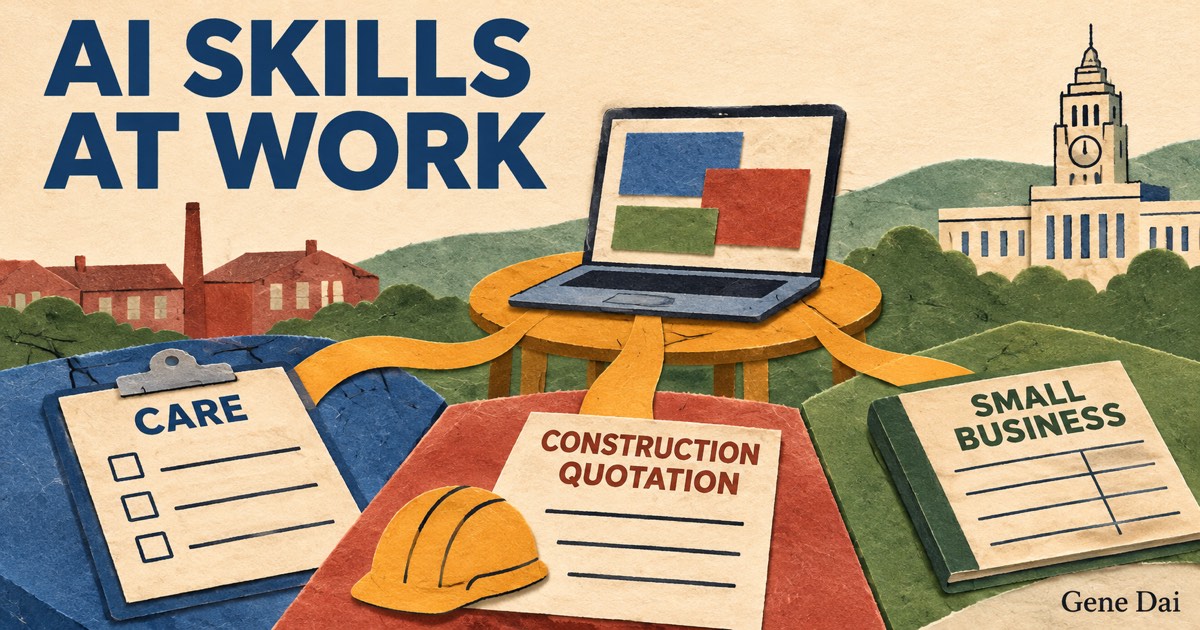
AI-generated editorial illustration.
On November 3, the British government assigned £231,000 to teach experienced Barnsley construction and engineering staff to use AI on quotes, tenders and safety paperwork. Another £184,403 went to Barnsley College to bring mobile training to hospital and social-care workers. Two more awards targeted people returning to work, young residents and small businesses. The four published awards add to £810,591.
The awards pay for training that has yet to report results. One provider will work inside firms for 90 days. Another will bring tasters to staff who may struggle to leave a shift. A third will run practical challenges with women and younger residents; the fourth will support 20 small firms. The government says the best approaches could travel beyond Barnsley, its first government-backed Tech Town.
A completed course would be a start. A better quote, a safer care handover or a job gained would be a different kind of evidence.
The distinction matters because Britain has already run an AI training fund whose planned reach far exceeded its actual claims. A January 2026 evaluation says a previous £7.4 million allocation drew 553 applicants against a design expectation of 4,000. Only 181 businesses ultimately claimed grants, and £381,096 was awarded. That earlier programme served a different sector with a different funding model. It still gives Barnsley a useful warning: awarding money and changing work are separate events.
In the November announcement, Minister for the Future of Work Kate Dearden placed the training inside existing jobs, from care to building trades. AI Minister Kanishka Narayan spoke to workers worried about their careers. The ministers’ stated ambitions meet at a point that grant documents cannot resolve: whether someone on an ordinary shift is allowed to practise, check the answer and decline the tool when it is unsafe. That is where the four delivery designs begin to diverge.
Four awards, four definitions of a skill
The new AI Upskilling Challenge Fund announcement describes four delivery partners, each with a different population and task. The split is a design choice. Generic AI literacy can be delivered as a lesson. Working safely with a patient’s information, an estimate for a client or a job application requires a different check at the point of use.
| Delivery partner | Award | Stated reach and work | Observable next test |
|---|---|---|---|
| Atheni Strategy | £231,000 | 140 people, mostly 40 or older, across six manufacturing, engineering and construction firms; quotes, tenders and safety paperwork | Whether completed documents improve without losing review, data protection or staff time |
| Optimise Cyber Solutions with Abbeydale Training | £200,000 | 20 small businesses; practical and safe AI adoption | Whether a usable workflow remains after training and who approves its use |
| Fossu, trading as Ignite AI, with community partners | £195,188 | 100 residents, including women returning to work and young people; challenges and buildathons | Whether participants gain work, progress or a useful business outcome, beyond attendance |
| Barnsley College | £184,403 | Mobile AI training for hospital and social-care staff and the wider community | Whether workers can apply a suitable tool during real shifts without weakening care safeguards |
These are plans and target groups. Dividing each grant by its headline participant count would be misleading: Atheni’s award includes product access and work with employers, while Ignite’s includes community delivery, and the college has no participant total in the announcement. Even the two firm counts refer to different interventions. A cost-per-learner league table would reward the provider that chose the cheapest thing to count.
Atheni begins with a quote or method statement already in a construction worker’s week. The college takes lessons to care staff rather than assuming they can leave a shift for a remote webinar. That choice can determine who reaches a class at all. It also makes a single success metric difficult: a better tender, a more confident applicant and less administrative time on a ward cannot be reduced to the same course badge.
The government’s AI Skills Boost programme aims to upskill 10 million workers by 2030. Barnsley’s grants put a smaller question inside that number: can a worker complete a familiar task better after training? An employer must still provide time, approved tools and a way to review the result.
The difference between the four awards also changes who gets credit. A provider may have taught an effective method but an employer may never grant access to the documents needed to use it. A worker may finish a class yet choose not to use a model for a sensitive task, correctly. If the programme records only use frequency, that decision looks like failure. The evaluation needs a category for appropriate nonuse: the participant recognised a task that belonged with a qualified person or an approved system. That is especially relevant in care, safety paperwork and employment advice.
A quote that someone still has to sign
Atheni’s current Barnsley invitation is unusually concrete. It offers six firms a funded 90-day programme during working hours. Its page says one anchor firm is secured and five places remain; it advertises a webinar for November 25. Firms must provide a senior sponsor, release staff time, share anonymised example documents and support questionnaires before and after the programme. The company says it will measure each person’s starting point and which tasks take less time at the end.
Atheni says its platform will combine trade context with each firm’s own documents. The provider’s November 3 statement says staff will choose where AI helps and check what it produces. Co-founder Louise Ballard argues that training should begin with the firm’s actual work. The company says it is building a local knowledge layer for regulations, standards and working language. Those are provider claims about the proposed method; the public materials do not show a finished deployment at all six firms or independently measured time savings.
As an analytical example, consider a tender; this is not a reported Barnsley customer case. A model could draft a description using an approved firm’s past bids and a set of requirements. A worker still needs to verify the price basis, project scope, current rules and anything the customer will treat as a commitment. If the draft cuts writing time but introduces an unsupported safety method, the faster first draft may make the final process slower. A useful evaluation would count correction and rework, not only minutes to first output.
Atheni’s requirement for a senior sponsor has a practical purpose. Staff can learn a tool in a workshop, then return to a firm that has no approved account, no document-access rule or no time to review outputs. A sponsor can decide which documents are eligible, which final signatures remain human and whether the team can spend paid working hours on practice. The requirement also selects for firms already ready to engage. If the programme reports strong results among six willing companies, it will not by itself prove the same approach works for less prepared firms.
There is another bargaining point inside that arrangement. Experienced workers contribute the examples, terminology and corrections that make a company-specific system useful. The Atheni statement says most of its intended 140 participants are over 40, and that the firm’s documents sit on top of a shared local knowledge layer. A participant may want to know whether their corrected examples stay within the employer, become material for the provider’s product or travel to other firms. Atheni says each firm’s information stays its own and its public programme page says examples will be anonymised. A contract and a technical data-flow review would still have to settle who can inspect, retain and remove each category of material. The public launch does not disclose that contract.
Pay for training time matters too. A 90-day programme during working hours gives a foreman or estimator a chance to practise while the relevant bids are live. It also costs the firm capacity. If the employer cannot release staff without delaying delivery, a fully funded course may still have a price the grant does not cover. Atheni lists staff time and a sponsor as conditions; tracking which eligible firms decline for those reasons would tell a future town more than a total of six places filled.
That selection problem appeared in the earlier Flexible AI Upskilling Fund evaluation. Evaluators found that many participating firms had already planned to invest in training. Some nonrecipients bought training themselves. The old scheme’s 50% match and requirement to source a course placed extra demands on small firms. Barnsley’s fully funded, provider-led model removes the match requirement. Whether it reaches workers and firms that would otherwise be excluded is still a question for the eventual participant record.
Training across a shift, a job search and a shop
Barnsley College’s mobile training takes a different route. The government says it will offer tasters to hospital and social-care staff and the wider community. College principal David Akeroyd says in the government announcement that training should fit the demands of care roles and reach people who otherwise struggle to access it. The college award is for learning, not proof that an AI system has improved patient care.
A hospital has a related but separate technology pilot. Barnsley Council said in March that Barnsley Hospital NHS Foundation Trust would begin deploying AI tools to reduce missed appointments, waiting lists and administrative work. That announcement stated aims, not measured results. Treating the college’s mobile lessons and the hospital’s deployment as one programme would obscure which intervention, if either, changed a patient’s experience. The training can help staff ask better questions about tools. The hospital still needs its own operational and clinical evidence.
For a care worker, a useful task might be understanding an approved scheduling tool or checking a draft communication. The boundary matters more than a prompt-writing trick: patient information cannot be treated like a practice document, and a generated answer should not become a clinical instruction merely because it sounds fluent. The public training announcement does not specify each approved tool, data-flow rule or assessment. Those details should be sought before describing the award as safer care.
The residents’ route has a different outcome. Fossu, trading as Ignite AI, will work with Barnsley YMCA, Postnatal Minds and the local chamber of commerce on challenges and buildathons for 100 people. Its stated audience includes women returning to work and young people. A community partner can lower practical barriers to participation that an employer training budget does not see. But a completed buildathon is not employment. The follow-up should distinguish confidence, a working artefact, an interview, a paid placement and a durable job.
The town already has two separate employment schemes. Barnsley Council announced in August an AI Career Launchpad with six months of training linked to a Level 4 apprenticeship and paid placements, and a Getting Job Ready with AI pilot for jobseekers referred through Jobcentre Plus. Those are not among the four November awards. Their existence shows why headline counts require a programme ledger: a resident might take a course, attend a buildathon and later enter a placement. Counting three activities as three people helped would inflate reach.
The August council release put more than £400,000 behind the Career Launchpad and said its curriculum would be freely available after the pilot. That creates two different tests. One is whether a participant completes a paid placement and moves into work. The other is whether another college can use the curriculum without Barnsley’s local employers and staff. Neither can be judged by the November grant announcement. They belong in the same town-wide account, with separate funding and participant records, because a government trying to replicate the Tech Town will need to know which intervention caused which outcome.
The route through Jobcentre Plus has its own boundary. The council says jobseekers may use AI to find roles, tailor a CV and practise interviews. Those activities can help someone present genuine experience clearly. They can also produce applications that sound polished but no longer describe the candidate’s work. A fair evaluation would ask whether the person can explain and defend the submitted material in an interview, and whether the support led to interviews or paid work. The council announcement describes a proposed service, not a placement rate or proof that AI-written applications perform better.
Optimise Cyber Solutions and Abbeydale Training will support 20 small businesses. The award notice promises safe adoption and practical implementation while developing female AI leaders. It does not publish a list of participating firms, a per-firm timetable or a measured productivity result. The useful next question is not whether owners can name an AI tool after a session. It is whether an employee can use an approved workflow, explain its limits and leave a customer record that another person can audit.
The provider’s existing site specialises in cyber-awareness training. That background suggests why security might sit near the front of its AI-adoption work, but the site does not describe the new grant’s lesson plan or its measurement protocol. A small firm should be able to ask which customer data is allowed in the tool, who administers accounts, what happens when a model changes and who receives the record of an error. Those are procurement questions for the new programme, not assertions that any participating firm has already encountered a breach.
The last training fund left money on the table
In 2024, Britain offered up to 50% match funding for AI training at small and medium professional-services firms. The published process and baseline evaluation says the scheme expected 4,000 applications and 2,000 funded businesses. It received 553 applications and approved 327. Of those, 181 submitted a funding claim by March 2025. The department awarded £381,096 from an announced £7.4 million allocation.
That does not prove there was little desire to learn AI. The evaluation identifies friction between interest and delivery: firms had to find a suitable accredited course, wait for an award and pay their share. Almost one in five surveyed successful applicants said they struggled to find training that met their needs; roughly one in ten struggled with affordability. Some firms said the relevant course disappeared or the project had moved on during delays. The report notes that 45% of approved businesses did not submit a claim, a group that includes both training that never happened and training paid for without a claim. It cannot be described simply as 45% who did not learn.
The older fund was designed to support a randomised trial, but the low number of applications made that plan infeasible. The evaluation is a process and baseline report, not an estimate of the programme’s causal effect on productivity. It reports that some businesses felt more informed after training without changing their processes, while others said AI had entered day-to-day work. Those accounts are useful, but they do not establish a single return on the £381,096 paid.
The employee survey in that evaluation is narrower than the programme total: 105 selected employees responded by February 24, 2025. Among those respondents, fewer than half believed they could quality-assure AI outputs before the funded training. Around a fifth said they did not use AI in their role. The sample was not a random draw of all UK workers, and these were baseline responses. Still, it points to a practical omission in many course counts. Knowing how to ask a model for text and knowing how to reject a plausible mistake are different skills. A new pilot that teaches one without testing the other would repeat a known blind spot.
Barnsley’s four awards change the delivery mechanics. Providers are named in advance; one teaches during working hours; another travels to care settings; community partners recruit groups that often miss employer-sponsored learning. That is a plausible response to the earlier access problems. It remains an inference until the new pilots publish who actually attended, who finished, what changed and what those changes cost. A six-firm sample can document concrete work well, but it cannot carry a national estimate on its own.

AI-generated editorial illustration. The path separates attendance from verified use and workplace outcomes.
A million courses do not describe a million changed jobs
The national denominator has a similar problem. In its AI Skills Boost explainer, the government reports 1,001,147 course completions shared by industry partners as of January 2026, covering training delivered since June 2025. It says those completions include introductory and advanced courses, external learners and partner employees. Partner-level breakdowns are not public for commercial reasons. The published figure counts courses. It does not report a unique-worker count or how many learners changed a work process.
The same explainer models a potential gain of more than £7.5 billion a year in gross value added if 10 million workers are trained and their output rises by 1%. The government itself calls the figure highly uncertain. It is a scenario, not a realised return from the current course completions. The 1% assumption does much of the work. Barnsley’s value is that its grants are small enough to ask what a changed task actually looks like, though the sample remains too small to validate the national scenario.
A separate Skills England and Department for Work and Pensions research programme gives a reason to start with tasks. Its executive summary draws on 23 workshops with about 150 organisations, ten case studies and 536 employer survey responses. More than 44% of surveyed organisations reported daily AI use, yet the authors found uneven learning through trial and error, peer advice and tool prompts. They recommend practical training tied to real decisions and the ability to recognise when AI should not be used. The survey describes its respondents; it is not a population-wide estimate that 44% of all UK organisations use AI daily.
That research also names time and staff pressure among employers’ barriers. The four Barnsley awards attack the access problem in different ways: paid work time at Atheni, mobile sessions at the college, community partners for returners and younger residents, and direct help for small firms. A published attendance total can show whether those channels delivered a course. It cannot show why a person who needed the training stayed away. A credible review would ask nonparticipants too, even if a short interview with a supervisor or resident is all the budget allows.
Even confidence can mislead if it is the only outcome. The Cabinet Office’s 2026 evaluation strategy describes a small randomised pilot of digital training for senior civil servants. It found preliminary improvements in behaviour and attitudes, including an AI Confidence module, but no statistically significant improvement on a newly developed self-reported productivity measure. The strategy cautions that the productivity measure had not been validated elsewhere. The finding neither condemns all AI courses nor establishes that Barnsley’s design will work. It shows why a changed attitude and an observed work outcome should occupy separate columns.
The missing evidence is a work record
Each Barnsley partner could publish a short, comparable record without pretending that all jobs are alike. Start with reach: eligible firms or residents approached, enrolments, attendance, completions and reasons for dropout. The denominator should include people who could not get time off, lacked an approved tool or found the format inaccessible. A programme aimed at those groups cannot judge inclusion from the people who made it into the room.
Then examine a task before and after training. Atheni could report how long a quote takes to reach an approved final version, how many corrections are made and whether a reviewer finds unsupported safety claims. A small firm could report whether a workflow survives a month after the coach leaves and whether staff know what customer information may enter the system. A college could record whether a care worker can identify a safe use case and a forbidden one during a shift. Ignite could follow a participant’s application, placement or business project without labeling a practice session as a job. These are proposed evaluation questions, not outcomes the providers have reported.
The comparison should survive the last training session. A task checked immediately after coaching shows that the lesson was understood; the same task checked 30 or 90 days later tests whether the worker can use it without the trainer. Record mistakes as well as successes, and allow an employer to report that a workflow was stopped after review. Otherwise the public record will favor visible adoption over the safer decision to discontinue a poor use case. Published totals can protect personal and commercial information while still showing the denominator, time window and method of verification.
The work record should also carry the human cost. A draft may save 15 minutes but add review time elsewhere. A generated email may accelerate administration while increasing correction calls. A business might adopt a tool because the grant includes licences, then stop when the funded period ends. An outcome file needs the period, baseline, reviewer, paid staff time, licence cost and any extra checking. Without those fields, a faster task can look like a productivity gain even when the burden moved to someone else.
The public documents do not yet describe a shared evaluation protocol across the four awards. That absence is consequential, though not evidence that no private protocol exists. If a government hopes to transfer a model from one town to another, it must know which parts are portable: a 90-day coach, a mobile unit, a community partner, a released hour at work or a tool licence. Barnsley’s construction employers and hospital have different constraints. The replicable lesson may be the method of choosing a task, rather than a particular course or vendor.
Nor should the grants be treated as an isolated national programme. The November release also mentions a £30 million investment for three Yorkshire regional mayors to extend AI work in communities and £23 million over three years for an AI Economics Institute. Those are different commitments with different purposes, not additions to the £810,591 training total. Their scale raises the stakes for a sound Barnsley record. If the local pilot becomes a template for larger spending, readers should be able to trace which observed result justified the transfer and which parts were assumed to work elsewhere.
November 25 is a recruitment date, not a result
Atheni’s Barnsley page still advertised five firm places and a November 25 webinar when reviewed for this November 9 article. Its 90-day programme has yet to produce a published before-and-after record for all six intended firms. The college and community programmes have also just received their November awards. A buyer can inspect design, eligibility and proposed checks today. Saved hours, safer care and new jobs from these four grants remain unreported.
The government and employers can publish the denominators and dates before claiming success: how many were reached, who could not attend, which tasks were attempted, who approved the outputs and what changed after support ended. The earlier fund’s largest gap opened between an awarded place and a claimed intervention. Barnsley’s decisive handoff will come later, when a worker returns to the quote, shift or application and can show what they now do differently.