
International Paper Put Relay's Factory Radio in the AI Budget
On this page 7 sections
AI-generated editorial illustration.
At 9 a.m. Eastern on September 30, Relay announced that International Paper had led a $36 million investment in the Raleigh company. Relay sells connected push-to-talk devices to factories, hotels, hospitals and other physical workplaces. The round brought its total capital raised above $90 million. Two weeks earlier, Relay had split its mobile software into separate worker and administrator apps and added photographs to conversations already capable of keeping searchable voice transcripts.
International Paper came to the round as a customer. It told Relay that the system had worked in loud industrial environments and that it saw the product as part of a modern technology stack. The packaging company did not disclose how many sites, workers or devices are involved, what it pays, or what changed after deployment. Relay did not publish a controlled measure of safety, productivity or maintenance performance.
A purchasing decision begins inside the undisclosed part. A radio is easy to understand: a worker presses a button, speaks and expects somebody to hear. An AI operations product asks the same action to do more. The message may be transcribed, searched, translated, joined to a location, attached to a photograph, routed into a workflow and reviewed by a manager. A conversation starts to become a work record.
International Paper’s investment puts that record inside an unusually large operating environment. Its 2025 annual report lists 62,602 employees, including 20,705 hourly employees in the United States. It also lists 15 U.S. packaging mills, 159 converting and packaging plants and 15 recycling plants, plus another large production footprint outside the country. Those figures describe the company, not the Relay deployment. They show why a familiar button can be more valuable than another screen, and why weak rules for the resulting data can spread far beyond a pilot.
A customer led the round
Relay’s funding announcement names International Paper as the lead investor, with new capital from clients of Cerity Partners, Harmonic Growth Partners and Thayer Investment Partners. Earlier investors G2 Venture Partners and Wind River Ventures also increased their positions. The release frames the round as an endorsement from industries that already buy the product. Thayer’s partners include hospitality operators; International Paper brings manufacturing experience and a customer’s view of the system.
Independent reporting adds two useful numbers. Axios Raleigh reported that Relay had about 300 employees and planned to hire roughly 100 more over the following year. The company did not disclose its valuation, revenue, annual recurring revenue, customer retention, gross margin or the mix between hardware and subscription income. Relay’s own pricing page requires a buyer to provide details before receiving a quote, so there is no public rate card against which to test a claimed return.
Even with those gaps, the financing carries a clear operating signal. A large customer is taking equity risk in the supplier, not merely renewing a contract. International Paper’s representative said Relay improved shift transitions, operating processes and responses to safety and maintenance alerts, and could connect frontline observations to other operational systems. Those are the customer’s statements in a vendor release. They are stronger than an anonymous testimonial and weaker than a disclosed site-by-site result.
Relay pairs a modest interaction with an expansive ambition. The worker keeps pressing a talk button. Behind that action, the company says its platform combines cloud communications, AI translation, location and automated workflows. The new capital will help Relay hire and expand the platform. A buyer still has to decide which layer earns the budget: clearer communication, safety response, equipment reliability, translation or a searchable operations record.
Mixing those benefits into one return figure would make a pilot difficult to judge. Replacing old radios can reduce repeater, repair and device-management costs. Faster response to a maintenance call can reduce downtime. Translation can change who understands a message. Searchable history can help investigate a missed handoff. Each has a different baseline, owner and failure mode. The investment thesis can be broad; the plant acceptance test cannot.
Voice wins before AI enters the room
Frontline software often starts with a form. The worker must remove a glove, unlock a shared device, find the right screen, type a description and submit it before returning to the task. In a noisy mill or a hotel corridor, that sequence competes with the work itself. A push-to-talk device starts from a behavior crews already know.
Relay’s current hardware page describes a dedicated device that can connect through 4G, 5G, private LTE, LoRa and Wi-Fi. Its published specifications list noise and echo cancellation, GPS, indoor location, emergency alerts and a claimed all-day battery. TeamTranslate is presented as real-time translation across more than 30 languages. These are product specifications and vendor claims, not measurements from International Paper’s facilities.
The device can earn its place without AI. A worker can send a short message while moving, looking at a machine or wearing protective equipment. A supervisor can reach a group without collecting personal phone numbers. A maintenance specialist can hear about a problem before somebody returns to a terminal. None of those uses requires a language model.
For a worker who is more comfortable speaking Spanish than English, real-time translation may remove a daily barrier. It may also turn an ordinary sentence into a safety instruction whose accuracy matters immediately. Relay has not published language-by-language accuracy under factory noise, and a buyer should not turn a product demo into a safety standard. Workers need a quick way to repeat, correct or reject a translated message without being blamed for the machine’s wording.
There are alternatives. Microsoft includes a Walkie Talkie app in Teams and lets administrators assign it through app policies. Its deployment documentation lists rugged Android devices and headsets with dedicated push-to-talk buttons. It also publishes target network conditions below 300 milliseconds of round-trip latency, 30 milliseconds of jitter and 1 percent packet loss. An enterprise that already licenses Microsoft 365 may prefer to extend that stack. Another may prefer a dedicated fleet with cellular service, location and device management bundled by one supplier.
This is not a simple radio-versus-app contest. A plant must test the whole communication path: button, microphone, hearing protection, network, channel rules, supervisor response and downstream ticket. The National Institute for Occupational Safety and Health warns that high workplace noise can mask alarms and verbal warnings. Its hearing-protection guidance tells employers to consider speech, distance, comfort and compatibility with other protective equipment. A louder speaker is not a substitute for noise control or a hearing-protection program.
IT also inherits a fleet rather than an app alone. Someone must assign devices, remove access after a transfer, manage chargers and accessories, test software updates, resolve lost hardware and decide which identity follows a shared unit. Microsoft may fit an existing mobile-device program; Relay may reduce carrier and radio infrastructure work. The better choice is the one the local team can support through a night shift, not the one with the longer feature list.
Relay’s strongest case begins here. The product does not ask a worker to adopt an AI chat window before receiving value. Communication can improve first. Translation, search and workflow automation can then be tested on top of that use. This order also protects the buyer from paying for an AI label when a reliable radio would have solved the immediate problem.
Searchable talk changes the labor bargain
Relay’s September product update makes the boundary visible. The company replaced one mobile app with Relay Communicator for everyday messages and Relay Admin for configuration and fleet management. It added picture messaging to channels where message history is enabled. A photograph of a cracked weld or damaged fixture can now sit beside the voice exchange that produced it, attributed and time-stamped.
Relay says spoken exchanges become searchable transcripts. Its message-history instructions explain the operational detail: an account owner or administrator can enable history for a channel, listen to messages and read transcriptions. A separate support article explains how to download a day’s transcripts as a CSV file. The history is available for seven days in the dashboard. Relay also warns that enabling the feature creates both an audio and text record and places responsibility for recording notices and consent on the customer.
An ordinary radio call normally disappears. Here, the exchange becomes accessible to people who were not on the channel when it happened. A supervisor can reconstruct a maintenance handoff. A safety team can review an alert. An operations analyst can look for repeated delays. The same record can expose an employee’s location, speech, language, mistakes, tone or complaint to a larger group of administrators.
Seven days can become permanent with one export. A recording retained briefly to investigate an emergency is different from a transcript copied into a performance file. Translation is different from classifying workers. A maintenance trend is different from ranking employees by talk time or response speed. The product’s dashboard window no longer governs retention after a CSV leaves it.
Relay’s enterprise terms state that the subscriber retains ownership of service data. The attached data-processing terms describe Relay as a processor and the customer as the controller. They require the customer to provide the necessary notices and obtain required consents or authorizations. The terms also permit processing needed to operate, support, test and improve the service, including insights and reporting. They identify precise location and union membership among categories that can qualify as sensitive data under applicable laws.
A separate notice for Relay’s optional Translation Channel says audio for that feature passes through Google Cloud and that Relay retains no record of the spoken audio. The notice does not establish the current data path for every translation or transcription feature. Procurement should ask which service, subprocessor, retention rule and model boundary apply to the exact configuration being purchased.
Those clauses are contractual boundaries, not a complete workforce policy. They do not tell an employee which channels are recorded, who may export a transcript, whether a message can be used in discipline, how a mistranscription can be corrected, or whether a safety complaint will be separated from productivity scoring. International Paper also reports 11,498 union-represented U.S. employees and operations subject to works councils and local labor rules outside the United States. A rollout across that footprint cannot rely on one generic notice.
A worker or union representative will ask a plainer question: can a sentence spoken to get a machine fixed later be read as evidence about the person who said it? That risk grows when devices change hands, names are assigned incorrectly or a transcript drops the words that made a warning conditional. The employer needs an answer before a contested record reaches coaching, discipline or a performance review.
Keeping some messages can protect both sides. No record protects the worker or the company when an urgent warning disappears, a maintenance request is missed or a supervisor denies receiving a report. A short, purpose-limited history may give employees evidence that they raised an issue. Search can reveal equipment problems previously dismissed as anecdotes. The policy task is to name the record, its purpose and the process that follows when it is wrong.
International Paper exposes the buyer economics
International Paper spent about $1.9 billion on capital projects in 2025 and expected $2.0 billion to $2.1 billion in 2026, according to its annual report. Relay’s contract or equity investment should not be inferred from those figures. The scale shows the environment in which a communication tool must compete. Mills already have maintenance systems, manufacturing systems, radios, phones, private networks, safety programs and local work practices. A new device creates value only when it closes a gap among them.
Relay describes that gap as information that is spoken but never enters a formal system. Its funding release cites a company-sponsored survey of 500 manufacturing professionals: 57 percent said their most important operational communication happened aloud and in person, while 17 percent said nearly everything workers noticed reached a system or log. Relay also reports that 79 percent experienced communication-related delay, rework or missed handoffs at least a few times a month.
These figures support the vendor’s product thesis. The questionnaire, sample construction and full results were not available in the announcement, so they do not establish the size of any buyer’s return.
Start the economic case beside a pump making an unfamiliar sound. A worker reports it. The message reaches the correct person. Someone decides whether to inspect, slow or stop the equipment. A work order is created. The inspection finds a defect or a harmless condition, and the result reaches the next shift. Every step can be observed. Delay, mistranslation, bad routing or a missing work order can also be priced.
Searchable voice can help at three points. It can preserve the original observation, reduce the time spent locating an expert and show whether the handoff closed. It cannot diagnose the pump on its own. It cannot guarantee that a supervisor responds or that the maintenance system receives a clean ticket. Turning every radio message into a record can also create noise, false urgency and review work.
The maintenance manager may see the hidden cost first. Better reporting can reveal a real backlog, but the queue still needs triage, parts, technicians and planned downtime. A supervisor who receives 40 searchable observations instead of ten radio calls has gained visibility and lost scarcity as an excuse. If staffing and priorities do not change, the system documents delay more neatly without reducing it.
The invoice should therefore be compared with the cost of the completed loop, not the number of messages. Hardware, service, accessories, charging, mobile connectivity, indoor-location infrastructure, integrations, support and device replacement belong in the numerator. Training, channel administration, transcript review, consent work and supervisor time belong there too. The denominator should be an outcome such as accepted maintenance handoffs, verified emergency response, avoided duplicate dispatch or a documented translation correction. Relay’s public pricing page offers custom quotes rather than numbers, which makes this buyer-side model necessary before a contract can be evaluated.
AI-generated editorial illustration.
Equity ownership adds another question. A customer-investor may gain a closer product relationship and influence over the roadmap. It can also become less willing to compare the supplier with an existing radio fleet, Teams, a private LTE tool or another vendor. Procurement should keep the investment thesis separate from site-level acceptance. A plant manager still needs permission to stop a rollout that adds review work or misses messages, even if the corporate parent owns shares.
Relay can answer that one managed platform is easier to operate than radios, panic buttons, translation apps, personal phones and separate location tools. Consolidation can remove handoffs as well as create dependency. A buyer should test both sides: how many systems and service hours actually leave, and how communications continue if the Relay account, network or integration is unavailable.
Reliability belongs in the model
Relay markets redundant connectivity across multiple cellular networks and Wi-Fi. Microsoft publishes network targets for its own Walkie Talkie app. Neither set of materials proves that a particular mill, stairwell, freezer, basement, elevator or remote yard will stay connected through a shift. Industrial wireless performance depends on the physical site.
NIST’s industrial wireless deployment guidance notes that harsh environments and crowded spectrum make reliable performance difficult. That observation is older than Relay’s current hardware, but the engineering problem remains. Metal, moving equipment, interference, coverage design and network congestion can turn a strong product specification into a weak local result.
A pilot should record delivery time and failure, not only whether a message eventually appeared. Emergency alerts need a tighter standard than routine coordination. A translated instruction needs the original audio, the translated output and a correction path. An indoor location needs a confidence or error boundary appropriate to the use. A battery claim needs to survive the site’s channel volume, signal conditions, temperature, accessories and charging practice.
For the safety lead, average delivery is the wrong comfort. The missed alert, stale location and failed fallback matter more than the median successful message. That does not require every channel to meet an emergency-service standard. It requires the company to label which scenarios are safety-critical and test them separately from ordinary coordination.
Success can expose a queue the company never staffed. When workers trust the button, they report issues that previously stayed local. Supervisors receive more alerts. Maintenance teams get more requests. A backlog can grow even as communication improves. Message volume would then reward the system for producing demand that nobody can close.
The system should degrade safely. Workers need to know what to do when a device loses service, translation is uncertain, location is stale or a transcript is unavailable. A plant cannot make a cloud feature the only route for an emergency without testing the fallback. The radio, AI and workflow layers have different failure modes; a green status page for one cannot certify the whole chain.
Two acceptance files for a plant rollout
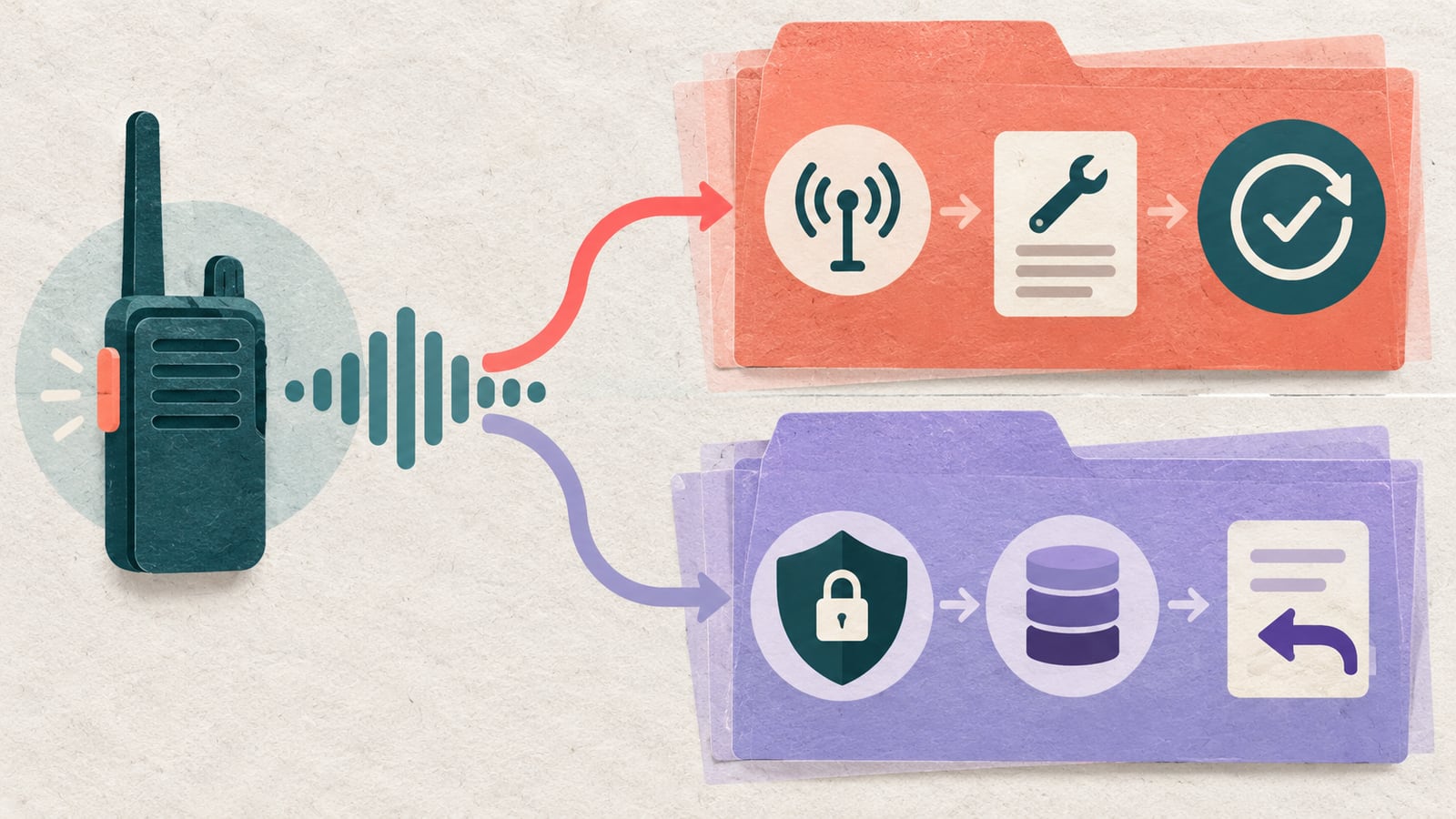
The operational pilot and the worker-data review should run together. Treating privacy as a document signed after the technical test would miss how the system is actually used. Treating worker consultation as a substitute for reliability testing would leave safety claims unproved. Two acceptance files keep the questions connected without collapsing them.
The operational file follows a message from button press to closed work:
| Field | Evidence to retain | Decision it supports |
|---|---|---|
| Scenario and channel | Routine call, maintenance observation, translation or emergency alert | Whether the feature is suitable for this class of work |
| Delivery | Timestamp, intended recipients, receipt and failure | Whether the communication path met its service target |
| Network and device state | Connection type, coverage zone, battery, accessory and software version | Whether failure belongs to the site, device or service |
| Translation or transcript | Original audio, output, worker correction and reviewer | Whether machine-produced text was usable and correctable |
| Downstream action | Assignee, work-order ID, response, disposition and next-shift handoff | Whether a message became completed work |
| Cost | Quote, hardware, service, integration, support and human review time | Whether the loop improved at an acceptable total cost |
The worker-data file defines the record before the first recorded shift:
| Field | Minimum answer | Decision it supports |
|---|---|---|
| Recording state | Which channels retain audio, text, images and location | Whether a worker can know when a conversation becomes a record |
| Purpose | Safety review, maintenance handoff, translation or another named use | Whether later reuse is compatible with the original reason |
| Access | Named roles allowed to listen, search, export or integrate | Whether administrators have more access than the work requires |
| Retention | Dashboard window, export location, deletion schedule and legal hold | Whether a seven-day feature becomes an indefinite local archive |
| Employment use | Allowed and prohibited uses in coaching, discipline and evaluation | Whether operational data quietly becomes a performance score |
| Correction and appeal | Route for fixing identity, transcript, translation or location errors | Whether a worker can contest a bad record before action follows |
| Representation | Required union, works-council, safety and local legal review | Whether rollout respects the workforce and jurisdiction involved |
No new software category is required. The two files form a compact purchasing record. Plant operations owns the work loop. IT owns identity, device and integration controls. Safety owns emergency scenarios. HR and labor relations own employment use. Security and privacy teams test access and retention. Workers test the device with the actual task and protective equipment. Finance reconciles full cost against accepted outcomes.
A 30-day pilot may be enough to find dead zones and confusing channels. It is too short to prove a lower injury rate or reliable predictive maintenance. The acceptance file should label those outcomes as unmeasured rather than filling the gap with message counts. A buyer can renew for communication value while continuing to withhold judgment on broader AI claims.
The budget test starts after the first alert
Relay has found a route into AI spending that begins with a physical object and an ordinary action. That route avoids a common adoption problem: asking a frontline employee to become a software operator before the tool helps. International Paper’s investment suggests that at least one large industrial customer sees enough value to support the supplier’s next stage.
It does not tell another employer to buy the product. The public record lacks a deployment size, price, comparison group, accuracy report and independently measured outcome. Relay’s trust center reports a SOC 2 and HIPAA Type 2 examination covering December 2024 through November 2025 and an ISO 27001 certification dated February 2026. Those controls do not decide whether an employer should record a particular channel or use a transcript in a personnel decision.
More important is the movement at the boundary of frontline software. A factory radio used to end with the person who heard it. A connected device can preserve the message, attach context and hand it to another system. That can make previously lost work visible. It can also make workers continuously legible to managers and machines.
The investment case will be decided after the button press: whether the right person receives the alert, whether the work closes, whether the record is accurate, whether the worker can challenge it, and whether the result is worth the full operating cost. Until those answers are retained beside the invoice, a factory radio has entered the AI budget without proving that the budget improved the factory.