
Motive and Samsara Take Fleet AI Beyond the Alert
On this page 7 sections
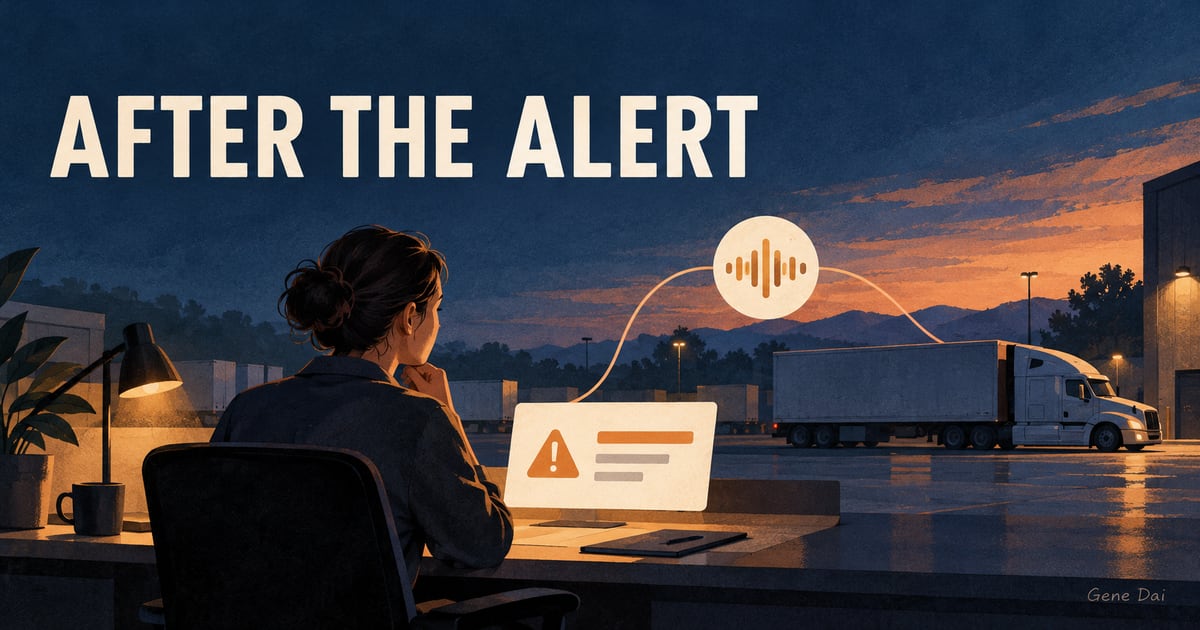
AI-generated editorial illustration.
At a trucking conference in Charlotte on October 19, Bennett Family of Companies safety director Jared Whitson described a truck that could return to a yard with a known fault and leave again before anyone dealt with it. His company has 4,500 vehicles across 14 business units. Four new AI agents are operating there, Truck News reported, including one that tells asset management, maintenance and safety staff when a vehicle with a critical code enters the yard.
That is a small, specific deployment. It is also a better starting point for judging the current fleet-agent market than a video of a synthetic voice talking to a driver. Bennett has identified an event, a place and the people who need to respond. Whitson has not reported a crash reduction, a maintenance saving or a staffing cut from those four agents. He told the publication he had deliberately started small to build trust.
Whitson’s account followed Samsara’s October 13 Agent Studio launch by six days. Motive’s October 19 announcement said its Agents could turn safety, maintenance and idling data into action. The rival products have different release calendars. Each asks a fleet to decide which alert should become a message, a work order, a call or a human judgment.
For the driver and the safety office, a false warning interrupts work; a missed one can leave a vehicle in service. An automated call may save a coordinator’s time, while the next human conversation starts with a harder exception. Count the path from detection to verified resolution, not the number of agents a carrier configures.
Four agents at Bennett
Whitson’s example contains the essential pieces of a real workflow. The equipment has to produce a fault code. The fleet has to know the vehicle has entered its yard. An agent has to alert the right teams before the vehicle goes back out. Then somebody must inspect, repair or hold it. Truck News says Bennett’s other agents monitor critical telematics events and identify drivers needing attention or coaching. The account does not say the agents close the work order, establish mechanical fitness or replace a supervisor’s judgment.
At the same event, Motive product manager Emily Parsons described a system in which the fleet sets conditions and decides whether the next action is a notification, contact with the driver or an escalation. Whitson supplied the customer-side constraint: the behavior must match Bennett’s existing policies every time. He was especially concerned that bad data would produce bad automatic actions. The two accounts meet at the point where a configurable trigger becomes a company’s actual safety procedure. A convenient template has little value if it assigns the wrong response to a critical code.
Motive sells a wider set of possible actions. Its launch release describes automatic fatigue outreach, weather warnings, fault-code explanations, work orders, out-of-service status and idling prompts. Customers choose the conditions and responses. Chief product officer Hemant Banavar said the product addresses the gap between an alert and a manager’s action. That is a vendor description of capability, not a measured result across its customer base.
An alert is cheap to create and expensive to resolve. A warning about a vehicle entering a yard has a discrete location and a defined team. A fatigue signal on a moving truck asks for the right driver identity, current context and a safe moment for communication. A manager may need to call, ask the driver to stop or hold the next assignment. If the detection is wrong, the driver needs a correction route. One configuration screen cannot settle those decisions.
Bennett’s fleet size illustrates why automation is attractive. Four agents across 4,500 vehicles is not four digital employees replacing four staff members. The number describes configured workflows, not labor equivalents. Whitson expects his people to spend less time compiling reports and more time on direct coaching and positive reinforcement, according to the independent conference account. He also said he could not honestly specify what those jobs would look like in six or 12 months.
That uncertainty is more useful than a headcount promise. A carrier can now see which manual steps an agent removes. It has not yet shown how the recovered time changes an employee’s shift, skill requirement or promotion path. If a supervisor no longer scans a fault report, the new work may be investigation, coaching, driver trust or exception handling. It may also be a larger queue of automated contacts to check.
Rules are live; the voice calendar is less clear
Motive’s two launch documents require careful reading together. The press release says Agents are available now and describes Atlas, its assistant, calling drivers in the cab. The company’s more detailed product blog says current Agents can use configured triggers and actions to reach people through email, SMS, app alerts and in-cab voice messages. It places voice agent outreach through AI Dashcam Plus later in 2026. It places plain-language agent creation, an agent library and goal-led behavior in early 2027.
Those statements could reflect different channels, pilot availability or marketing shorthand. The public documents do not reconcile them. As of October 21, the conservative reading is that rule-defined Agents are available and that Motive has presented interactive driver-call scenarios, while the detailed blog has yet to mark voice agent outreach on the newer camera as generally available. A buyer should ask for an account-level entitlement, supported hardware, geography and a live test before planning a staffing change around that call.
Existing alerts are also not identical to the new agent layer. Motive’s safety-event documentation separates event capture from the in-cab audio or visual warning. Some behaviors support one but not the other. Real-time audio requires a compatible dashcam; a Vehicle Gateway alone cannot play it. An agent that chooses a response therefore depends on the older detection and device settings beneath it. A carrier cannot infer from an Agents announcement that every truck and safety event has the same voice path.
Another interface has a different access model. Motive’s October 19 MCP documentation allows fleet admins to connect data and actions to outside AI tools. Fleet managers and operators cannot yet authenticate through that connector, and connected admins currently see fleet-wide data; narrower role and region scoping is planned. This is a separate surface from native Agents. A buyer should verify its access independently of an internal alert workflow.
Status is part of product quality. A fleet manager needs to know whether a capability can be used this week, whether it needs a particular camera, whether it is on a roadmap, and whether a customer example is a pilot. These are ordinary purchasing questions when software will contact a worker or put a vehicle out of service. A demo can show the intended flow. It cannot show what happens when the driver rejects the warning or the network fails.
Samsara’s usage clock runs ahead of safety proof
Samsara’s October 13 release describes Agent Studio as available to all customers. Its platform offers prebuilt agents and a builder for custom chat and voice agents. In a conference briefing reported by Truck News, company executive Eric Danko said it had more than 25 prebuilt agents and that customer usage was accelerating. The first 500,000 prompts took 112 days; the latest 500,000 took 16. This measures a faster rate of prompts among customers using the product. It does not establish a sevenfold gain in safety, fewer workers or even sevenfold growth in the number of paying fleets.
Some tasks have a nearer-term administrative measure. Grand Isle Shipyard’s agent compiles monthly forms, inspection reports and asset data in about five minutes per division. Samsara calls that a 99% reduction in report-generation time and about $100,000 in annual specialist capacity.
S. Bertram Foods uses an agent to flag hours-of-service risk three hours before a potential violation and reports an 84% cut in weekly manual review time. StreamTech Industrial reports 500 fewer hours of unassigned drive time over two months. These customer examples were selected and published by Samsara. The tasks and time windows are clear. A public matched comparison or independent audit is not available.
Derek Champagne, Grand Isle’s vice president for corporate security and asset management, said in the Samsara release that reporting work had consumed more than six figures a year. His explanation points to specialist capacity, not a reported reduction in payroll. The release does not show how that capacity was scheduled after the reporting task shrank, nor whether the monthly output required more checking. A five-minute draft report and a signed operational report are different deliverables. For a buyer, the second timestamp is the useful one.
Voice has its own denominator. Samsara says voice interactions overtook chat within four weeks of launch and that roughly 75% of organizations using voice agents increased weekly usage after deployment. Those are interactions and usage among adopters, not a survey of every driver’s preference or evidence that calls are safe while moving. Tiny Kirby, a Clyde Companies driver quoted in the release, said start-of-day briefings and two-way audio helped drivers prepare and stay alert. That is one worker’s reported experience; the company has not published a representative driver study.
Jordan Carriers supplies the safety claim. Danko described the roughly 1,000-driver fleet assigning lower-risk coaching to agents so human coaches could focus on more serious behavior. He said the carrier reported a 30% crash reduction. Truck News recorded his statement. The public account gives no baseline period, miles driven, crash definition, exposure mix or independent control. The number is a reported customer outcome with unresolved attribution.
For a fleet choosing between them, Motive has a named four-agent Bennett deployment; Samsara says its voice and custom builder are generally available and offers more quantified customer use cases. Neither release shows a comparable cost per vehicle, agent-usage contract terms or standardized safety-outcome study. Procurement has to test the workflow it will run. Prompt counts and template counts cannot answer that question.
| Question for a fleet buyer | Motive public evidence on October 21 | Samsara public evidence on October 21 |
|---|---|---|
| Can a customer configure agents now? | Company says yes for trigger-and-action workflows; Bennett reports four operating. | Company says Agent Studio is available to all customers with templates and custom builder. |
| Is interactive driver voice generally available? | Release describes it; detailed blog dates voice agent outreach on AI Dashcam Plus to later in 2026. Ask for account-level proof. | Company says customers build calling agents; current voice interaction metrics are vendor-reported. |
| What outcome is public? | Bennett describes alert delivery and planned work reallocation, without a quantified safety result. | Several customer time claims; Jordan Carriers’ crash claim lacks a public comparable denominator. |
| What must the fleet verify? | Device fit, trigger accuracy, driver contact, work-order closure and escalation. | Call timing, false positives, coaching quality, crash-rate comparability and staff time. |
From warning to verified safety
A missed fault can cause a breakdown, while a preventable collision costs far more than a lost delivery slot. Fleet managers make these decisions inside a strained budget. ATRI’s October 18 industry survey put fuel prices first among nearly 3,100 stakeholder respondents; driver shortage was fifth, compensation ninth and retention tenth. AI in trucking remained a top-ten concern. These rankings do not forecast software return. They show what else competes for the fleet’s money.
ATRI’s insurance research found that liability premium costs rose 18.6% between 2021 and 2024 to 10.2 cents per mile, even as industry heavy-duty truck-involved crash rates fell 2.6%. An agent vendor may use insurance pressure to make the safety pitch. A carrier still needs its own insurer, exposure history and contract terms to know whether better alerts will change its premium. National insurance trends cannot price the Bennett pilot.
At that industry average, ten million miles would correspond to $1.02 million in annual liability premium cost. This is illustrative multiplication, not a Bennett figure or an estimate of what either product can save. A purchase case might claim that one fewer crash changes that bill. It must first specify the carrier’s actual covered miles, deductibles and renewal terms, then show an outcome over an appropriate period. A reduction in alerts, by itself, cannot be entered as an insurance saving.
Safety claims also need a denominator that travels with the fleet. FMCSA’s crash statistics label 2025 figures provisional. National crash totals from the agency can describe the problem, but they cannot measure an individual agent deployment. A fleet that drove fewer miles, changed routes or replaced equipment might report fewer crashes with no contribution from software. Conversely, a growing fleet could have more crashes in absolute terms while its rate per million miles improves. Both the count and exposure belong in the same report.
Most agent demonstrations stop at the action: the call was made, a ticket appeared, a manager received a summary. The outcome occurs later. Did a driver pull over in a safe location? Was the fault real? Did the technician repair it before the next assignment? Did the driver receive a correction if the system identified the wrong person? Did the carrier avoid an unsafe dispatch or merely move the paperwork earlier? The intervals between those steps are where employee time, liability and actual value sit.

AI-generated editorial illustration. The visual separates an automatic signal from a human inspection.
Manual follow-up fails too. Bennett’s yard example is compelling because the truck’s return creates a narrow window to act. Samsara’s three-hour HOS warning might let a driver find parking while options remain. A carrier could improve service without hiring more coordinators. Yet low-quality contacts can use up the attention automation was meant to save. The benchmark needs false alerts, ignored contacts and human rework alongside the timely interventions.
The driver sees a different workflow
For a driver, the same automation arrives as a message in the cab, a call at the end of a shift or a changed dispatch instruction. The fleet may call it a safety intervention. The driver needs to know why the system contacted them, whether the information is correct, whether a response is expected while moving, and who can reverse a mistake. That information cannot be left to an administrator’s setup screen.
The public stories contain two different worker viewpoints. Samsara quoted Clyde Companies driver Tiny Kirby describing start-of-day briefings and two-way audio as helpful. Bennett’s account, by contrast, came from its safety director; the independent article did not report a Bennett driver’s experience with the four agents. That absence does not imply objection. It means the pilot cannot yet answer how a driver experiences an agent’s warning, its timing or the process for challenging it. A fleet moving beyond a limited pilot should ask drivers directly and keep that feedback alongside the alert log.
Motive’s existing safety-event help page says a driver cannot dismiss or edit a safety event themselves. Where available, they can mark it reviewed in the Driver App; a Fleet Admin can reassign it to the correct driver or dismiss it as invalid. This describes the safety-event product, not every new Agent behavior. It nevertheless identifies a practical imbalance: the event can be created automatically, while a correction may need someone with different access. A carrier should test that path with an incorrectly assigned event before it automates coaching or discipline around the data.
A fatigue signal also needs a protected stopping decision. The FMCSA Safety Planner’s explanation of 49 CFR 392.3 says a driver may not operate, and a carrier may not require or permit operation, when illness or fatigue makes safe driving impossible. The regulator’s ELD harassment FAQ says information from logging technology must not be used to pressure drivers into violating fatigue or hours rules. Neither source says Motive or Samsara has violated a rule. They explain why an AI call that detects fatigue must never become an automated demand to keep moving.
Voice is useful in a cab because typing is not. It also introduces timing and clarity problems. A prompt that reaches the driver on a highway should be short enough to hear without drawing attention from the road, and a nonurgent coaching conversation can wait until a stop. Samsara’s examples include a start-of-day briefing, a geofence arrival instruction and an end-of-shift lower-risk coaching call. Those moments are different from a live emergency. A fleet should set contact rules by situation and test them with drivers, not treat every phone call as the same feature.
Time can move between workers without disappearing. A coordinator might save twenty minutes searching for a fault. A driver might spend five minutes disputing a false event. A mechanic might receive a work order earlier but no additional shop capacity. If only the coordinator’s saving enters the business case, the automation looks better than the operation feels. The pilot should record rework and interruptions in every affected role.
Safety managers inherit the exceptions
Whitson said Bennett’s employees could move toward field coordination and meaningful corrective actions. That is a plausible redesign, not an observed labor-market result. The supervisor’s value shifts from noticing every event to deciding which events merit intervention, checking the system’s version of events and maintaining trust with drivers. If the agent handles routine messages, the human queue becomes more concentrated in disputes, recurring behavior, ambiguous fault codes and incidents with serious consequences.
Neither vendor release gives a staffing ratio for the new queue. A safety department could close easy cases faster and spend longer on complex ones. It could also inherit more cases because a wider net detects marginal events that used to pass unseen. This is a question of case mix, not an agent-to-employee conversion. During a pilot, a manager should review samples of both agent-closed and escalated cases to see whether the routing rule helps.
Work also reaches maintenance and dispatch. Motive’s fault-code flow can open a work order and mark a vehicle out of service when a customer’s criteria are met. Someone still has to decide whether the code calls for immediate repair, whether a replacement vehicle is available and who tells the customer about the delayed load. Samsara’s HOS warning can arrive three hours early, but a dispatcher may need to find a rest stop and change an appointment. The action is fast; the operation must absorb it.
That division should appear in a job description before a carrier budgets staffing savings. A supervisor who previously scanned alerts might spend more time resolving disputed events. Dispatch may take over more route changes. Mechanics may see better-prioritized work orders without gaining repair capacity. Training can prepare drivers to respond to voice prompts, but it consumes paid time as well. None of these changes makes an agent a unit of labor. Each changes what a human must be ready to do on the next shift.
These jobs have budgets that rarely appear in an agent demo. A safety manager may need time to review disputed events. Driver training may need to cover how voice alerts work and when to ignore a nonurgent prompt until stopped. Maintenance may need more capacity if the system discovers problems sooner. Legal and insurance teams may need to agree on record retention and the meaning of an unresolved alert. Truck News reported Whitson’s concern that detailed safety records could matter in later litigation. That is a buyer’s concern, not evidence of a specific case or a reason to suppress relevant safety data.
The same product can serve a small fleet differently from a 4,500-vehicle group. Whitson suggested a one-person manager of ten drivers could gain capabilities that previously required a larger staff. That is a scenario, not a staffing study. The smaller carrier may have no dedicated safety analyst and could value a reliable exception alert more than a complex custom agent. It may also lack the people to investigate false positives. The product has to reduce total work, not merely move it from a dashboard to a driver’s phone.
Few manager touches can be a misleading success metric. In safety work, a manual handoff may show that the right person was involved. A buyer should separate clerical work from accountable judgment. Searching for a fault code may be waste. Hearing a driver’s account after a fatigue warning may be the service.
Five receipts for a fleet pilot
A practical pilot can start with one narrow workflow, such as Bennett’s critical-code alert when a vehicle enters the yard. It should have a baseline period, a matched route or vehicle group where possible, and a record of what staff and drivers actually did. A second workflow, such as an HOS parking warning, should be evaluated separately. A maintenance alert and a driver call have different risks and denominators.
| Receipt | What to record | Decision it answers |
|---|---|---|
| Event | Trigger type, source, vehicle, time, location, confidence or threshold, and false-event correction. | Was the event real and attributable to the right vehicle or driver? |
| Contact | Channel, device eligibility, delivery time, safe contact window, driver response or failed delivery. | Did the right person receive usable information without an unsafe interruption? |
| Human work | Manager review, dispatch change, coaching time, mechanic time, dispute and rework. | Did work disappear, move to another team or become more complex? |
| Resolution | Work order closed, vehicle released, rest taken, appointment revised or event dismissed. | Was the problem actually handled rather than merely acknowledged? |
| Outcome | Comparable miles, crashes, near misses, downtime, HOS violations, insurance cost and worker feedback over a defined period. | Did the operation improve enough to justify the price and labor change? |
This is an editorial evaluation framework, not a reported Motive or Samsara product screen. A pilot should state who owns each field and who can correct it. If the vendor cannot export the sequence or distinguish a sent message from a resolved safety issue, the buyer has a measurement problem before it has an AI problem. A result should be reported with its time window and exposure: crashes per mile, downtime per vehicle-day, unresolved events per hundred alerts, and manager minutes per completed case.
The first review meeting should examine failures as closely as successes. Choose a sample of alerts that produced no contact, contacts that produced no response, and responses that did not close a work order. Ask whether the trigger was wrong, the device was unsupported, the driver was unavailable, or the receiving team lacked capacity. Then inspect cases that the agent marked complete. A clean status can hide an unresolved vehicle or a driver who still needs an explanation. This review is slower than counting prompts, but it can tell the carrier which part of the workflow to change. It also makes the pilot useful if the eventual conclusion is to keep a simple rule and decline the more elaborate voice agent.
Buyers should also compare the product to a better manual process, not only to the least organized current state. A simple rule that sends a fault-code alert to maintenance may solve Bennett’s yard problem without an interactive call. A voice agent may be justified for a new driver arriving at an unfamiliar facility at night. Both can be useful. Their value comes from different failures, and their costs may sit with different teams.
A useful public report would follow live fleets over matched periods and define every measure. Samsara has selected time-saving cases and a crash claim needing more context. Motive has a named customer with four operating agents and a voice schedule that requires clarification. A buyer still cannot calculate safer miles from either release.
At Bennett, the critical-code agent can tell three teams that a truck has returned to the yard. The consequential moment comes after the notification: whether someone inspects it before the next dispatch, whether the driver receives a clear answer, and whether the truck leaves safe. That is the safety call the software cannot count for itself.