
The Local Bill Behind Amazon's $1 Billion Data Center Pledge
On this page 7 sections
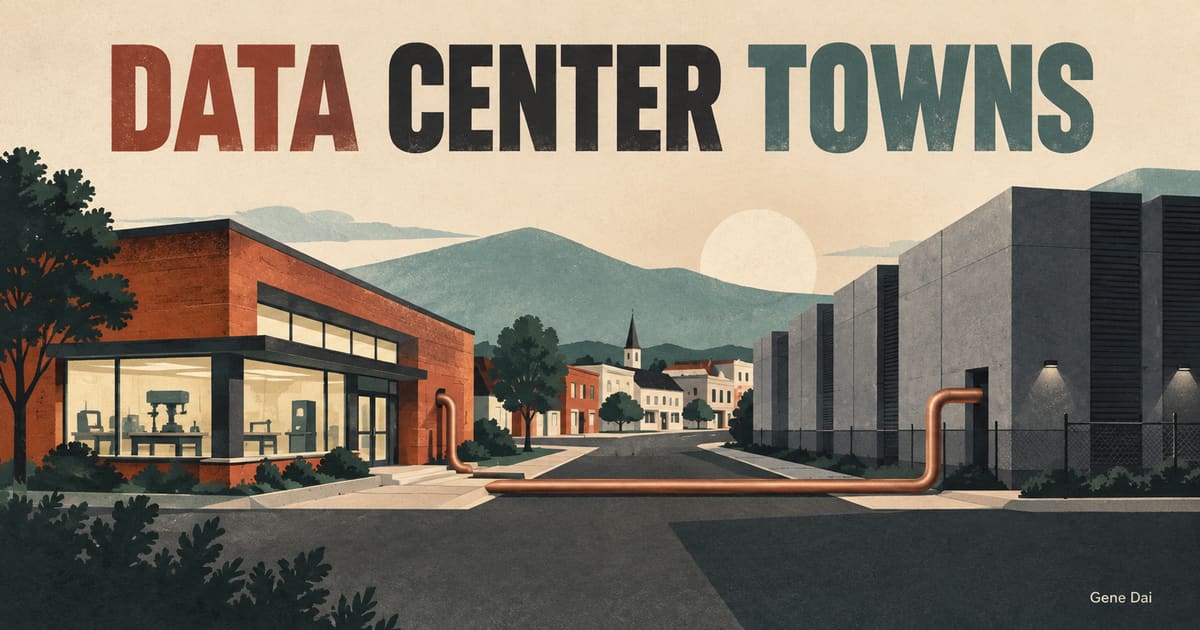
AI-generated editorial illustration.
On October 2, Amazon Web Services chief executive Matt Garman put a new number beside the company’s data center expansion: more than $1 billion for the U.S. communities that host its facilities, to be spent over five years. The Built Together announcement paired free community college with trade training, home energy upgrades, water projects and grants directed through local foundations. It also carried a promise to stop using nondisclosure agreements with government agencies on data center projects.
Four weeks can be enough to complete the shortest course in Amazon’s proposed modular training centers. A worker entering the electrical trade through the usual route faces a very different clock: the Bureau of Labor Statistics says most electricians learn in a four- or five-year apprenticeship, with roughly 2,000 hours of paid work each year. A certificate can be useful without making its holder a licensed electrician. The distinction matters to any town counting future jobs before it has seen a training site, a contractor hire or a permanent payroll.
Another clock had already started. On September 8, Oregon Governor Tina Kotek paused work on requests for state-owned land for new data centers while a state advisory committee considers energy, water, infrastructure and job creation. That was a limited instruction to state agencies, not a statewide ban on data center construction. It nevertheless shows why a company’s community grant and a government’s land or utility decision cannot be filed as the same transaction.
For a resident, the offer becomes real at three counters: a college admissions desk, a contractor’s payroll office and a utility billing department. The national announcement names none of the local agreements behind them yet. A billion-dollar headline cannot fill those blanks.
October 2 attached a community budget to the buildout
Amazon says its new program adds more than $1 billion over five years to the community spending it already makes. Garman’s announcement says the company contributed more than $1 billion to U.S. data center communities in the previous three years. Those are company-reported totals covering different periods and programs; the second figure is a future commitment, not cash already delivered. The public launch does not give a county-by-county allocation or an independent audit of the earlier total.
The new program has three broad parts. The first offers education and training: Amazon aims to connect more than 300,000 people in data center communities to free certificate or associate-degree access and to expand a network of modular training centers. The second would support efficiency improvements in homes and public buildings and water projects. The third would send flexible funding through local foundations for priorities such as roads, fire equipment, housing or schools. Amazon says local residents and organizations will guide those grants.
The program page contains a detail easy to miss in the phrase free community college. Amazon says it will cover the remaining out-of-pocket cost after financial aid for eligible local residents pursuing high-demand credentials. It lists electrical trades, HVAC, fiber optics and IT, but also health care, education, public safety and manufacturing. This is broader than a recruitment pipeline into Amazon. A town should know whether its college agreement covers tuition alone, required tools, transport, childcare or foregone wages before it calls the route free to a particular worker. Those extra costs are questions for a local agreement, not charges Amazon has publicly promised to pay.
Amazon says it has begun establishing college agreements and plans to launch the new offering in the coming months. The FAQ says application processes, eligibility details and dates vary by community and are still being established. A national target of 300,000 connected students is therefore a useful scale marker, but it is not enrollment, completion or employment. Even the unit needs care: access to a degree pathway differs from an awarded degree, and a student may pursue a field unrelated to the data center.
For short trade programs, Amazon reports three modular training centers in operation, six under development and 16 more planned. It says each center can train about 2,000 to 4,000 people a year across courses lasting four to 16 weeks. By the end of 2028, it aims to prepare up to 100,000 learners annually across the network. At full operation, 25 centers multiplied by the top of that per-center range would equal 100,000 training places. That arithmetic is a capacity illustration, not evidence that all 25 centers will open on time, run at the high end, graduate everyone or place them in local jobs.
The proposed centers have electrical trainers, fiber splicers and simulated mechanical galleries. Amazon needs workers to build and run the facilities from which it sells computing capacity. For a county, the useful document is an occupation list: which roles accept a short certificate, which require supervised apprenticeship hours, and which employer will sign the first paid offer?
Four weeks and five years lead to different jobs
An electrical training center can introduce a worker to tools, safety practices, basic installation and a contractor. It cannot compress every legal and practical requirement of a skilled trade into a month. The BLS occupational profile says most electricians learn through a four- or five-year apprenticeship; most states require licensing, and technical schooling can sometimes earn credit toward that path. It projects about 72,700 U.S. electrician openings a year, on average, from 2025 to 2035. That national number includes replacement openings and many industries. It is neither Amazon’s vacancy list nor a count of jobs waiting in a particular county.
A fiber splicing certificate, a data center technician module and a licensed electrical apprenticeship solve different staffing problems. A four-week class may open a paid apprenticeship or a support role for someone who would not start with a two-year program. But the decisive questions land with the contractor: what can this graduate do safely, does the company recognize the credential, and when is the first paid shift?
Amazon says its courses have direct pathways to employment at the company, its construction partners and other regional employers. The wording describes a route, not a guaranteed job. The public launch does not publish a placement rate, starting wage, employer-by-employer hiring commitment, apprentice conversion rate or retention measure. An educator who reports only registrations will make the program look larger than it feels to a resident who completes it and cannot find the next paid step.
The broader list of community college subjects complicates a simple data center jobs claim. A nursing certificate or a public-safety credential can benefit a town without supplying Amazon’s construction crew. That is a legitimate community benefit if residents wanted it. It should be reported as such. Otherwise, a large education-access figure may be used to imply that hundreds of thousands of workers entered a specialized infrastructure labor market when the program was designed to serve many local occupations.

AI-generated editorial illustration. The short course and the supervised trade path have different endpoints.
Amazon’s own timetable creates a measurable sequence. First comes a signed agreement with a college or training partner. Then residents can apply. Then a participant attends and completes a course. A contractor can offer paid work. A worker can enter an apprenticeship, earn hours, qualify under state rules and stay employed. If the course is for a data center operations role rather than construction, the employer and qualifications may differ again. The links between these stages are where local reporting should look. Treating the announcement as the last stage erases most of the work.
The person carrying the cost changes along that sequence. Amazon may cover a course fee. A college supplies instructors and equipment. A contractor must provide supervised work, wages and safety management. A resident still has to reach the site and keep household income intact. The program page names some of these partners, but it does not turn all their costs into Amazon obligations. A town with a workforce shortage can welcome Amazon’s money and ask for a placement agreement at the same time.
Construction peaks before the permanent payroll
Job totals around data centers can be true and still be hard to compare. Amazon’s October 2 post says more than 2,300 people are currently working on construction at two sites in Madison County, Mississippi, and more than 1,500 at a Newton County, Georgia site. It says its facilities will employ more than 1,700 people in Madison County and 400 in Newton County once complete. These are Amazon’s site-specific figures and plans. The two construction counts describe current work at named projects; the operations figures describe expected employment. They should not be summed into an enduring headcount or applied to every future site.
A Virginia legislative study offers a second way to see the shift. Its staff reported that a representative 250,000-square-foot data center may have about 50 full-time workers after opening, roughly half of them contractors, while construction of one building can place around 1,500 workers on site at its peak for a project usually lasting 12 to 18 months. The study is about Virginia’s industry and uses representative examples supplied by data center participants. It does not audit Amazon’s Mississippi or Georgia headcount. Its value is the distinction between a construction peak and operating payroll.
Those periods leave different marks on a town. Construction can bring wages, supply purchases, lodging demand and tax receipts quickly. It can also draw workers from outside the county and compete for electricians already working on housing, hospitals or the grid. Once the site opens, its smaller operations team may hold durable, well-paid jobs. The program serving the building crew needs an answer for workers when that crew leaves: another employer, another project or a route into operations.
The most useful local employment report would publish three counts instead of one: residents hired during construction, residents in long-term operations and residents who used the program to obtain paid work elsewhere. It would show wages and retention where privacy permits, and it would identify contractor roles separately from Amazon employees. That is a proposed reporting design, not a claim that Amazon has committed to those fields. It would let a town judge a broad skills investment without pretending every graduate has to join one operator.
Construction and operations also run on different calendars. A 16-week course started after major electrical installation is complete may be too late for that site but still useful for another local project. A four-year apprenticeship started today might outlast the construction window and serve future maintenance or grid work. County officials and colleges need a pipeline schedule tied to actual contractors and start dates, not just a national annual capacity target.
Training for health care, public safety and manufacturing may outlast a temporary building boom. That breadth is a strength of Amazon’s college plan if existing local employers can hire the graduates. The proof would be offers and wages across those employers, not the number of subjects listed in a course catalog.
The power bill has a longer horizon
Amazon’s new Data Center Commitment says it works with utilities, regulators and grid operators so the energy prices it pays cover its electricity and required infrastructure improvements. It also promises annual publication of energy use, energy efficiency, water use, water efficiency and the share of carbon-free energy. Those are significant commitments. A community grant does not itself determine a utility tariff, and a company statement is not a rate order.
The Virginia legislative study found that existing electric rates at the time allocated current service costs appropriately to data center customers. It also warned that a large increase in data center demand could raise system costs for everyone as utilities build generation and transmission and buy power in tighter markets. In one modeled scenario, a typical Dominion residential customer could see generation and transmission costs increase by an estimated $14 to $37 a month by 2040 in constant dollars. That is a conditional Virginia estimate, not a prediction of an Amazon customer’s bill or proof that current Amazon contracts shift costs.
The scale of the national demand question has changed since that study. Lawrence Berkeley National Laboratory’s 2026 update estimated that U.S. data centers could use 9.5% to 15.3% of the country’s electricity by 2030 across its scenarios, with an 11.8% reference case. The model uses equipment shipments, device power and cooling assumptions. Its numbers describe the whole sector, not Amazon’s meter or one utility district’s forecast. The local test belongs in service contracts and rate proceedings.
Oregon has already moved part of that question into public policy. Its September directive preceded Amazon’s October offer and addressed requests for state-owned land, not every private site. The rate design and siting decisions still require their own public records.
Water has its own accounting problem. Amazon says it has contracted more than 65 replenishment projects worldwide that are expected to return more than 8 billion gallons annually and that it aims to become water positive across its data centers by 2030. Those are company-reported global commitments and modeled future flows. A town deciding whether its supply can serve a new facility needs the site’s actual water source, seasonal withdrawal, cooling design, discharge route and the timing and location of any replenishment. Water returned to one watershed is not automatically available to a household near another site. Amazon’s annual reporting promise could help, but the local figures must exist in a form residents can inspect.
The home-efficiency offer belongs in this same section without being confused with the plant’s power bill. Amazon aims to upgrade more than 30,000 homes and 300 schools or community buildings over five years. It estimates 20% to 40% energy savings for upgraded buildings, while its program FAQ warns that a household’s total monthly bill can still change with rates, weather and use. A family can benefit from insulation and still pay more per kilowatt-hour. Both facts can be true. The program’s effect should be reported through participating households’ measured use and bills, alongside the utility’s rate decisions.
Eligibility will shape who experiences those savings. A homeowner may be able to approve an insulation project directly. A renter may need a landlord’s consent, even when the renter pays the electricity bill. Amazon’s national materials do not yet explain how each local upgrade program will handle that split. A county should publish its selection rules, the type and location of completed work, and the measured change in use. Otherwise, the announced number of homes could rise while households closest to a facility see little benefit. The same discipline applies to schools: an upgrade count says that work happened, while a school’s metered use and maintenance costs show what it delivered.
Oregon puts land and rates on separate calendars
The Oregon instruction is narrow enough to get lost in a national headline. On September 8, Governor Kotek told state agencies to pause work on requests for state-owned land for new data centers. The directive did not halt private land transactions, county permits or construction statewide. Nor could it have been a response to a Built Together offer announced more than three weeks later. The governor’s stated reason was that Oregon needed a coordinated view of land, power, water, infrastructure and jobs before making more state property available.
That distinction matters to a county with a proposed campus on privately owned land. A foundation grant might be negotiated this year while the utility asks a regulator to approve a service agreement on another schedule. A county planning board may review traffic, noise and land use, while state water authorities examine withdrawals. A pause in one channel cannot substitute for a decision in the others. Residents need to know the docket or meeting where each part of a deal can still be changed, and the date after which their comments arrive too late.
The governor’s announcement pointed to Oregon’s large-load rate reform and to an advisory committee that may inform legislation. The Oregon Data Center Advisory Committee is taking comment on preliminary questions through October 24. Its scope includes energy affordability, water, siting, economic development and workforce effects. The committee is gathering input on state policy; it is not adjudicating Amazon’s October pledge or a specific campus application. A comment can ask for site-level demand forecasts and public benefit reporting without assuming the committee can approve a utility tariff.
There is a company case worth hearing in those proceedings. Data centers can bring construction work, equipment purchases, tax receipts and long-lived computing infrastructure; a national program that finances college access and home upgrades could distribute some benefits beyond the facility fence. Delays to land or grid approvals also carry costs for an operator planning capacity. Those possible benefits are strongest when the underlying agreements are visible. A county cannot compare them with a ratepayer’s exposure or a forgone tax payment if the company presents all local value as one national dollar figure.
Before a site is approved, someone has to publish a forecast. After it opens, someone has to compare the forecast with jobs, bills and withdrawals. A public timetable for the permit, utility case, water decision and foundation awards would let residents follow each commitment to the office that can enforce it. Amazon, too, could show where its rate coverage and training partnerships have become binding arrangements.
Community choice stops at the edge of a grant
Amazon says Built Together will route millions of dollars a year through local foundations, with residents and local groups directing the money to roads, parks, fire departments, housing and other needs. This gives people a say over a defined pool of community spending. It does not, by itself, grant a foundation authority over land-use approval, a water permit, utility cost allocation or the tax treatment of server equipment. Those powers sit with different public bodies, under different rules. A town should ask who has a vote at each table.
The company’s new tenets say it no longer uses nondisclosure agreements with government agencies on its projects, hosts open houses and will share plans early. Ending an NDA can make a negotiation easier to scrutinize. It does not publish every contract automatically, settle the merits of a site or guarantee a resident can change a decision. The measure of transparency is the record available before the vote, including projected loads, water use, rate terms and the local-benefit offer.
One older deal shows why the accounting needs a long view. Good Jobs First’s Subsidy Tracker records an estimated $1 billion in property-tax exemptions over 15 years for five planned Amazon data centers in Morrow County, Oregon, approved by local authorities in 2023. This is a watchdog estimate of foregone taxes under a specific incentive arrangement, not a cash grant from Amazon and not a current measurement of the new Built Together program. The figure should not be netted mechanically against a national, five-year pledge. It does show why a county must put company donations, expected tax payments and negotiated exemptions in separate columns.
The accounting question is sharper than whether a billion cancels a billion. The exemption estimate covers one Oregon arrangement over 15 years. The new pledge covers many U.S. communities over five. The town receiving a foundation grant may not be the town foregoing property revenue; even in the same town, a restricted donation may fund a park while a school district loses a tax source it could have used for staff. A local budget comparison needs annual amounts, recipients, restrictions and the public services each revenue stream would support. It also needs the counterfactual: what tax would actually have been collected under the approved deal and what development would have occurred without it? The watchdog record raises a question; it cannot answer all of those county-level calculations.
The state policy hearing and the foundation’s grant meeting may both invite residents, but they decide different things. A grant recipient can report a new fire truck or scholarship. Only the relevant public authority can approve a rate or permit. Residents should be able to see which meeting makes which decision before an open house or grant ceremony is offered as proof of consent.
Meta offers a useful comparison in form, not a winner’s table. Its Future is for Everyone Fund also describes a $1 billion commitment to U.S. data center communities. Meta lists eligible counties, routes applications through ChangeX, asks recipients for measurable outcomes and says a current application window runs from September 14 to October 19. Amazon is instead describing a mix of college access, training centers, efficiency upgrades and locally directed grants whose community application details are still being established. The dollar headlines match, but program windows, spending categories and reporting routes do not. Neither announcement proves an employment or ratepayer outcome.
A town can check the promise in stages
Before a county votes on a site or a foundation awards a grant, it can ask when each promised record will become public. The following editorial table pairs Amazon’s national targets with documents and outcomes that local officials, educators and residents could request. It is a proposed check, not a description of existing Amazon reporting.
| Public promise | First record to request | Outcome to check later |
|---|---|---|
| More than $1 billion nationally over five years | Annual allocation by community, recipient, date and spending category | Dollars received and used locally, distinct from prior spending and tax abatements |
| Free community college access for more than 300,000 people | Named college agreement, eligibility rules and costs covered after aid | Enrollment, credential completion and costs still paid by the student |
| Up to 100,000 trained annually by 2028 across 25 centers | Center opening dates, approved curricula, capacity and partner employers | Completion, paid placements, apprenticeship starts, wages and six- or twelve-month retention |
| Local jobs from construction and operations | Contractor roster, local-hire definitions and expected construction schedule | Resident construction jobs, permanent operations jobs and work at other employers counted separately |
| No added electricity burden for residents | Utility service contract, approved tariff, load forecast and grid-cost allocation | Actual customer bills, utility costs, capacity additions and any stranded-cost exposure |
| Energy and water benefits | Site-level water permit and energy data; household-upgrade eligibility | Metered water and power, upgrades completed and measured household savings |
| Community-directed grants and open engagement | Foundation governance, meeting dates, project plans and public documents before approval | Grants awarded, local decisions carried out and any unresolved siting concerns |
Each row moves from an early document to a later outcome. A signed college agreement is stronger than a press-release goal but weaker than a completed credential. A job offer is stronger than a training seat but weaker than a year of paid work. A rate order is stronger than a corporate assurance, yet billing and load data still have to follow. The record should mature as the project does.
A single return-on-investment number would conceal who receives each benefit. A construction wage, a long-term data center salary, a school grant, a reduced electricity use figure, a tax exemption and a new transmission line have different recipients and time periods. Publish them together, but keep the units separate. The early October records do not yet settle whether an individual town receives a good bargain or one that favors only some residents.
Oregon’s public-comment window closes on October 24. The state will still have to decide what belongs in a permit or rate rule; Amazon will still have to turn its national pledge into local agreements. A resident weighing a four-week course has a nearer deadline. Is a contractor offering paid hours, and will those hours count toward the years the trade requires? The first visible return on the billion-dollar promise may be a paycheck, with a worker’s name and a local employer’s name on it.