
A $100 Million Bet on Engineers Who Can Deploy Claude
On this page 8 sections
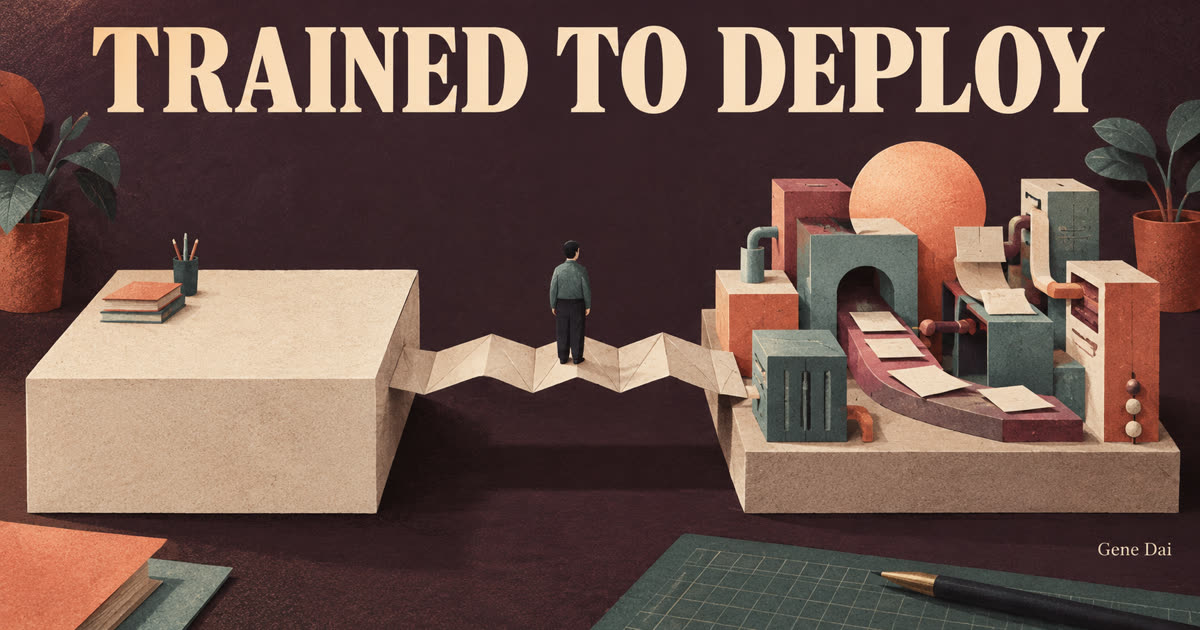
AI-generated editorial illustration.
On October 2, Anthropic opened a residency for engineers from its customers and consulting partners. Accenture, Bain, Capgemini, Commonwealth Bank of Australia, Deloitte, McKinsey, Morgan Stanley and Novo Nordisk are among the first organizations with people in the cohorts. Each candidate must arrive with a named Claude project to lead back at work. The program starts with a simulated enterprise deployment, ends its in-person stage with a graded practical, and then gives those who pass 12 weeks to build a real use case in their own organization.
Anthropic committed $100 million and set a target of 10,000 Frontier Deployed Engineers by the end of 2027. The first full engineer badges are expected in early 2027. For now, the public count is a target, with no reported graduation rate or tally of production systems. The company has put a large budget and a deadline behind its belief that enterprise AI needs people who can make a model work inside an actual business.
When the classroom ends, a bank engineer returns to the bank’s security review, release schedule and customer obligations. A consultant returns to a client account. A model company can teach both to build with Claude, but it cannot, by issuing a badge, transfer responsibility for a customer system. The useful test is who owns that system once the instructors leave.
A nomination, then a real project
Anthropic asks organizations to nominate software engineers who already have strong fundamentals, a record of building with large language models and experience helping colleagues adopt AI. Prior experience building agents is not required. Each nominee brings a named Claude project. This is a way to put training against a live business need rather than a generic course catalog.
The 10,000 target describes a selected population of working engineers, not beginners starting from zero. Employers already trust these nominees with engineering work. A junior developer may have curiosity and time to learn, yet lack the consequential project needed for nomination. Sending only the most established engineers could strengthen delivery while leaving the entry ramp almost as narrow as before.
That entry problem deserves its own budget line. OpenAI’s August analysis of enterprise use found that, six months after adoption, early-career employees sent 13 more ChatGPT messages a week than executives in its customer sample. Message counts measure product use, not engineering judgment, and OpenAI’s customers are not Anthropic’s nominees. Still, the comparison cautions against assuming enthusiasm sits only at the top of a career ladder. If an active younger worker cannot own a project or find a senior reviewer, an advanced residency will not by itself create a path from user to builder.
Steve Corfield, Anthropic’s global head of business development and partnerships, framed the scarcity as people who understand both Claude and how a particular business operates. The named first cohort spans consultants, a bank and a drugmaker. They do not share a single kind of project. A financial institution’s data access and customer controls differ from a life-sciences research workflow; a consulting firm’s engineer may move between clients. That variety is valuable training material, but it makes an aggregate graduate count a thin measure of operating capability.
Commonwealth Bank’s technology chief Rodrigo Castillo said in Anthropic’s launch post that his teams had produced up to three times more code changes in the previous year while using AI tools. That is the bank’s own account of activity, not a quality measure, a causal estimate or an Academy result. Novo Nordisk’s Loic Giraud described Claude work already under way in research and software development. His statement places the training within an existing program; it does not identify which drug-development result a resident will produce. The bank may want production software discipline. The drugmaker may need someone who can work beside scientists and their review process. Neither task is solved by the same generic lab exercise.
Nomination gives the employer a job: reserve twelve weeks of project time, clear data and system access, identify a business owner and say what a successful deployment would change. Anthropic routes eligibility questions through account teams and partner managers. It has not published how nominations are allocated among the first organizations, who pays each engineer’s salary during the residency, or how many project hours are protected from normal work.
Those questions belong on the nomination form. In week four, an engineer should have a deployment window as well as a badge track.
The first cohorts are running in San Francisco, New York and London. Geographic presence shows where the in-person stage is available now. It does not establish regional access to the full 10,000 target or guarantee that an employee in another country can join without travel and time away from work. The firm’s project calendar is therefore part of the admission decision, even if it is absent from the announcement.
Two $100 million promises with different jobs
Anthropic’s new $100 million commitment sits beside an earlier $100 million announcement. On March 12, the company launched the Claude Partner Network with an initial $100 million commitment for 2026. That network offers partners training, technical support, joint market development and certifications. Anthropic said a significant share of that investment would go directly to partner support, including sales enablement and customer-deployment work. It also said its partner-facing team would grow fivefold.
Anthropic says the October Academy builds on that network. The announcements describe different program jobs: a broad partner channel on one side and a smaller, deeper engineer residency on the other. The public pages do not supply a spending ledger that shows whether the Academy commitment is incremental to, overlaps with, or includes parts of the March allocation. Adding the headlines into a verified $200 million of new cash spending would make up an accounting fact the company has not published. Neither commitment is the same thing as money already spent.
The new residency sits above a large certification base. Anthropic’s October announcement says professionals across 46,000 firms have earned more than 175,000 Claude certifications and nearly 4,000 people have completed Basecamp, which teaches the curriculum its Applied AI teams receive at onboarding. Those numbers come from the company. They show reach across partners, not how many of those people can take a difficult customer workflow through security review and operate it after launch.
The residency asks a smaller group to take on harder work. An organization can send many staff through a general certification and still rely on a handful of senior people to connect the model to sensitive data, define evaluation cases, resolve production errors and answer a business owner when the output is wrong. The Academy takes that hidden dependency and turns it into a named role. A useful budget comparison therefore separates three purchases: broad literacy for many staff, advanced project training for a few engineers, and continuing operational support for the workflow they ship. The $100 million headline alone cannot say which purchase a customer will need most.
Finance teams face costs beyond the supplier commitment. A twelve-week resident may remain on the employer’s payroll, miss other project deadlines and draw time from colleagues who provide test cases or security review. Anthropic’s public page does not price a seat or specify reimbursement for that employer time.
Divide $100 million by 10,000 and the result is $10,000 per target engineer. That quotient is arithmetic on two announced figures. It is neither tuition nor a stipend, salary subsidy or actual cost per graduate. Treating it as the training price could leave the employer short of time and money for the project itself.
Twelve weeks beyond the classroom
The program begins with multiple in-person days alongside Anthropic engineers and licensed instructors. Participants work through a simulated enterprise deployment that runs from use-case selection through security review and handover. A graded practical on a new scenario determines whether the engineer earns a Claude Resident Engineer badge. Those who pass then lead their named project at their own organization during a 12-week residency, supported by Anthropic engineers and a peer cohort. A second assessment determines the Frontier Deployed Engineer badge.
That sequence makes the practical more than a vocabulary exam. A new scenario tests whether the participant can apply what was taught when the inputs change. The twelve-week project adds a second environment: the employer’s own systems, colleagues, process owner and constraints. The two badges mark different stages. It would be wrong to call a person fully graduated after the in-person practical when the company describes the second assessment as the final step.
The published outline stops before the hardest assessment details: scoring rubric, pass thresholds, hours with Anthropic engineers, seat cost and the standard for a customer-verified production system. A security rejection, delayed data integration or sensible decision to stop a project could affect a participant’s final badge; Anthropic has not explained how. These are the conditions that make enterprise engineering different from a course exercise.
A project could succeed by stopping a bad use case. In a simulated assessment, selecting the wrong workflow or overlooking a data boundary should matter. In an employer’s live environment, the responsible result may be a narrower automation, a human review step or a decision to postpone launch. A completion target creates pressure to count graduates. The project owner needs room to count a prevented failure as learning, even if it does not produce a glossy deployment slide.
Anthropic’s medical-residency analogy is a useful explanation of supervised practice. It should stay an analogy. Medical licensing has legal, professional and patient-safety institutions outside a single supplier. The Academy’s badge is a company credential. The employer still has to decide who may approve a system, who carries operational liability, and whether its own review accepts the engineer’s work.
For the engineer, the stakes continue after the final practical. A participant could become the person everyone calls when a new agent fails, while their job description and compensation still reflect an ordinary software role. The employer should decide before nomination whether the residency creates a specialist position, a temporary assignment or a skill expected of the existing role. It should also decide how that person gets a peer reviewer. Otherwise the celebrated graduate can turn into an informal support desk for every team that wants Claude connected to its process. The public Academy announcement describes an assessment; it does not set those career terms.
A credential cannot sign off a live system
The difference between a badge and a working system appears at the first handoff. An engineer can make an agent solve an example case. A production owner needs to know what the agent may access, when it may act, what a human must review, how failures appear in logs and which person can change or stop it. These are ordinary operating questions. The model may be the most sophisticated part of the demonstration and still the least difficult part of the handoff.
The OECD’s June 2026 policy brief on AI and skills found that skill shortages were a barrier for many employers in the underlying surveys. About 40% of non-adopting manufacturing and finance employers cited skills as the main barrier, and more than half of non-using small and medium-sized enterprises cited a skills constraint in separate research. The brief also says fewer than 1% of workers need advanced AI skills. Its most recent underlying data date from late 2024, and these figures do not measure demand for Anthropic’s specific residency. They do make clear that an advanced engineer cohort and broad workforce training solve different problems.
Workers using AI who received employer-funded training were more likely to report better performance and working conditions in the OECD’s cited surveys. Respondents reported those gains; the surveys cannot isolate the effect of a particular course. Even a capable engineer needs a business owner who can describe the work and people who will use the result. Without them, a team can ship a technically sound system around a process nobody has changed.

AI-generated editorial illustration. The open tray represents the customer’s responsibility after a training program.
That is why the Academy’s strongest design choice may be requiring a named project before training begins. It forces the employer to pick a workflow that can be examined after the twelve weeks. But the project name alone is insufficient. A company can nominate an engineer for a task that has no cleared data, no decision maker and no place in the release schedule. The more useful nomination document would say what the engineer is allowed to build, which reviews are needed, who supplies feedback from users, and what the customer team must be able to do without Anthropic support by the end.
The handoff concerns authority as well as competence. A provider teaches its preferred methods and product. The customer must retain the ability to challenge those methods, compare alternatives and reverse a workflow that fails. An evaluation set written only by the vendor can pass a system the customer cannot explain. A release approved only by the engineer can bypass a team that bears the operational risk. The residency can lower a skill barrier; it cannot replace the customer’s authority to decide what goes live.
Consultants and customer engineers face different incentives
The cohort list mixes two employment relationships. Commonwealth Bank of Australia and Novo Nordisk can train their own engineers to improve internal systems. Accenture, Bain, Capgemini, Deloitte and McKinsey can train engineers who will work on client accounts. Anthropic gets a stronger delivery channel in both cases. The customer gets a different kind of capability transfer depending on who employs the engineer.
An internal engineer can carry context from one workflow to the next. Their manager can assign maintenance time, move them into an architecture role and teach colleagues how a system was built. The risk is concentration: if one person holds every prompt, evaluation case and vendor contact, the organization owns less capability than its badge count suggests. A second engineer and a documented runbook may matter more than another certification ceremony.
An internal engineer’s time is especially visible in a small company. A large bank can nominate someone while other teams keep the old system running. A small buyer may have one person who understands both its data and its production code. Sending that person to an in-person program, then reserving a project for twelve weeks, can slow ordinary releases.
The OECD’s skills brief identifies small and medium-sized firms as particularly exposed to skill constraints. It does not say the Academy will admit them at the same rate as the large first-cohort names. A partner-trained engineer working beside an internal owner may be a smaller buyer’s feasible first step, provided the handoff is real.
A consultant brings a broader view of deployment patterns and may have access to specialists the customer cannot hire quickly. The risk is a contract boundary. The client may receive a system while the key knowledge stays with the services firm. A twelve-week residency can improve a consultant’s craft and the consulting firm’s sales proposition, but the end client needs its own operators, documentation and right to test changes. A supplier-sponsored credential can make the consultant more credible; it does not settle the client’s renewal economics.
A consulting firm faces its own tradeoff. It can deploy a newly trained engineer to several accounts and spread the cost of instruction, but each customer’s workflow demands local knowledge. If the engineer moves too quickly, the client loses the person who understands why a particular exception was routed to a human. If they stay too long, the project becomes expensive custom service. A buyer should ask how long the named resident remains on the account and who takes over after that person rotates away.
There is a fair counterargument. Customers often need speed more than ownership on day one. A bank or drugmaker may have a promising use case and few staff who understand a changing model platform. A trained consultant can get the first production workflow over the line while an internal team learns beside them. The skill transfer can be designed into the contract. It need not be a choice between doing everything internally and renting competence forever.
The Academy could also feed product improvement. Engineers at customers and partners encounter failures that a model lab does not see in a controlled demonstration: messy permissions, awkward user behavior, latency targets and review burdens. Anthropic’s instructors can learn from those cases, if the organizations can share them appropriately. Customers should know what feedback may return to the model provider and how confidential workflow information is handled. The public Academy post does not describe that arrangement. It is a contract question, not a reason to assume a data transfer occurs.
This employment split is already visible in the wider market. Earlier this year, TCS outlined a plan for thousands of forward-deployed engineers and AWS announced a large embedded engineering organization. The new Academy is narrower: it trains people who mostly remain on customer or partner payrolls rather than promising Anthropic will put 10,000 employees into clients. The difference changes whose balance sheet carries salary, whose manager protects time and whose career ladder recognizes the work.
Microsoft trains teams while OpenAI builds a delivery arm
Anthropic’s program is one answer to the deployment labor problem, not the only answer. Microsoft described a different lesson in its September 17 account of internal AI transformation. Kathleen Hogan wrote that Microsoft initially treated AI like a traditional tool rollout: licenses, training and adoption. Use plateaued. The company moved toward redesigning workflows with the people doing the work. Its Camp AIR program brought cross-functional teams to real business challenges and has scaled to more than 3,000 engineers across the relevant organization, according to Microsoft.
Microsoft also reported selected internal results: an account-manager group had 20% higher close rates and 9.4% higher revenue per manager than a lower-usage comparator; selected supply-chain workflows cut cycle time by up to 75%. Its notes limit those findings to particular groups and periods. They are company measurements, not a controlled estimate for every employee or proof that Camp AIR caused those results. Their relevance to Anthropic’s program is the team around the engineer. The workflow owner, manager, security reviewer and front-line user have to learn together. A residency focused on one excellent engineer can fail if everyone else returns to the old process.
OpenAI has taken a more capital-intensive route. In May, it announced a majority-controlled Deployment Company with more than $4 billion of initial investment. Its plan puts forward-deployed engineers inside customer operations to design and ship production systems. This is an investment announcement, not a verified amount spent or proof of business impact. It also places more delivery labor in a company controlled by the model provider, rather than training a customer’s own engineer through a residency.
After the first deployment, expertise sits in different places. A provider-owned services arm can supply capacity and gather product feedback quickly. A customer-trained engineer can retain context and perhaps lower dependence on outside help. A consulting partner can spread methods across clients. Each can fail if a buyer cannot operate and judge the resulting system. The correct choice depends on the customer’s existing engineering bench, time to production, data boundaries and willingness to pay for continuing support.
OpenAI’s August Enterprise Signals report shows why labs care. Its top 10% of enterprise customers by output tokens per active user generated 8.3 times as many tokens per active user as typical firms in June, up from 2.6 times in January. That is a measure of use inside OpenAI’s customer base. It measures neither profit nor quality or worker learning.
A model company has a commercial reason to help customers move from a few chat sessions to repeatable workflows. The output-token gap alone cannot tell a buyer whether that move paid off. The residency, delivery arm and team accelerator each try to close the distance between usage and reliable work.
The acceptance test belongs to the buyer
Before nominating an engineer, a buyer can agree on a short acceptance sheet. It should be simple enough for the project owner to use during a weekly review and demanding enough to prevent a graduation photo from standing in for a production launch. The sheet below is a proposed buyer tool, not an Anthropic curriculum or an account of any participating company’s internal process.
| Decision before nomination | Evidence at week 12 | Who must sign off |
|---|---|---|
| Name the workflow and its current baseline | A test showing accepted output, time, cost and error rate on representative cases | Business owner and users |
| Define the data and actions the system may use | Permission map, denied-action tests and a way to revoke access | Security and data owners |
| Choose what must remain human | Sampled reviews, escalation route and logs that show who accepted an action | Operating manager |
| Set a failure and rollback condition | Evaluation cases, incident owner and a rehearsed stop procedure | Engineering and risk owner |
| Plan the handoff | Runbook, second trained operator and a change process independent of the resident | Customer engineering lead |
| Price the continuing work | Full model, review, integration and support cost at expected volume | Finance and procurement |
This asks more than an attendance register and leaves room for a pilot to end without a launch. The final decision might be that the project needs another month, a smaller scope or a different tool. Those are valuable outcomes if they prevent a weak deployment. A graduation rate that penalizes prudent stops would reward the wrong behavior.
The same sheet exposes the workload the announced $100 million cannot buy on its own. Customer employees must provide representative cases, review failures and change a process. Managers must allow time. Security teams must evaluate access and data retention. Finance must decide whether the system’s benefits survive human review and support costs. No single engineer can do all of that without authority the employer has granted.
The customer should also ask what survives the resident’s departure or promotion. If the trained person changes jobs, can someone else run the tests, update the permissions and answer an incident? If the only person who knows the system is the person whose name is on the badge, the project has trained an expert and created a single point of failure. A second operator may be a better incremental investment than the next use case.
The acceptance sheet can give the engineer permission to report an inconvenient result. Suppose the tests show that a retrieval step works in a demonstration but fails on permissions in the ordinary system. The week-12 evidence should record that failure and the decision to narrow scope, rather than quietly drop the difficult cases. This is a proposed review example, not a reported Academy project. It makes the project’s learning portable to colleagues even when a product launch is postponed.
Early 2027 offers the first result
Anthropic expects its first full Frontier Deployed Engineer badges in early 2027. That is the first public milestone against which this program can be judged, though a badge total alone will remain incomplete. The more useful questions will be how many nominees entered with a real project, how many completed the practical, how many finished the 12-week work, and what happened to those projects after the instructor’s support ended. The Academy announcement has not promised to publish each of those measures.
Ten thousand engineers by the end of 2027 would be a large specialized network. It would still be a fraction of the people who need to understand AI in their jobs. The OECD’s less-than-1% advanced-skills estimate and Anthropic’s much larger certification count point to a layered workforce: many employees need usable literacy and room to practice; fewer need to build systems; an even smaller number should carry production sign-off. Training one layer does not erase the obligations of the others.
For a customer considering a nomination this month, the first decision fits on one page: the workflow, the engineer’s protected time, the people who will challenge the result and the evidence needed to keep it running. At the end of the proposed twelve-week review, the engineer may return with a badge. On the following workday, a user will open the system. Someone at the customer must know which test passed, which one failed and whom to call before trying again.