
Levent Alpöge Has a Checked Proof and an Unwritten Explanation
On this page 6 sections
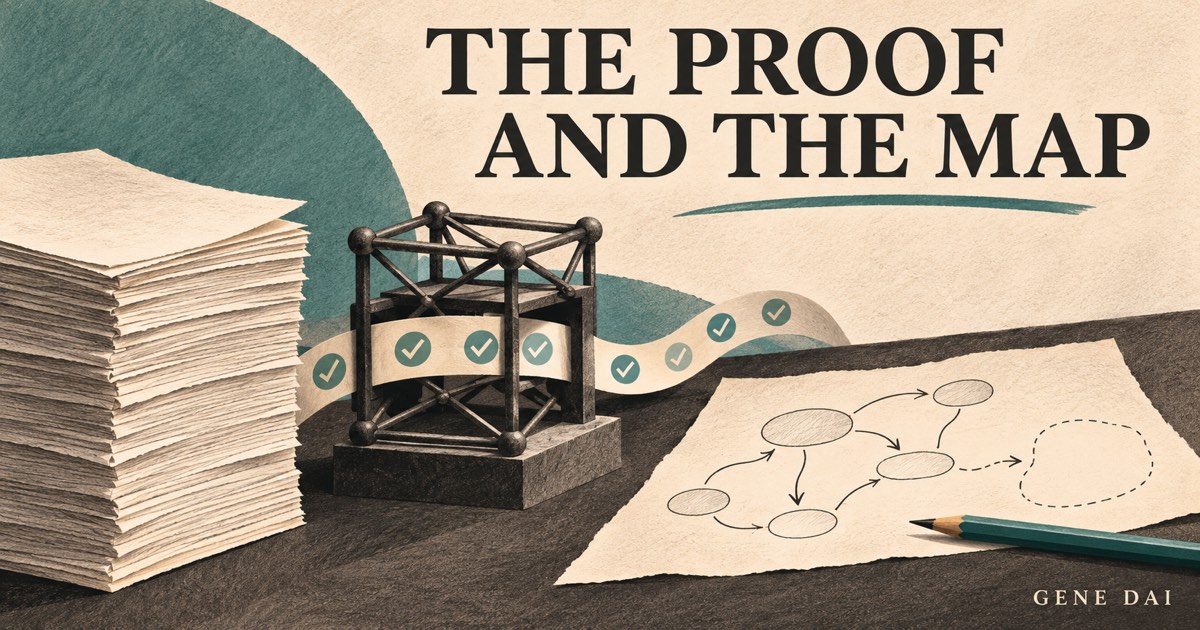
AI-generated editorial illustration.
On November 20, Levent Alpöge put a four-page note on his personal website. It said he believed he had found, working with Anthropic’s Claude, a proof of the Riemann hypothesis. The note pointed to fourteen parts of a compressed Lean archive. Alpöge did not offer a conventional paper that a number theorist could read from first lemma to last. He said the argument was long and that he still intended to understand it well enough to explain it.
The next day, the Lean and Mathlib communities published a joint statement endorsing the formal proof. They said they had full confidence in the result and certified both the statement being proved and the proof that reached it. That is a consequential distinction from a model’s assertion that it solved a famous problem. It is also a narrower conclusion than saying the mathematical profession has finished absorbing the argument, that Anthropic has established exactly what Claude contributed, or that a prize has been awarded.
Alpöge’s own November 20 note frames the result as a collaboration in which he supplied mathematical direction and Claude accelerated near the end. That account is first-person evidence about his experience. The public verification record tests the Lean artifact, not the conversations that produced it. A reader trying to judge the news therefore has two separate questions. Did the code prove the intended theorem under the stated formal assumptions? And what can a mathematician learn, reuse and attribute from a result that arrived in roughly 17 million lines of code before an ordinary exposition?
The first question has an unusually strong public answer. The second has only begun to acquire one. Treating them as the same question would erase the most interesting part of Alpöge’s work: an expert who spent years on number theory used an AI system to reach an artifact that other experts could check before they could comfortably explain it.
Four checks behind the certificate
The Riemann hypothesis is a statement about the nontrivial zeros of the zeta function. The Clay Mathematics Institute’s problem description states it in a compact way: those zeros have real part one-half. That technical sentence has consequences for how tightly mathematicians can describe deviations in the distribution of prime numbers. It does not mean that a program has suddenly produced a practical method for predicting the next prime, breaking encryption, or accelerating every scientific calculation. Those would be different claims, needing their own evidence.
The distinction between a theorem and a calculation is useful here. Checking the locations of an enormous finite list of zeros would add evidence that the hypothesis survives every tested case. It could not establish the claim for all nontrivial zeros, because there would always be more cases beyond the list. A formal proof, if it reaches the right universal statement from accepted axioms, aims to close that gap. The review therefore begins with the exact proposition in the code. It does not begin with the visual size of the archive or the number of machines that ran it.
A proof assistant such as Lean checks a formally expressed claim against a chain of formal steps. The apparent simplicity of the headline is therefore deceptive. If the formal statement were weaker than the historical problem, a codebase might compile and still leave the real question open. If a file introduced an extra unproved assumption, a green build might establish only a conditional result. If the proof relied on a checker bug, its output would not settle the intended claim. A reader should ask what was stated, what was built, which axioms were used and which independent checker accepted the proof.
The joint statement answers those questions as four separate tests. First, it identifies the target as Mathlib’s established definition of the Riemann hypothesis, not a fresh definition invented inside Alpöge’s archive. Second, it reports that dozens of people compiled the library and reproduced the same raw proof export. Third, a file importing only Mathlib isolated the statement and two comparison tools matched the theorem proved by the new library against Mathlib’s target. Fourth, multiple checkers, including Lean’s kernel and independently implemented ones, accepted the inert exported proof. The statement says this last step keeps the checking process away from any hypothetical executable tricks inside the source files.
The sequence also guards against a less obvious failure: the proof can be logically valid while the story told about it is too broad. A checker cannot decide whether a journalist’s phrase such as “AI solved all of number theory” matches the theorem. It can verify a precisely typed proposition. The community’s statement is careful about that typed proposition, which is why a reader should quote its scope instead of borrowing a more expansive slogan from commentary.
That is why the certificate matters. A compiler success alone would be a weaker result. A persuasive prose summary alone would be weaker still. The community describes a chain that connects a recognized mathematical statement to a checked proof term and then submits that term to more than one checking implementation. The statement is a public institutional judgment by people responsible for the relevant formal tools. It does not ask the audience to trust Alpöge or Anthropic on authority alone.
The dates on the check records matter. MIT mathematician Andrew Sutherland’s verification page records a narrower snapshot, explicitly updated on November 20 at 19:45 UTC. It reports that all 175,187 modules compiled, the five headline theorems used only three standard axioms, every module passed a Lean kernel replay, and an independent Rust kernel accepted the full export. At that snapshot, some longer checks were still running and two named checkers could not process a particular inductive type. Those entries describe the state at the page’s recorded update time, not a contradiction of the later joint statement. They are also a reminder to attach timestamps to verification claims rather than treating a live dashboard as a timeless verdict.
Sutherland’s page is valuable for another reason: it states exactly what a passing check means. The formal claims, as written against Mathlib’s definitions, follow from the listed standard axioms according to the kernels used. That is powerful. It still rests on the checkers and the definitions being what the community believes them to be. The joint statement addresses that risk through independent implementations and statement comparison. Neither document purports to tell a general reader what the central mathematical idea is. A certificate can settle formal validity while leaving the route through the proof intellectually opaque.
A number theorist arrived before the model
Alpöge is easy to miscast as either the human who merely pressed a button or a lone mathematician who happened to use a faster calculator. Neither description follows from the public record. His personal site lists a number-theory research career, including work on integral points, Hilbert’s tenth problem over number fields and arithmetic statistics. A Harvard-hosted CV records his appointment as a junior fellow in the Society of Fellows from 2021 to 2025. His current site says he works at Anthropic. Those are professional records and self-descriptions; they support his preparation for the problem, not a claim that every step in the new archive was his.
The specific value of preparation appears in his note. Alpöge wrote that he had long expected to work on the Riemann hypothesis and had tried to become familiar with tools that might someday bear on it. He sketches a connection between a toy setting, Stepanov’s argument over function fields, Fourier-analytic ideas and a chain of theta lifts. A reader outside number theory should resist converting those phrases into a solved explanatory narrative. Alpöge himself says the argument needs simplification and a proper written treatment. The note is a map of what he thinks happened, not yet a guided tour of the full proof.
This history matters because AI-assisted research is often told as a contest between a model and the field. The account here begins with a specialist choosing a problem, recognizing an analogy and steering the system toward a promising mathematical situation. Alpöge wrote that Claude then surpassed him near the finish line. That is a striking first-person report. It cannot, on its own, quantify how many ideas were initiated by the model, how many were selected by the human, or which parts of the long formalization were generated, edited and checked in what order. Public logs of the November collaboration would be needed to audit those shares.
An earlier Anthropic result makes the change in scope visible. In August, the company described an unreleased Claude research model that improved a lower bound for the proportion of zeta zeros known to lie on the critical line, from 41.6% to 67.2%. Anthropic reported that Alpöge and Ralph Furman examined that work and that a Lean formalization was produced. The company also said it did not expect those particular techniques to prove the full Riemann hypothesis. That August result is mathematically adjacent and shows Alpöge’s prior role in validating model work. It is not evidence that the November proof is the same argument, that the model independently solved the full problem in August, or that the later division of labor was identical.
The August project also shows the temptations of model-lab storytelling. Anthropic described many candidate ideas, subagents, numerical checks and a large output-token count. Those are process measures for that earlier experiment. They can help a reader see how a lab organizes search and validation, but they do not measure the mathematical value of each idea. They certainly should not be imported as a token or agent count for November. Alpöge’s newly posted note does not supply a comparable public process ledger. The defensible November claim is simpler: he says he worked with Claude, published the formal artifact and intends to explain the mathematics.
Independent Associated Press reporting described the November announcement as a claim when it first appeared. That was the correct status at the time of that report. The subsequent Lean/Mathlib certificate changes the evidence for formal correctness. It does not retroactively turn an early news report into an account of the later check, or turn Alpöge’s self-report about collaboration into a separately observed transcript. Publication dates matter in a story whose status changed in a day.
Seventeen million lines are an audit problem
The headline size of the archive is arresting, but line count is a poor substitute for understanding. The joint statement calls it a 17-million-line Lean library. Sutherland’s page counts 175,187 modules. Those figures describe a huge formal artifact; they do not say how much of the code is new mathematical insight, routine scaffolding, imported machinery, repeated patterns or generated proof detail. A serious review has to follow dependencies and theorem statements rather than infer originality from volume.
For a mathematical community, that scale changes the first review task. A human referee cannot realistically read every line as if it were a conventional journal article. Formal checking can reduce the burden of finding a hidden invalid inference, provided the formal statement, dependencies and checker are sound. It does not reduce the burden of deciding whether the argument expresses a reusable technique, which earlier results it draws on, whether a shorter exposition is possible, or what future work it makes easier. A 17-million-line certificate and a 20-page explanation could eventually serve different functions.
Sutherland’s MIT page gives an unusually practical picture of reproducibility. Its listed exported proof is compressed to several gigabytes and expands to much more; the page says a local end-to-end comparison needs roughly 100 GB of memory and 70 GB of disk. It records hashes and tool versions so independent groups can compare the same object. This matters because “the code is public” is not the same as “any reader can check it on a laptop.” Expensive verification can still be public and reproducible, but the resources and exact input versions are part of the evidence.
One can see the need for exact scope in the term “generalized Riemann hypothesis.” Alpöge’s note says the method extends to a generalized result. Sutherland’s page clarifies that the GRH in his check record means the version for Dirichlet L-functions. The Lean/Mathlib joint statement certifies the Riemann hypothesis itself. It would be careless to use that one paragraph to certify every generalization a reader might have in mind. A broad name can cover different families of L-functions, and each theorem statement needs to be identified before a claim about it is repeated.
The resource requirement creates a practical asymmetry. A mathematician can read a four-page announcement immediately, but only a team with sufficient storage, memory and technical familiarity can repeat the largest check. Public hashes and logs let smaller groups inspect what was run and compare independent runs without pretending they performed the full computation themselves. That is a legitimate division of labor if the raw inputs, tool versions and failures stay visible. It is not the same thing as every observer personally reproducing the proof.
The exact bytes matter as much as the public URL. A verification team needs to know that the parts it downloaded correspond to the author’s release, that its compiled Mathlib files are the expected versions and that the exported theorem is the one it means to test. Sutherland reports hashes, a Mathlib version and byte comparisons for its check. The joint statement describes a separate file that imports only Mathlib before comparing theorem statements. These measures answer different failure modes. A hash ties an assertion to bytes; a statement comparison ties those bytes to the intended proposition; a kernel check tests the formal derivation.

AI-generated editorial illustration. The four stages stand for statement, source library, formal check and human explanation.
For the general reader, the right analogy is a demanding software supply-chain audit, with a crucial difference: the end product is a mathematical theorem. The analogy helps explain the layers of trust, but it can also mislead. Passing a proof checker is stronger than merely running an application test suite; a checked proof term is meant to establish logical consequence in a formal system. It is weaker than a claim that the system has revealed the conceptual heart of the proof. The distinction is important because “verified” can mean anything from a successful compile to an accepted proof of the exact historical statement. The November 21 statement describes the latter.
The human explanation has started, not finished
Alpöge’s note says he wants to understand and communicate the argument. That is not a perfunctory promise after a machine check. Mathematical proofs do more than settle yes or no. They show why a claim is true, which tools did the work and whether the same idea might solve neighboring problems. Without an account that specialists can inspect in their own language, those lessons remain hard to extract. The formal certificate and the conceptual explanation are complementary outputs. If another researcher wants to apply the method to a different L-function, the formal theorem may provide a dependable endpoint, but it does not tell that researcher which of the thousands of intermediate constructions should be adapted. A concise proof can make that choice visible. Until then, reusing the result is easier than reusing the route to it.
The work of explanation also creates a place for criticism that a binary checker result cannot supply. A reader may ask whether a thirty-line lemma hides the central idea, whether a known theorem has been repackaged in a new notation, or whether a surprising detour is actually necessary. Such questions do not negate a valid formal proof. They decide what the community can learn from it. The answer may change as experts find shorter routes through the archive.
Waterloo mathematician Michael Rubinstein has begun to cross that gap. His project page links a working, human-readable guide focused on the zeta-function case. It says the draft was written with help from Claude, Codex and Gemini and is intended as an aid to studying the Lean proof. Its working status should be preserved. It is evidence that mathematicians are trying to reconstruct a narrative, not a final independent referee report or a replacement for Alpöge’s unwritten exposition. Other readers may find a different simplification; a proof’s best explanation need not be its first.
The early Quanta account reported the announcement while independent checks were still developing and said it would update as mathematicians examined the code. Its timing shows why fast coverage of scientific claims needs a status clock. A first-day story could responsibly say “claim”; a second-day story could cite a formal certification. Neither is entitled to say that the field already understands the proof’s ideas, or that all downstream claims in AI science have been validated.
The Clay Mathematics Institute’s rules add another clock. For a Millennium Prize solution to be considered, Clay requires publication in a qualifying outlet, at least two years after that publication and general acceptance in the global mathematics community. The Lean/Mathlib statement is significant evidence of formal correctness. It is not a Clay prize decision and does not replace the Institute’s process. Alpöge’s four-page note and archive arrived only on November 20. It would be premature to write about the prize as money won, or to equate a day of formal checking with the broader publication and acceptance sequence.
The clocks can diverge for years. Formal-methods reviewers may gain confidence in validity before number theorists agree on a short vocabulary for the argument. A journal may want a readable paper; mathematicians may want an independent route through the ideas; formal methods researchers may focus on checker trust; AI researchers may want a documented account of what the model did. These groups can all be acting responsibly while asking different questions. A news article that collapses them into one applause meter hides the work each group still has to do.
Alpöge’s own language is unusually open about the unfinished human work. He wrote that the argument is incredibly long and that he hopes it can be simplified. He also said the process changed how he felt about a problem that had guided him for years. Those are his stated reactions, and should be attributed to him. They do not license invented scenes of him at a desk, private conversations with Claude, or predictions about his career. The public documents already supply enough drama: a checked result arrived before its author could offer the explanation he wanted to write.
A model-lab result needs its own provenance
Anthropic makes Claude, so it has a clear interest in how this event is understood. The public Riemann announcement came from Alpöge’s personal site, while the independent formal certificate came from Lean and Mathlib. That separation makes the evidentiary chain stronger than a single corporate press release. It also leaves a different question open: what, precisely, should be credited to the model? Alpöge’s account supports a collaboration. The certificate supports formal correctness. Neither, without process records, can allocate discovery and proof labor line by line.
Attribution has several layers. A human may choose a problem, recognize an analogy, formulate a decisive conjecture, request a formalization, reject a bad direction and decide when a proof is ready for public release. A model may propose a lemma, fill a difficult gap, search references, generate code or repair a type error. The public artifact can show the final dependency structure, but a finished theorem file is not a diary of how each idea arose. Even a transcript would need interpretation: a prompt that selects a fruitful direction can be as important as thousands of generated lines. A confident percentage split between Alpöge and Claude would be invented unless the collaborators published a method for assigning one.
An audit of contribution could begin with a dated development record. A dated process account could identify the first appearance of the main ideas, the human prompts that steered the work, failed attempts and the point at which formal checking exposed errors. It would allow outside researchers to compare Alpöge’s summary with the development record. It would still leave judgment about intellectual credit to the field. The immediate value of such a record is methodological: it could show whether another expert, given similar tools, could reproduce the pattern of discovery rather than only rerun the final proof.
One spectacular case is a poor sample from which to estimate a model’s general research ability. Anthropic’s August report described a model assisted by human mathematicians on a related zeta result. The November proof is a much stronger claim about a specific theorem and a specific formal artifact. It does not demonstrate that Claude can autonomously solve any unsolved problem, that an unformalized model answer deserves similar trust, or that model use removes the need for expert judgment. The conditions here were unusual: a highly prepared researcher, a problem with a precise formal target, a massive Lean library and a motivated external community able to verify it.
Those conditions also create a new sort of scientific bottleneck. If AI systems can produce more candidate arguments than specialists can explain, the scarce work moves toward choosing worthwhile problems, pinning source artifacts, checking theorem meaning, independently validating formal steps, writing intelligible accounts and deciding what to teach. That is an inference from this case, not a measured trend across mathematics. The example shows that formal validation can move fast when the ecosystem and community exist. It does not tell us the average cost of doing this across fields that lack such infrastructure.
One should resist a second inference as well: that a checked result means every premise about the world has been checked. The Riemann hypothesis is a formal mathematical statement. A medical trial, a labor-market prediction or a product performance claim includes empirical assumptions that a proof assistant cannot establish from logic alone. The value of this event for AI research is a disciplined chain from a specified claim to a checkable artifact. Its limits travel with the kind of claim being made.
The AP report and Lean/Mathlib statement illustrate why an independent newsroom should keep different verbs for different evidence. Alpöge announced; the communities certified a formal result; reviewers are working to explain; Clay may later assess a prize-eligible publication under its rules. None of those verbs is interchangeable. Using the right one is more useful to a reader than choosing a dramatic single headline for all four stages.
What a reader can check next
A reader without a server capable of replaying the Lean export can still inspect the structure of the evidence. Start with Alpöge’s note for what he claims and what he says remains to write. Read the joint statement for the four certification tests, then the dated MIT verification record for concrete hashes, versions and caveats. The documents have different authors and purposes. Their overlap is stronger evidence than a chain of articles citing one another.
The next material changes are specific. A stable human-readable paper should identify the central lemmas and the prior results on which they rest. Independent specialists should be able to trace that account back to the formal code and say where a simplification preserves the proven claim. Reproduction logs should stay tied to exact archive and library versions. If further generalizations are reported, their precise formal statements need separate checks. A public account of the Alpöge-Claude workflow would help evaluate contribution claims, though it is not necessary for the theorem’s formal validity.
For readers interested in the AI itself, the unanswered questions are operational. Which model version was used? How were candidate paths selected and rejected? What human interventions changed the course of the work? How much of the formal code was generated and how much was edited or independently reviewed? The public note does not answer these in an auditable way. That absence is not an argument against the formal proof. It is a limit on claims about model autonomy, research efficiency and a repeatable discovery process.
Readers need not become number theorists to follow the evidence chain. The practical question is how to evaluate a public scientific claim when the explanation and the certificate arrive in the opposite order from what people expect. Here the formal result has the unusually detailed endorsement of the tool communities. The author himself says the human account is unfinished. Both can be true at the same time, and both are more precise than either blanket skepticism or unqualified celebration.
Alpöge ended his note by saying he wanted to simplify and share the mathematics. Today the note links fourteen archive parts, while the readable paper he intends to write is still ahead of him. The formal certificate gives mathematicians a theorem they can rely on under its stated assumptions. What they can teach from it, and how this kind of collaboration might work again, will depend on the explanation that follows.