
Julie Bornstein Makes the Shopping Agent Ask Before It Buys
On this page 8 sections

AI-generated editorial illustration.
On November 17, Julie Bornstein’s Daydream introduced an AI fashion agent that can keep looking after a shopper closes the conversation, assemble an outfit and prepare a purchase. The company said customers could use it through the iOS app or text message. A Vogue Business preview showed co-founder Lisa Yamner resuming a request for a trip, then changing pieces in a suggested look. It was Yamner’s demonstration, not a reported account of Bornstein shopping, and it was a bounded preview rather than a test of a completed order.
Daydream’s November 9 terms draw a precise line. Asking the agent to prepare checkout does not authorize it to submit an order. The shopper must confirm a specified merchant, items, sizes, shipping details and total or maximum. Approval covers one order, expires within 30 minutes if unused, and must be renewed if the total or material details change. These are published rules. They do not establish that every checkout works smoothly or that the same explanation appears clearly on a phone.
Bornstein has spent years trying to make fashion search feel less like filtering a database. The new agent crosses a different line: it can move from finding a dress to placing an order through a checkout provider. Her product decision turns the last human click into a test of the whole system. Did the agent understand the occasion and size? Did the merchant still have the item at the displayed price? Did a commission alter what surfaced? Did the person see enough to approve the purchase?
Those questions matter more than the launch label. An agent can continue searching in the background and still leave the consequential decision with the shopper. The hard part is making that stop point visible and useful after an opaque chain of recommendations. Daydream has put one answer in its terms. What it has yet to publish is independent evidence of how that answer performs when an ordinary shopper changes a size, rejects a suggested outfit, loses inventory or needs a return.
A second attempt at a familiar problem
Bornstein did not arrive at shopping software from a model laboratory. A Stitch Fix biography lists earlier digital commerce roles at Nordstrom, Urban Outfitters and Sephora before she became Stitch Fix’s chief operating officer in 2015. The company described her remit as spanning customer experience, marketing, warehouses, service and the styling organization. That combination helps explain the current product choice. Style is only one part of a purchase. Catalog operations, fulfillment and customer service decide whether a suggestion survives contact with the customer.
Her first startup, The Yes, asked people to signal likes and dislikes in order to build a personalized fashion feed. TechCrunch’s 2020 launch interview described Bornstein and technical co-founder Amit Aggarwal building the app after an initial $30 million raise. The product depended on a catalog of partner brands and on explicit signals about style, size and budget. The customer told the system what she wanted by accepting or rejecting items; the service then tried to make the next set more relevant.
Pinterest announced completion of its acquisition of The Yes on June 10, 2022. It said it would sunset the app and site as the team worked on Pinterest’s shopping platform. The announcement proves the acquisition and planned product sunset. It does not prove that The Yes had solved personalization or that its technology produced a particular result at Pinterest. An Index Ventures profile, written by a Daydream investor, recounts Bornstein’s and Yamner’s reasons for starting again; those recollections are useful as their own account, not an independent success measure.
The investor profile says Pinterest founder Ben Silbermann approached Bornstein about using The Yes as part of a larger shopping effort, then stepped down weeks after the acquisition. It presents the change in leadership as part of why Bornstein’s work there narrowed. That is a participant account filtered through an investor in her next company. The safer conclusion is that an independent product ended and the team entered a larger platform with different priorities. Daydream gives Bornstein control over the product again, but it also restores the burden of acquiring shoppers, keeping merchant data current and making the business work without Pinterest’s distribution.
Daydream’s June 2025 launch offered conversational fashion search across brands. Bornstein told Vogue Business that people expressed needs involving an occasion and body type, while the earlier system often returned a page of results. The agent is her response to the gap between finding possibilities and deciding what to wear. That account comes from the founder. It has an observable product sequence behind it: Daydream added screenshot-based shopping and Siri search in September 2026, then announced an agent with memory, ongoing search and checkout two months later.
The Yes and Daydream share a founder, a fashion catalog and a personalization thesis. At The Yes, a shopper pressed yes or no on an item. At Daydream, the shopper can describe a need, leave the search running and later approve an order. That is a larger job for the software. Pinterest’s acquisition and Daydream’s financing say little about whether customers spend less time finding a satisfactory item, buy fewer wrong sizes or return fewer purchases. Those outcomes have to be measured separately.
From search results to a standing request
The Daydream release describes a shopper giving the agent a need or an inspiration image. It then searches more than 10,000 brands, proposes an item or full look, offers virtual try-on and can keep working on alerts or later suggestions. TechCrunch’s launch account adds a persistent clothing rack for saved pieces and says the company combines general models with its own fashion-focused systems. These details are reported from the launch and company explanation. The public accounts do not reveal the ranking model, its training data, its error rates or a measured comparison with ordinary search.
Vogue’s preview gives the first half of that chain a shape. Yamner described a trip, the agent proposed looks, and she changed the pieces. Beyond the preview, Daydream says a shopper can state an occasion or budget, then leave a request open for a sale alert or later suggestion. The system must match that request against products, prices and sizes before it prepares an order. The last step, under the terms, is to present that order for approval. Each handoff adds a different failure mode. A correct description of style is little help if the size is unavailable. A good match can become a bad purchase if the price changes between search and checkout.
This is why Bornstein’s decision to move beyond search matters. A search page displays options and leaves most interpretation to the shopper. An agent chooses what to narrow, when to return, what to bundle and which merchant receives the order. It can reduce the work of comparing multiple sites, but it also shifts more of the selection process out of sight. The agent’s usefulness depends on making enough of that process legible for the customer to correct it.
Daydream says human stylists help shape the fashion knowledge behind its suggestions. Vogue reported the appointment of stylist Francesca Sully, while TechCrunch’s account names Francesca Salih. The published names conflict, so this article does not use the appointment to establish a particular person’s identity or role. The broader point is narrower and supported by both accounts: the company says human styling expertise feeds its recommendation system. It has not published how often a human reviews a specific recommendation or how that work changes a measured outcome.
Bornstein told Vogue Business that roughly 97% of searches on Daydream contain no brand name. That is a founder-reported internal statistic, without a disclosed time window, denominator or definition of a search. If representative, it makes the product’s job harder: the system must infer taste and fit from an occasion or mood, then choose from many merchants. The figure cannot establish that the agent does this well. It does explain why Bornstein believes a general shopping assistant may miss the detail that matters in fashion.
The approval that makes an order
Daydream calls the purchase feature Buy for me. Its terms separate three actions that can blur in marketing language: asking for a product, starting checkout and confirming one order. The first creates a recommendation. The second authorizes the service to prepare checkout and share information needed for that task. Only the third authorizes Daydream and its provider to place an order with the identified merchant. This is a contractual description of the intended flow, not a record of a transaction we performed.
The terms require a preview of the merchant, items, quantities, sizes, shipping details, currency and total including tax, shipping and disclosed fees, or a maximum amount when a precise total is unavailable. The approval expires no later than 30 minutes if unused. Changes to the displayed total or maximum, merchant or other material details require fresh confirmation. The language says approval cannot be reused for another order. These constraints make the customer decision more specific than a blanket instruction to shop on the customer’s behalf.
The merchant sets prices, handles payment and fulfillment, and manages returns and refunds. Daydream and its checkout provider prepare and place the confirmed order, while the merchant remains the seller. The privacy policy says the provider receives contact, address, order and purchase-approval information. Buy for me currently uses guest checkout; when a merchant requires sign-in, the shopper can buy on that merchant’s site instead. The customer may experience one conversation, but the work crosses several companies.
That division becomes visible after a mistake. Daydream’s terms direct a customer to the merchant about a return, refund or product problem. A failed agent handoff, however, could leave the shopper asking Daydream whether an order was submitted at all. The customer needs an order status that distinguishes preparation, approval, submission, merchant acceptance and fulfillment. The published terms warn that a payment authorization does not guarantee acceptance or delivery. They do not disclose a measured rate of duplicate attempts, delayed confirmations or support cases. Those are the records a serious evaluation would inspect before describing checkout as effortless. A refund path that exists in a legal document still has to work across the particular merchant and payment provider involved.
Consider an illustrative case, not a reported Daydream transaction: a shopper approves a jacket in one size at a displayed total, and the merchant’s stock or shipping charge changes before submission. The published terms say a material change cancels the prior approval and requires another one. That is a meaningful guardrail only if the customer sees the new detail, understands which order is pending and can stop without losing control of a payment already authorized. The terms also warn that expiry cannot reverse an order already submitted. A pending approval and a completed order have different consequences.
A useful checkout test would log the time and exact details shown at each of those states, then change only one variable at a time. Start with a size that goes out of stock before approval; repeat with a shipping fee that changes after the preview; then let a valid approval expire without submitting. In each case, the question is whether the phone shows a new merchant, total or size before another tap, and whether the shopper can tell if any payment was authorized. A separate test should reject a suggested look, leave the app, and return later to see whether the agent remembers the rejection without treating it as permission to buy. Those observations would connect the appealing idea of background shopping to the costly moments when human control matters. The test would also need a merchant receipt and a return request, because an in-app success message alone cannot establish that the seller accepted the order or that a refund will follow the same route. None of these trials is reported here as having been performed.
No public test in the sources reviewed establishes how often this boundary is triggered, how long the handoff takes, or how the agent explains a failed purchase. Vogue’s preview showed the styling conversation. It did not publish an error-rate study of checkout or a return journey. For a product that promises to act while the user is away, these mundane transitions would be more informative than a demo in which the suggested outfit looks plausible.
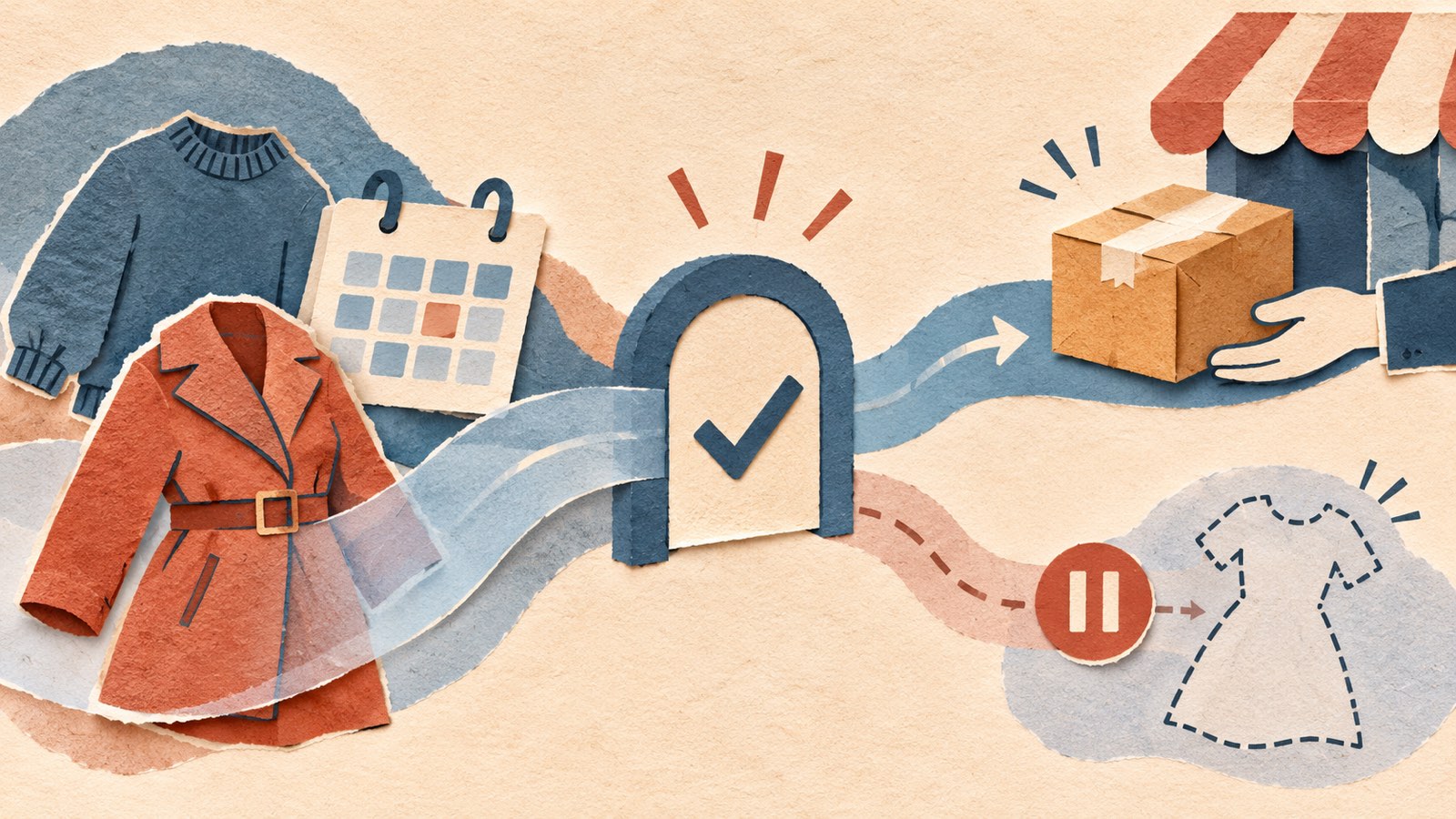
AI-generated editorial illustration. The approval and pause depict the published order rules, not an observed Daydream screen.
A calendar can improve the outfit and enlarge the data request
Daydream’s privacy policy describes optional connections to Gmail and Google Calendar. It says the Gmail permission is read-only but may permit broader access than the purchase-history feature uses. On connection, the service searches a year of purchase-category messages and later mail, with additional order-related searches possible. The company says it retrieves matching text without attachments, sends it through an AI processing provider to decide whether it is purchase-related, stores selected order fields for purchases, and does not save the text of rejected messages in its application database.
The Calendar description is more extensive than a simple reminder. Daydream says it processes all upcoming events and events that ended in the prior twelve months on the primary calendar, including titles, descriptions, times and locations. It says it does not request attendee names or addresses, though personal information can appear in event text. Purchase lines and checked-message records are kept for twelve months under the stated policy; calendar events are kept until twelve months after they end, with open-ended recurring events retained until disconnection. These are policy commitments. We have not inspected the actual permission screen, connected an account or audited deletion.
A calendar could tell a stylist there is a wedding or work trip. Email purchase history could help avoid suggesting another item in a size a customer already rejects. The same access gives the agent and its providers more context to protect. The policy draws a line: connected-account data is excluded from general model training, ad targeting and routine human review. It says disconnection deletes the connector’s active database data and revokes its token, while provider caches, abuse records and encrypted backups may last longer under specified limits.
That line matters because other Daydream data is handled differently. The same policy allows use of ordinary prompts and interactions to improve the service and describes hashed contact identifiers and conversion information for advertising measurement, subject to choices and law. It says the connected-account restrictions take precedence over those broader permissions. Readers should not flatten that into either “Daydream trains on your inbox” or “Daydream collects no shopping data.” The published document distinguishes a connected inbox from the chat and transaction records generated while using the product.
The policy’s existence is not proof of security or comprehension. A useful independent examination would compare the permission prompt, actual fields sent, deletion behavior and provider retention against the text. It would also check whether the service gives a shopper a sensible outfit without connecting either account. Daydream says connection is optional. If the core shopping experience requires more context than a user wants to share, that is a product problem as well as a privacy problem.
Commission behind every recommendation
Daydream is free to download, and Bornstein told Axios it earns a commission on sales made through the platform. She said the company does not sell ad space. In Vogue Business, she said commercial relationships do not influence which items the agent recommends and that Daydream receives the same commission level on purchases. These are attributable statements by the founder. Neither publication disclosed a ranking audit that could independently verify them.
Daydream’s terms allow compensation tied to referrals, engagement or transactions, including affiliate commissions, and say paid connections will be identified where required. Its privacy policy describes conversion measurement and reporting to participating merchants. These documents do not prove that a commission changes the order of results. They do establish a commercial relationship that a shopper ought to understand when the same assistant recommends a jacket and then offers to buy it.
There is a difference between a uniform percentage and neutral ranking. Even if Daydream earns the same rate from every completed purchase, a recommendation system might favor products with more reliable inventory feeds, lower return risk or easier checkout. Those factors could improve the shopper’s experience; they could also concentrate visibility among participating merchants. The product could earn more in absolute dollars from an expensive item at an equal percentage rate. None of these possibilities establishes improper behavior. They show why Bornstein’s statement about commission needs a test of recommendations and merchant coverage rather than a simple yes-or-no answer about ad placement. The ranking and the eligible catalog are separate things to disclose.
The business model makes eligibility and ordering worth inspecting. Daydream could search the full public fashion market, its partner catalog or a changing subset; the launch material does not specify the full ranking universe. A relevant item from a brand without a commercial relationship might appear, or it might never enter the candidate set. A preferred item could be out of stock with one merchant but available elsewhere. A curated catalog can be useful if product data and checkout access are reliable. The shopper needs to know what the catalog excludes and why one available alternative ranks above another.
The counts in the launch coverage need careful labels. Daydream says more than two million shoppers have used its earlier discovery service since June 2025. Axios reported 325 direct retail and brand partners representing more than 10,000 brands and three million products. The current App Store description says two million items, so public catalog counts are not perfectly aligned. None of those figures is the number of weekly agent users, completed purchases, repeat buyers or satisfactory recommendations.
The counts suggest broad reach, but a customer needs a narrower measure: what fraction of products matching a size, budget and delivery date does the agent surface? A large catalog may improve choice while making ranking harder to explain. Bornstein’s claim of uniform commission rates can be checked against commercial terms and recommendation behavior. The public product count cannot verify it.
The size and return problem is still offstage
Fashion recommendations carry an unusually specific error cost. A model can correctly identify a silhouette and still choose a size that does not fit. A virtual try-on can show how a garment might look in an image without measuring its fabric, cut, movement or comfort on a person. Daydream’s launch material describes virtual try-on and personalized fit preferences; it does not present a published, independently run fit-accuracy study or return-rate comparison. The distinction protects the product from a false promise as much as it protects the reader from one.
Bornstein’s history makes the missing measure especially relevant. Stitch Fix combined data with human stylists and physical shipments. The Yes learned from explicit product likes and dislikes. Daydream wants to hold a more persistent sense of taste across a large multi-brand catalog. Each generation changes the data available to the service, but none removes the practical problem of size and satisfaction. The product may learn from a rejection or return; public material does not show whether it does, how quickly, or with what effect.
The company also has to reconcile three product clocks. A shopper’s preference may be stable over months. Fashion inventory and prices can change during an afternoon. An order must be correct at the moment of approval. The approval rules explicitly acknowledge one part of that problem by requiring a fresh confirmation when material details change. Search and recommendation quality require separate checks for stale listings, unavailable sizes and changed shipping terms. The available launch accounts do not publish their frequency.
Vogue Business reported that Daydream had not disclosed conversion or retention figures needed to assess repeat purchasing. That is a more useful absence to record than pretending the two-million-shopper count measures agent adoption. A product can attract curious searchers and still struggle to earn recurring trust at checkout. It can also work well for a narrow cohort without becoming a general fashion habit. The disclosed figures do not distinguish those possibilities.
Why a specialist agent might matter
Daydream’s wager is that fashion needs more structured product knowledge than a general-purpose assistant can supply. Bornstein described to Vogue Business a system that has to understand how brands relate aesthetically as well as compare prices. Daydream’s earlier September screenshot and Siri launch showed the same specialization from another angle: it tried to turn a saved image into shoppable pieces and alternatives. The agent adds memory and an ongoing task to that retrieval work.
Specialization could help with requests that conventional filters handle badly: an outfit for a particular event, an alternative to a saved picture, or an item with a familiar style at a lower price. That remains a product hypothesis. A general assistant could reach more stores; a retailer’s own agent could know its inventory more precisely. Daydream has to show that its catalog and fashion data improve the final choice enough to earn a place in a shopper’s routine.
The competition is already moving. Vogue Business reported plans by Zalando for an agent that would buy across retailers from 2027, alongside brand-owned assistants and general consumer agents. Those are announced plans and adjacent products, not evidence that Daydream has lost or won a market. The comparison that would matter is narrower: give shoppers the same real request and measure product relevance, size accuracy, total cost, completion, reversals and satisfaction across systems.
There is also a distribution question. Daydream is available through its app and SMS, while its privacy policy describes embedded “Powered by Daydream” experiences on merchant sites. Embedded reach may bring the assistant closer to a purchase, but it changes who controls the context. A merchant-site visitor may see recommendations in a narrower assortment than an app user. The policy says both Daydream’s and the merchant’s privacy rules can apply. The company has not published a cross-surface study showing whether the same shopper gets the same ranking, disclosures and approval experience in each setting.
What the launch proves and what it leaves open
The November 17 release, current terms and US App Store listing establish that Daydream is presenting an agent product with a purchase flow. Independent reporting establishes that the founders demonstrated and discussed it with journalists. The documents also give a real approval rule that can be checked later. They do not establish independent consumer outcomes. The public record is strongest on product scope and written boundaries, weaker on repeated use, recommendation quality and transaction reliability.
The questions can be made measurable without inventing an industry benchmark. For search quality, run identical requests with size, budget, occasion and shipping constraints; record which returned items satisfy them at the merchant site. For recommendation independence, compare the order of commercially connected and unconnected items under stated preferences, if the full eligibility set can be observed. For checkout, test a changed price, unavailable size, expired approval and merchant requiring sign-in. Record whether the customer receives a clear new choice and whether any order was placed without it. For privacy, inspect the actual connector permission and deletion path. These are proposed tests, not tests performed for this article.
The most important denominator is repeat decisions. How many people who used the new agent in its first complete month return for a second shopping task? How many approve a purchase, and how many of those purchases generate a return or support request? What fraction of suggested items was available in the stated size when the customer acted? A two-million historical discovery audience does not answer any of these. Nor does a demo in which the founders know the desired outfit.
Even a later success number would need context. A completed purchase rate can rise if the agent shows fewer, safer items, if promotions make products cheaper, or if it reaches shoppers who were already ready to buy. A lower return rate could reflect a different product mix rather than better size advice. A useful comparison would follow similar requests across the old search experience and the new agent, report how many people encountered each, and include returns and support work after the initial order. Bornstein’s claim is about a better decision, so a checkout count alone would understate the work and overstate the proof.
At the point of order, Daydream’s terms require the merchant, size, shipping details and total to be shown before the shopper confirms. A changed amount calls for a new approval. That is where Bornstein’s agent has to earn trust: the shopper returns after leaving it to work, can see exactly what it chose, and can decline before the order is submitted. The written rule exists. A public record of how it holds up under ordinary mistakes does not yet.