
Canva Combines Product Teams as 1,271 Workers Face Change
On this page 6 sections
AI-generated editorial illustration.
On November 3, Canva published a note from co-founder and chief executive Melanie Perkins to its staff. 1,271 people, or 22% of the company, would be affected by a reorganization. Some would take changed roles, others would be asked to move to a central hub, and some would leave. Product, Growth and Platform would become one Product organization. At a company expanding its AI products, that decision changes how work reaches customers and where the people who built it will go.
The company note leaves the central arithmetic unresolved. It does not say how many of the 1,271 will depart, move or take a changed job. A headline calling them all layoffs would miscount exits; a headline about harmless reshuffling would erase the cost of moving or learning a different role. Perkins says growth slowed for the first time in a decade. She does not allocate the reorganization among AI, competition, product complexity, cost and location decisions.
Perkins described a practical problem: improving one piece of Canva’s product could require handoffs across Product, Growth and Platform. Her answer is to combine those groups, widen roles and reduce layers. She also wants Sydney to become the primary home for more product teams and expects most hybrid employees to spend roughly two or three days a week in an office from January. These are distinct levers. A merged reporting line can reduce handoffs; relocation changes the pool of people who can do the work; fewer layers can shorten decisions but also remove experienced coordination.
The plan puts a common software ambition under a sharp test. One team is supposed to take a customer problem from model to interface to purchase and publication. The people who owned narrower pieces face a different job or destination. Canva has announced the shape; the output, worker destinations and cost will come later.
An affected count with three different outcomes
The 1,271 figure is the denominator for the announcement, not a published redundancy total. Perkins wrote that some people would have their roles changed, others would be asked to relocate, and some would be leaving. There is no numerical breakdown, no final organization chart, no team-level distribution and no account of how many employees will accept a new role. The company says teams in 37 countries face different local requirements, so the timing and procedure will vary. An exact global exit count cannot be calculated from the note.
A broader job can keep a person on payroll while changing their skills, training time and manager. A move to Sydney can end an employee’s tenure even if the job survives. A departing specialist may receive severance while Canva loses the history behind a product decision. Each route has a different cost for the person and a different effect on the company’s capacity. The 22% headline prices none of them.
Canva specified support for people who leave. It promised at least six months of salary, inclusive of statutory entitlements, regardless of location. Recent joiners would lose the one-year vesting cliff, and workers in countries where Canva provides healthcare would keep that coverage for 12 months. Departing employees can keep their company MacBook, receive career coaching and one year of LinkedIn Premium, and opt into an alumni directory shared with investors and partners. The company also announced a US$10,000 Canva Collective Fund grant for eligible departing workers who want to start a business or community project; applications close December 14. These are disclosed terms. Canva has not shown how many people will use them.
The support package is substantial enough to be part of the business decision, not a footnote to it. Six months of salary creates an immediate cash obligation. Continued healthcare and career support extend the company’s responsibility after employment ends. The opt-in directory might improve placement, but Canva has not reported its uptake or the number of people who find another role through it. The grant has a fixed amount per recipient, yet no disclosed applicant or award count. A complete account would keep commitments, take-up and outcomes in separate columns.
The distinction between an offered route and a viable one matters most to the employees who must choose. A role can be nominally available but require a move, a new specialty or an office schedule that changes care arrangements. A person can receive an exit package without wanting to leave the work they built. Canva has described the support it intends to provide; its note does not include employee testimony or a survey of preferred outcomes. Reporting a preference on their behalf would invent a voice that the public record does not contain. The observable next step is a count of offers, acceptances and departures, separated by location and type of change.
There are also two clocks. Canva scheduled an all-hands meeting for November 10, followed by organization meetings from November 11. Managers may know where a role sits before a person knows whether relocation is viable. The announced January office expectation starts later. A reader should resist drawing a finished staffing map from a note that itself says conversations and local processes still have to happen.
The merger changes who owns a customer problem
Perkins’ most concrete organizational diagnosis was that Canva’s product work had been divided into narrow areas of ownership. A change to one part of the experience could pass from Product to Growth to Platform. The company says these handoffs made it harder to solve larger customer problems and deliver a unified product. Its proposed remedy is one Product organization with broader roles and fewer layers.
The company has a credible reason to care about integration. In a Visual Suite update, Canva said people create more than one billion designs a month on its platform, with more than 100 million using Presentations monthly. Its enterprise business had doubled over the preceding year, by Canva’s account. Those measures describe product scale and commercial direction. They do not disclose operating margin, per-user revenue or how many people are needed in each product team. They do explain why a small discontinuity between a document, sheet, presentation and website can touch many workflows.
An end-to-end product owner is useful only if the team can influence the whole chain. Consider a marketing group that moves from a whiteboard to a brief, a budget sheet, a presentation and a published page. Canva’s product story promises that the project can remain in one system. An internal team that controls only the editor cannot fix a broken data import, a confusing trial-to-paid step or an unreliable publishing service. Combining groups could place these decisions with the same leadership. The benefit is a hypothesis about handoff cost until the company reports results.
Specialists exist because the problems differ. Growth teams know pricing and conversion; platform teams own reliability and shared services; designers and engineers protect the quality of an individual workflow. A wider role might help an employee cross those boundaries. It might also load three specialties onto one desk. Removing a management layer can shorten a decision while pushing its coordination work onto senior individual contributors. The tasks do not vanish when a box disappears from the chart.
Canva has not published a before-and-after measure for handoffs. There is no median time to ship an integrated feature, rate of customer complaints crossing product lines, service reliability trend or count of ownership disputes. Those measures could test the merger. Today the company has named a friction and proposed a management fix; a gain from smaller teams remains unproved.
A customer sees the boundary more directly than an org chart does. In the same Visual Suite update, Canva presents DocuSign’s brand operation as an example of a small design team supporting hundreds of marketers through a shared, self-service design system. The account comes from a Canva marketing page, so it does not independently establish savings or customer satisfaction. It does identify a workload a combined product team might have to serve: a brand kit, a document, a presentation and a publishing step that must keep the same rules. If users have to repair the output by hand at each boundary, internal ownership consolidation has not solved the customer problem.
There are several plausible ways the merger could work. A single group might prioritize a stubborn cross-product bug faster because it no longer negotiates between three vice presidents. Shared engineers might make reusable editing controls available to every format. Or a broad roadmap might pull attention toward the largest product while smaller services wait longer for fixes. The note announces a structural response; it does not rank these outcomes. A useful quarterly review would publish a few comparable customer journeys, the time they took before and after the change, and the defects or support requests that followed. Faster shipping with more rework would be an incomplete win.
The hiring plan matters as much as the reporting line. Canva says it wants broader ownership, but the note does not say whether a designer, engineer or marketer can move into a wider product role through training, or whether those jobs will be filled through external hiring. A merger can create a short period when experienced people are still employed but no longer know who owns their work. It can also expose genuine overlaps that are hard to see when teams keep separate roadmaps. To distinguish the two, the company would have to count internal moves, open roles, external hires and voluntary departures over the same period. A count of eliminated boxes would tell little about the skills left inside the new group.
The location change sharpens that question. Bringing more product teams to Sydney can make discussion faster for people in the same room. It can also narrow recruitment to those able to relocate or work in that hub, while teams in other countries continue serving local customers. Canva says it will keep investing in a global team where proximity to markets matters. Which decisions need co-location and which need local knowledge remain unresolved in the public plan. If a customer problem crosses markets, a Sydney-centered product group still needs people who understand the customer elsewhere. The number of office days is therefore a staffing and product-design choice, not only a workplace policy.
AI makes the product boundary harder to draw
Canva is developing its own models while keeping partner models and conventional design software in the product. Its October 21 account of Canva Research describes a research lab of more than 160 scientists and engineers within a broader 400-person AI unit. Canva said its AI tools had been used more than 36 billion times. The unit measures use of features, not paid customers, completed designs or revenue attributable to AI. A team trying to build the next feature must decide where model quality, editing controls and product usability meet.
The company says it developed a more efficient image-to-video system that yields 70% more generations per GPU-hour than its earlier baseline. This is an internal efficiency measure with a defined technical denominator. It does not reveal total GPU expense, quality-adjusted cost per accepted design or gross margin. A cheaper generation can support a free tier, a lower price or more usage. Which outcome matters to the business depends on whether users can take the result into a finished workflow.
At Canva’s scale, even a small difference in generation cost can matter, but the published numbers cannot produce a margin estimate. The 36 billion AI-tool uses are cumulative and may include many kinds of features; one billion designs a month is a separate flow measure. A use might help with a draft, an edit or an export. Dividing one by the other would mix time periods and units, then make every design look like the same AI workload. A product owner needs a narrower cohort: the same type of project, the model calls it consumed, the human edits required and whether the finished work was published or bought. That cohort could connect engineering efficiency to customer value. The public figures do not.
The October 22 launch of Canva Craft adds a second decision surface. Canva says its in-house image model can generate at 2K resolution, is available in Canva and through a public API, and was evaluated using more than 25,000 image comparisons by internal designers and researchers. The company also cites a favorable third-party ranking. These are vendor descriptions of capability and evaluation. They do not establish that the model is cheaper than every alternative for Canva, or that it improves customer retention. They do show why a product team cannot treat model development as a laboratory isolated from interface, editing, safety and developer distribution.
Craft also creates an ownership question inside the new Product organization. The team selling API access wants dependable latency, pricing and developer documentation. The team building Canva’s editor wants outputs that remain editable and comply with a customer’s brand rules. A research team may optimize a model against designer judgments, while a support team sees complaints about a failed campaign asset. Those are related feedback loops, but they are not the same metric. Merging reporting lines can make the loops easier to join only if someone decides which customer failure should change the model, which should change the editor, and which requires a person to review an output. Canva has not published that decision rule.
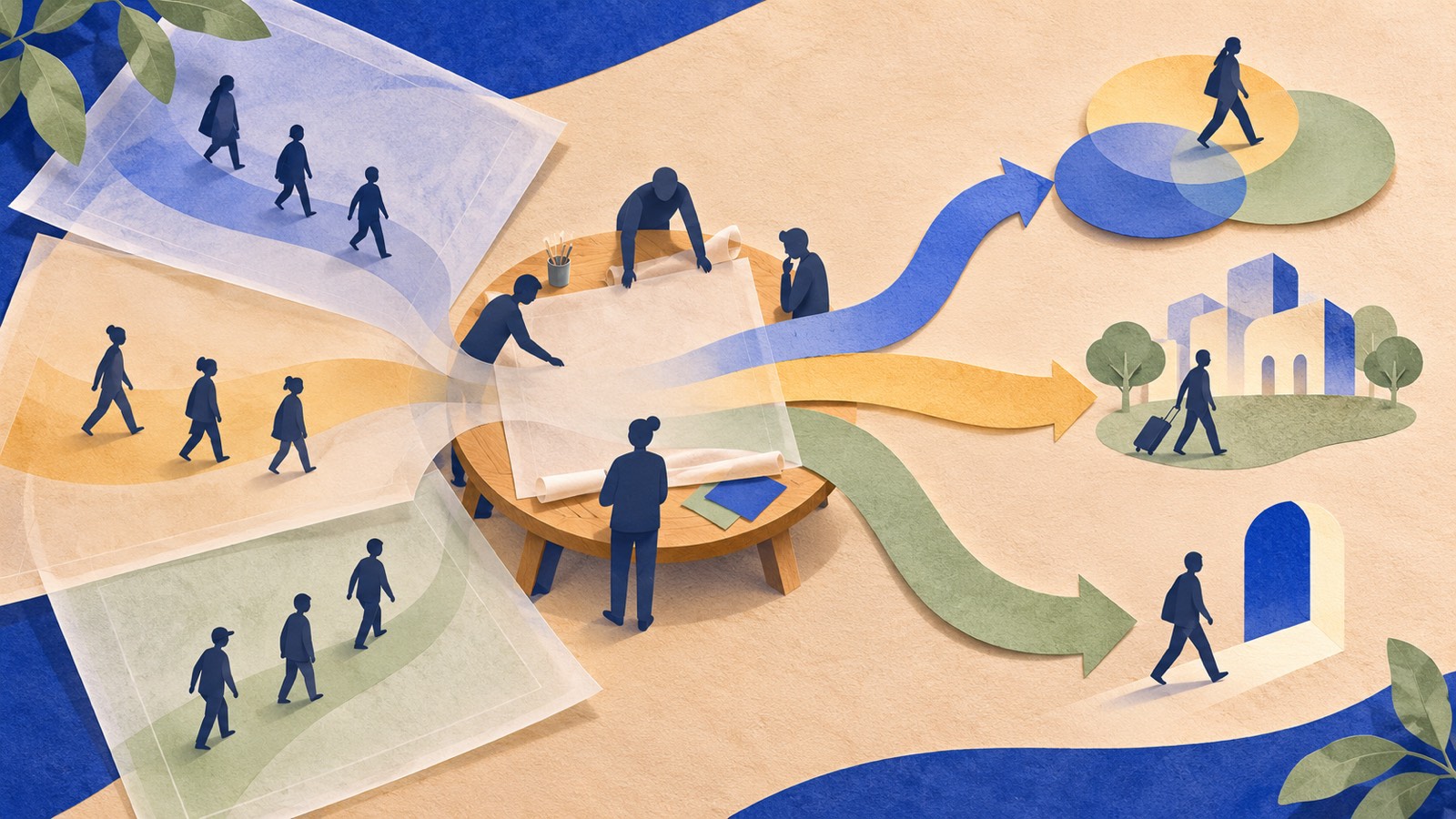
AI-generated editorial illustration. The paths explain possible worker outcomes, not their undisclosed counts.
Canva’s AI 2.0 announcement describes conversational design, editable layered output and workflows that connect to outside tools. The public product description is ambitious: a user can start with an idea and move toward a finished deliverable without exporting it across several services. A model that produces attractive first drafts is one component. Connectors, permissions, brand rules, review and publishing are others. Each sits on a different part of the old organizational map.
This makes the Product/Growth/Platform merger more than an internal tidying exercise. It puts model cost, user adoption and delivery quality closer to one product decision. Yet the November note does not say which work will disappear, which work will expand or how AI specifically affects the 1,271 people. Canva is both investing in AI and changing its workforce. The public evidence supports the coexistence of those decisions, not a headcount attribution to model productivity.
Rivals show a different kind of convergence
Figma provides a useful competitive contrast, with a limit. On October 15, its co-founder and chief executive Dylan Field introduced workflows that bring design, code, context and agents closer together on one canvas. The product direction resembles Canva’s ambition to keep work within one environment, but the customer tasks and business models differ. Figma’s post says AI can make a proof of concept cheap while leaving the harder work of deciding what should ship. That is a product claim, not evidence about Canva’s staffing choices.
Figma’s 2026 AI report supplies a wider view of the people using these tools. The company says the report draws on 8,403 survey responses and 639 qualitative interviews across several years. In its latest wave, 41% of respondents said AI meaningfully changed how teams work together, compared with 7% two years earlier. It reported that developers doing design work rose from 44% to 60%, while designers participating in development rose from 21% to 41%. These are survey results from Figma’s audience, not a census of the software industry or a measure of Canva employees. They make broader roles plausible; they do not prove every specialist can be removed without consequence.
The survey also describes the problem from the builders’ side. A designer who can join development work has a wider range of tools; that does not mean they can maintain every service behind a finished application. A developer who can work on visual design still needs feedback about the user’s task. The apparent overlap in job activity can improve collaboration, or it can hide a new unpaid review burden. Figma measures reported participation, not hours, defect rates, pay changes or promotion paths. Canva’s reorganization would need its own evidence about how much cross-role work its employees actually take on and whether the people doing it have authority to make the final call.
Adobe’s research on creative work complicates a simple replacement story. Across two snapshots of US creative job postings, Adobe reported an 8% increase, from roughly 10,500 in September 2025 to 11,300 in April 2026, while postings explicitly requesting AI skills rose from 10% to 15%. Adobe also surveyed 1,433 working creatives and 3,300 people training to enter creative work. Its research has different samples, dates and methods from Figma’s survey or Canva’s staffing note. It cannot tell us whether Canva’s affected staff will find similar jobs. It does suggest that AI skill demand and creative employment can rise together in a market even while an individual company shrinks or reorganizes.
The research reports that mid-size and large employers were more likely than small ones to mention AI skills in creative postings. That difference can widen the options for an experienced employee with both craft and tool knowledge, but a job ad is still only an expression of demand. It does not show that a Canva employee in Sydney, Manila or another location can take the role, earn the same pay or retain a comparable career path. Canva’s alumni directory and career coaching are attempts to bridge that gap. Their practical value will depend on placements, not the number of names placed in a list.
The word “generalist” blurs several changes. Canva wants broader accountability inside its product organization. Figma sees more cross-role work among its surveyed users. Adobe’s job-posting snapshots still show demand for creative specialists with AI skills. These measures come from different populations, and none predicts how many of Canva’s affected employees will find another job. Together they warn against assuming that a wider internal role has erased the market for depth.
A decision matrix for the reset
The announcement is early enough that a testable ledger is more useful than a verdict. The table separates what Canva has said from what a product leader, worker or investor would need to observe. It is an editorial measurement framework, not a claim that Canva has adopted these metrics.
| Decision | Disclosed now | Evidence needed next | Wrong shortcut |
|---|---|---|---|
| Workforce disposition | 1,271 people, 22%, affected by role change, relocation or departure | Counts by outcome, acceptance, location and date after local processes | Calling all affected people layoffs |
| Product ownership | Product, Growth and Platform move into one Product organization | Time from customer problem to shipped fix; handoffs and owner disputes | Assuming an org chart removes coordination work |
| AI investment | 160-plus researchers, 400-person AI unit, model and product launches | Quality-adjusted cost, accepted outputs and product retention | Treating uses or GPU throughput as profit |
| Worker support | Six-month salary floor, stated benefits and US$10,000 grant option for departures | Eligibility, uptake, placement and actual payouts | Equating an offered benefit with an outcome |
| Location | Sydney becomes a larger product hub; January office expectation of roughly two to three days | Moves accepted, retention after moves and team coverage | Treating relocation as a neutral role change |
A founder or product leader could apply the same frame without Canva’s scale. If three teams are merged, record the handoff that disappeared and the new work someone must absorb. If a model shortens the first draft, measure the review and correction effort. If a wider role is offered, report whether a person can take it without an impossible move. Then keep savings, product performance and worker outcomes in different columns. The model is especially important when a company says a smaller team will move faster; speed is an output to test, not a property of smallness.
The matrix also protects against a tempting comparison between unrelated numbers. The 1,271-person affected group is a one-time change to an employee population. The 36 billion AI uses count accumulated product activity. The six-month salary floor is an obligation tied to departing workers, while the 70% GPU-hour improvement is a model-engineering result. None can serve as the denominator for another. A sentence such as “AI allowed Canva to do the same work with 22% fewer people” would require a verified exit count, a defined work output, a comparable period and a causal analysis the company has not supplied. The simpler, defensible account is that Canva is reorganizing amid a technology and growth transition.
Canva’s November meetings will clarify the organization. The January office change may reveal how much product talent can remain or move. Later releases can show whether the combined group delivers fewer handoffs and a more coherent experience. An employee placed into a broader role might gain real authority. Another may discover that the new job requires a move or skills they cannot acquire in time. Both are outcomes of the same plan, and the public note cannot yet count them.
The work still has to land somewhere
Canva’s decision arrives at a strange point in software history. It sells tools that allow small customer teams to create more visual work. It is building its own AI models to lower generation cost and improve control. At the same time, it is changing the structure of the teams that make those tools, during the first year of slower growth in a decade. This combination creates a clear business wager: broader ownership and closer collaboration should help Canva ship a more unified product with fewer organizational seams.
There is no public result for that wager yet. The company has named the handoffs and disclosed a large affected group. It has given no final departure total, team-by-team labor plan or before-and-after product measure. A person deciding whether to move to Sydney, accept a wider job or leave will experience the reset before an investor sees any efficiency figure. When the new Product organization ships its first integrated release, trace one customer problem across the old boundary: who carried it through, and where did the people who once owned each step go?