
OpenAI's One-Week Device Puts AI Engineering Through a Factory Test
On this page 6 sections
AI-generated editorial illustration.
On November 3, OpenAI described a device that two team members designed with GPT-6 Astra in less than a week. A contract manufacturer produced a small batch of prototypes in less than a month. The device was meant to let a person talk to Codex; the model helped define requirements, design an enclosure and printed circuit board, and write software. The speed is striking. So is the correction in the same OpenAI account: getting the design ready for manufacturing took several rounds of review because the model missed production limits, tolerances and assembly details.
That is a more useful starting point for an engineering manager than a claim that AI can now make hardware. A design can look coherent on a screen and still be expensive or impossible to build repeatedly. Someone must check whether a supplier can hold a tolerance, whether a part can be assembled, whether the electrical and mechanical revisions agree, and whether the simulation answers the question the team actually asked.
The announcement arrived amid a broader contest. Autodesk is putting AI-assisted feature reconstruction and automation inside Fusion. Siemens and NVIDIA say their engineering agents can set up chip-design analyses in minutes and explore more alternatives. OpenAI is testing a general model across CAD, simulation and manufacturing drawings with racing and automotive collaborators. These are different routes into engineering work, with different claims and evidence. None yet establishes a general, independently measured reduction in the time or cost of delivering an accepted physical product.
The expensive moment arrives when a file leaves the engineer’s screen. A supplier has to quote it, make it and answer for the parts that do not fit. That is the moment the latest AI demonstrations have to reach.
A fast prototype meets a slow acceptance test
The OpenAI side project compresses several disciplines into a short calendar. Mechanical design had to fit electronics. Firmware had to connect the device to Codex. A manufacturer had to turn files into objects. The company says Astra made the enclosure, internal supports and PCB while two people worked on the project as a side activity. It does not disclose their engineering hours, supplier invoice, number of failed revisions, yield, unit cost or field reliability. The published timeline ends at a prototype.
Manufacturing did happen. That matters more than a rendering or a generated design file alone. But a small batch is also a forgiving scale. A technician can adjust a fixture, hand-fit a component or clarify a drawing during a pilot. At production volume, each exception becomes a repeatable cost.
Consider an illustrative scenario, not a reported OpenAI defect or customer case. A clearance works on the first bench-built unit but fails across a supplier’s normal variation. A screw can be reached in the prototype but not in the planned assembly sequence. The factory asks for another drawing, the buyer waits for another quote, and the engineer has to decide whether to change the part or the process. The model’s first answer may have saved drawing time; the revision now consumes a supplier slot and a test window.
OpenAI identified three actual classes of trouble: production limits, tolerances and assembly detail. It did not say which specific part failed or how many iterations each class required. The disclosure nonetheless sets a useful boundary around the model claim. Astra could produce an integrated starting point; humans and the manufacturer still had to transform it into a buildable package. The distinction is between generating design candidates and accepting a process capable of reproducing one.
The same distinction applies to engineering software that never reaches a shop floor directly. A 3D model, a drawing, a bill of materials and a simulation can each look plausible while disagreeing with one another. A release process has to reconcile them. If an AI system makes ten alternatives available in an afternoon, the engineering team may spend less time drafting and more time deciding which alternative deserves a full check. That decision cannot be delegated simply because the drafting was.
There is a tempting but unsupported labor conclusion here: two people built a device quickly, so a conventional hardware team needs fewer people. The announcement does not provide a counterfactual team, equal quality target, hours worked or production program. It says nothing about a steady product line. A manager can use it to identify promising tasks, not to set a staffing ratio.
Three routes into the engineering workflow
OpenAI’s November 3 report presents the model as a worker across tools. Its hardware and infrastructure teams use Codex and ChatGPT to create and revise CAD models, prepare drawings, set up simulations and review designs. The company says token use across those teams has grown 23-fold since February. That measures model consumption, not delivered parts, accepted designs or saved payroll.
The technical result is narrower still. OpenAI reports that a newer internal model scored 0.875 on BenchCAD 2.0 versus 0.594 for GPT-6 Astra at its highest reasoning setting. The benchmark tests reconstruction of 3D parts and assemblies and identification of circuit-board connections. An engineer needs those capabilities. The test does not include a supplier saying the drawing is complete, a quality team measuring repeatability, or a product group deciding which trade-off to accept. The gap between the score and a shipped part is work, not a rounding error.
Autodesk’s October Fusion release works from the application outward. AutoTimeline, in technical preview for Fusion Design Extension users, uses AI-assisted feature recognition to turn imported, history-less geometry into an editable parametric design. That is a narrower problem than asking a model to invent a complete device. It can be valuable when a supplier sends a neutral file that must be changed, but the engineer still has to check whether inferred design history represents original intent.
Fusion’s Autodesk Assistant can edit multiple bill-of-materials rows by natural-language instruction. The vendor says overrides to quantity, estimated cost and physical properties remain identified separately from the CAD model. That separation is operationally important. A procurement quantity can differ from the modeled count for a valid reason; an unmarked discrepancy can mislead purchasing. The assistant can also help create configuration rules, while System Modeler offers a visual way to automate repeatable design and manufacturing steps. These features sit inside a system that already owns design objects and revision context. They are product capabilities, not evidence that every resulting design is correct.
Consider the bill of materials at the end of a design meeting. Engineering changes one component. Purchasing has already reserved stock under an earlier part number. The factory needs a quantity that includes scrap allowance, while the CAD assembly contains only the units fitted to the product. Those are ordinary differences, and an assistant that surfaces them could save time. The failure would be silently making the rows agree when the differences are intentional. Autodesk’s explicit override markers are relevant because they give a reviewer a place to see why the procurement record diverges from the model. This is an illustrative workflow, not a reported Fusion customer outcome.
Siemens and NVIDIA attack a third bottleneck: analysis across specialized engineering tools. In their October 22 release, they say an AI-driven electrothermal workflow can set up multiple tools in under five minutes instead of several days and allow 50 times more design exploration than manual methods. They also report up to 10 times faster supported Simcenter simulations and performance predictions up to 1,000 times faster with PhysicsAI models trained on simulation data. These are vendor claims for specified workloads, not a common benchmark against OpenAI or Autodesk. Prediction speed and physical accuracy must be judged separately.
The Siemens case is unusually clear about the bottleneck it wants to remove. Thermal analysis of stacked chips can require moving through more than one electronic design tool before a designer knows where heat may build. An agent that sets up those tools faster could give the engineer more options before a design freezes. But more options can also increase the obligation to check that the setup, materials and operating assumptions match the intended chip. A buyer should ask which part of the claimed time saving is setup, which is solver runtime, and which survives the sign-off needed before manufacturing. The published numbers answer the first two questions only within the described workloads.
The tools can share a project without sharing a definition of success. A model may translate a messy requirement into a candidate design. Fusion may make an imported part editable. A simulation stack may evaluate heat across more variants. Then a supplier may reject the preferred option for a reason absent from every digital input. The rejection is not an embarrassing exception to the AI story. It is part of the engineering work.
| Route described by the vendor | Publicly described capability | Evidence still needed before a production claim |
|---|---|---|
| OpenAI model across tools | Device prototype; CAD, drawing and simulation assistance; racing and vehicle-design research | Engineering hours, corrected revisions, accepted drawings, supplier yield and field reliability |
| Autodesk inside Fusion | Editable feature reconstruction, BOM assistance and configurable automation | Accuracy of reconstructed intent, approval history, change propagation and customer outcomes |
| Siemens/NVIDIA across EDA and simulation | Faster setup and broader design exploration on named workloads | Independent accuracy checks, workload mix, end-to-end cycle time and total cost |
The table compares what each company disclosed. It does not rank their tools. A buyer who puts all three under one budget line called “AI engineering” will miss which review team receives the extra work.
The scan-to-drawing job shows where judgment goes
OpenAI’s work with Chip Ganassi Racing provides a sharper operating case than the side-project device. The racing team’s research and development engineers are testing a workflow that turns a 3D scan of an existing part into editable CAD and then into a 2D manufacturing drawing. Original design files are sometimes missing. In that situation, a scan contains surface information but not necessarily the intent behind a hole, a fit or an allowable deviation. The digital object has to become an engineering decision.
Matthew Ortman, an R&D engineer at Chip Ganassi Racing, told OpenAI that the model had helped move raw scan data to a solid body, and that he could apply feedback and manual changes directly in CAD. The company’s account says CGR engineers review the resulting models and drawings for accuracy and manufacturability. It does not report an accepted-part count, reduced scrap, validated tolerance class or a controlled comparison with a human-only workflow.
Suppose the original CAD file is gone and only an old component remains. What must the recovered model preserve? Critical mating surfaces, material assumptions, inspection references and drawing notes matter more than a visually close surface. A demo can look excellent while leaving a supplier to guess. The responsible engineer needs a way to mark inferred dimensions, inspect the surfaces that affect fit, and decide which uncertainties need a physical measurement. This is an illustrative decision, not a reported CGR part history.
The supplier has an interest that does not appear in a model benchmark: a drawing clear enough to price and produce without an open-ended clarification queue. If a buyer sends an AI-assisted drawing but leaves inferred features unmarked, the supplier must either ask more questions or put uncertainty into the price. Neither response is evidence of supplier resistance to AI. Both are ordinary ways of allocating manufacturing risk. A test should therefore record the number of clarification cycles, the time to a firm quotation and the reasons a supplier rejects a file.
This is one reason a short demonstration can disappoint a mature engineering team. The hardest files are often old, poorly documented or split between mechanical, electrical and purchasing systems. The model may recover a useful shape from a scan, but the engineer still has to know which missing detail is harmless and which will force a machine shop to stop. A product that makes that distinction visible has value even if it generates fewer parts in a demo. A product that hides uncertainty may look faster until the first order goes out.
Autodesk’s AutoTimeline aims at a related but distinct problem: making imported geometry editable by inferring a feature history. A recovered history can save manual rebuilding. Yet the path from “editable” to “faithful to the original design intent” needs review. A machining operation, molding draft or assembly clearance may be invisible in the geometry a model sees. The new capability expands a designer’s options; it cannot supply missing historical facts without another source.
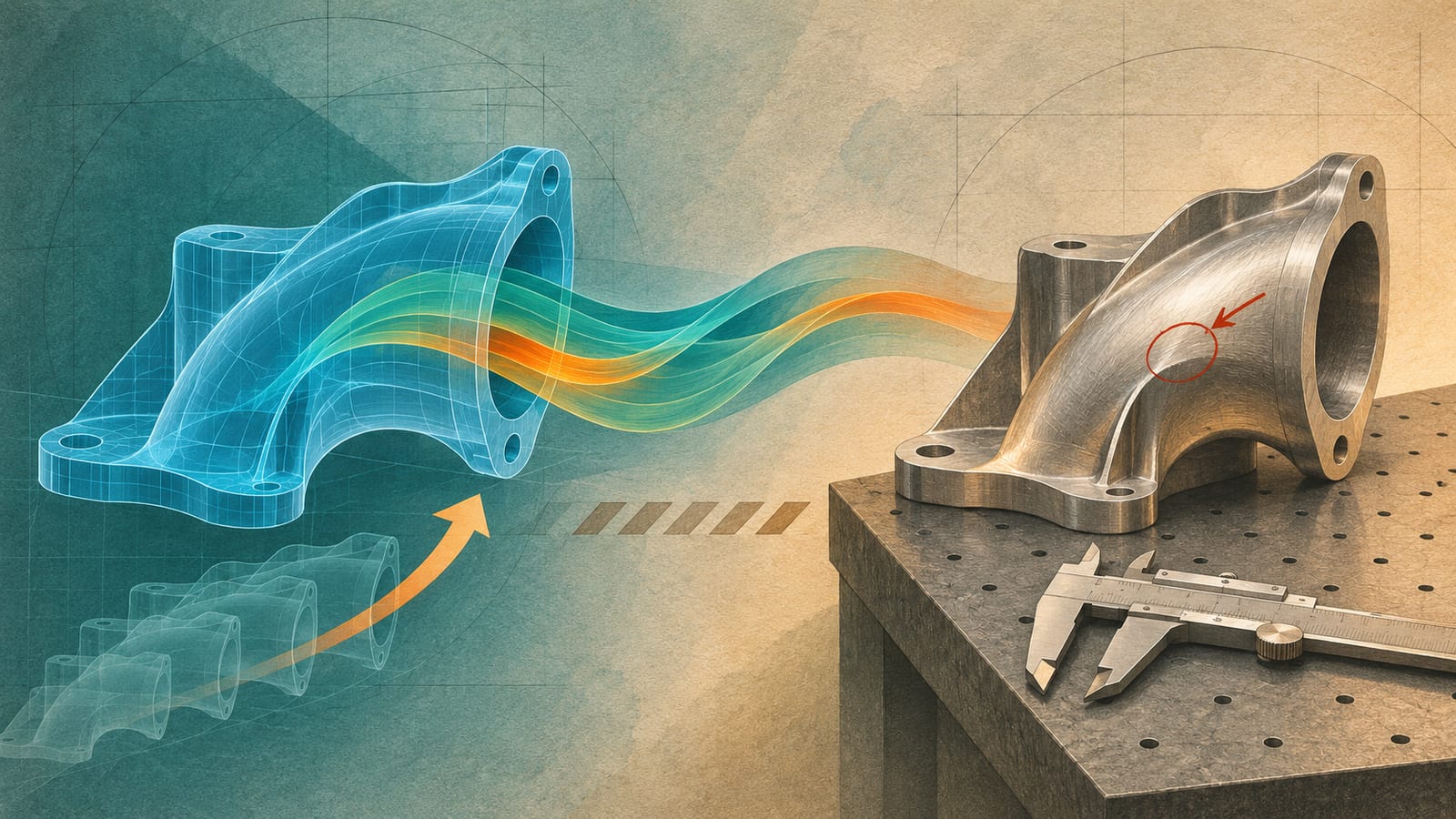
AI-generated editorial illustration. The gap represents review between a digital candidate and a physical part.
The labor change is subtler than replacing a drafter. Time spent recreating an outline may fall. Time spent identifying which surfaces are critical, challenging an inferred feature and explaining uncertainty to a supplier may rise. Fewer redraws could coincide with more senior review per accepted part. None of the announcements measures that employment outcome.
Mazda’s design room adds a second constraint
OpenAI’s newly announced research collaboration with Mazda extends the question from reconstructing existing parts to exploring new vehicle shapes. The companies are testing whether models can help aerodynamics and crash-safety engineers develop and evaluate designs. OpenAI describes workflows that model a nose shape, simulate airflow and refine promising options while taking styling and cost into account. It says it will share results later. There is no disclosed production vehicle, homologation result, measured drag reduction or safety finding.
The named conflict is specific. Mazda principal engineer Akihiro Nakata says designers ask whether an aerodynamically favorable shape has to look a certain way. Engineers can explore many variants and learn which geometric features drive performance, leaving room for a visual identity. That is an engineering design conversation. A model that proposes more candidates may change the conversation’s pace, but it does not decide which compromise the company should ship.
Vehicle design also shows why simulation is an intermediate artifact. The result depends on the model’s assumptions, boundary conditions, input geometry and fidelity. A simulated gain might disappear when manufacturing variation, material behavior or another design requirement enters. Crash safety and aerodynamic performance are not interchangeable tests. OpenAI describes research with Mazda’s engineers; it does not claim a vehicle has passed either certification or a factory release.
Siemens’ faster analysis claims sit at the same boundary. More variants can reveal a better solution if the underlying model is reliable and if engineers have time to inspect the most consequential outputs. The 50-times exploration figure is not 50-times more verified products. Nor does a 1,000-times prediction-speed claim mean a thousandfold reduction in total development cost. The faster component might expose a slower queue for physical tests, tool qualification or approval.
The questions are familiar to engineers, but AI changes their volume. When candidates become cheap, selection rules matter more. Which cases get higher-fidelity simulation? Which require a prototype? Who records when a model was trained on or compared with an older simulation? How are rejected alternatives preserved so a later team does not repeat a known mistake? Without that operating layer, the most impressive speed metric can multiply the number of unreviewed possibilities.
Mazda’s styling concern keeps a narrow optimization from posing as a product decision. An illustrative design trade-off, not a reported Mazda result: a nose shape improves one simulated aerodynamic measure but conflicts with brand design, pedestrian requirements, packaging or cost. The research collaboration gives engineers more ways to investigate those conflicts. It does not transfer authority to choose a production vehicle to the model.
Acceptance is the scarce deliverable
The U.S. National Institute of Standards and Technology has a 2026 AI-for-manufacturing research program focused on metrics for human-AI teaming, fitness for purpose, interpretability, system integration and semantic correctness. NIST describes planned pilot studies and comparative benchmarks, including manual, AI-generated and hybrid integration approaches. It does not certify the tools in this article. The program is useful because it names the measurement gap: task speed alone does not say whether an AI-assisted system worked correctly in a manufacturing setting.
A separate NIST digital-twins workshop report identifies verification, validation, uncertainty, interoperability, cybersecurity and workforce readiness as persistent barriers. Those are not a list of defects found in any one vendor. They are reasons to preserve a human and technical acceptance process after a simulation or model produces a plausible answer.
Verification and validation answer different questions in this setting. Verification asks whether the calculation or artifact followed its stated specification. Validation asks whether that specification represents the physical problem the team needs to solve. A beautifully executed simulation of the wrong airflow condition can pass one test and fail the other. The distinction is especially valuable when an agent automatically builds the model or chooses parameters. A reviewer needs the inputs and assumptions, not only the final image. NIST’s report discusses these barriers at a program level; it does not tell a buyer that a particular OpenAI, Autodesk or Siemens workflow failed them.
An engineering buyer can turn the gap into a release test. The matrix below is an editorial operating aid. It is not a standard, and a small device team will assign owners differently from an automaker.
| Handoff | Minimum question to answer | Evidence to retain | Accountable reviewer |
|---|---|---|---|
| Requirement to generated design | Which constraints were explicit, inferred or missing? | Requirement version, assumptions and candidate file | Design owner |
| CAD to drawing or BOM | Do dimensions, materials, configuration and quantities agree? | Revision comparison, exceptions and approved overrides | Mechanical or electrical lead |
| Design to simulation | Are boundary conditions and model fidelity appropriate? | Input version, solver settings, calibration and uncertainty | Analysis lead |
| Drawing to supplier | Can the process hold the required tolerances and assembly sequence? | Supplier feedback, prototype inspection and disposition | Manufacturing or quality engineer |
| Prototype to production | Does yield and field behavior meet the release threshold? | Acceptance criteria, repeated builds, defects and sign-off | Product and quality owners |
The matrix makes one economic point visible. An AI tool may reduce drafting or analysis setup time but add review cost if it produces more variants or ambiguous assumptions. A procurement case should count both. It should compare accepted outputs per engineering hour, avoidable rework, supplier clarification cycles and physical test cost under the same quality threshold. If the denominator is “prompts issued” or “parts generated,” the business case can improve while the factory gets slower.
Finance has to choose the comparison period carefully. The first prototype often carries one-time setup, unfamiliar software and the cost of teaching a supplier what changed. A later build may improve even without AI because the team has already learned the part. Conversely, an AI workflow that creates many more candidates can consume extra simulation and testing capacity while lowering drafting hours. A fair pilot should hold the acceptance threshold constant and report the full path from requirement to accepted part, with the human review hours visible. No vendor release cited here provides that complete comparison.
There are cases where automation could reduce review too. If a CAD system reliably catches an inconsistency before a drawing leaves the team, a checker may spend less time on routine mismatches. Autodesk’s October release adds more API coverage for inspection and drawing tasks, and OpenAI’s infrastructure team says Codex helps flag drawing and specification inconsistencies. Those are plausible routes to fewer repetitive checks. The public material does not yet quantify false positives, missed defects or the downstream effect on accepted parts.
Someone has to decide what the reviewer checks, with which instrument and at which revision. A final signature cannot recover the cost of a fixture already cut to a wrong drawing. A measurement before the supplier commits material might.
Engineering roles change at the handoff
Software teams have seen a similar division between generating code and operating it. The physical world makes the cost of a wrong assumption harder to hide. A file can be regenerated in seconds; a fixture, PCB order or vehicle prototype consumes material, supplier time and a scheduled test slot. This does not make AI less useful in engineering. It changes the unit of useful work from “candidate produced” to “candidate accepted for the next costly step.”
For a junior engineer, a model that drafts a drawing can be a useful teacher if the engineer still has to explain every dimension and verify the part against the assembly. It can also remove the routine work through which that engineer used to learn why a tolerance or note matters. Teams should decide which tasks remain supervised practice and which are safe to automate. Our earlier analysis of AI skill erosion addresses that wider training problem; the engineering version has a physical acceptance test.
For a senior engineer, the work may move toward boundary judgment: selecting a simulation fidelity, finding a missing manufacturing constraint, resolving a disagreement between design and purchasing, and signing a release. A company that measures only the number of AI-assisted drawings risks underfunding these reviewers. The scarcity may show up in a queue of approvals rather than a shortage of ideas.
For a buyer or CFO, the purchasing decision turns on where the organization can keep provenance and correction visible. A model that moves among tools may help with unusual work but need tighter integration to preserve revision identity. An embedded assistant may have better access to CAD context but stay inside one vendor’s workflow. A simulation agent may explore more cases while depending heavily on training data and model assumptions. The existing design stack, supplier interface and team’s ability to inspect outputs determine which compromise is tolerable.
That question belongs in a pilot contract. Ask the vendor to identify the file types the tool reads and writes, how a reviewer sees the source revision, how a rejected output is corrected, and whether a supplier can receive the resulting drawing without losing notes or units. The answers may be mundane. That is a virtue. A factory does not buy a benchmark score; it buys a repeatable way to make and inspect parts. The team should write the acceptance criteria before it sees the fastest demo, or the demo will set the criteria for it.
None of the public announcements establishes a net change in engineering headcount. OpenAI’s 23-fold token-use growth is usage; Autodesk’s features are capabilities; Siemens’ speed figures are workload claims. A company could use the same tools to ship a product sooner, to explore more variants, to reduce an outsourced drafting bill, or to ask the same engineers to cover more projects. Labor effects require observed budgets, task time and quality outcomes. Treating every faster subtask as a job removed would skip the work that comes after it.
The manufacturer gave OpenAI’s one-week device the answer a model could not supply on its own: tolerances, production limits and assembly details had to change. The next useful measure is the number of corrected revisions that survive another build. That count would say more about engineering progress than the first week’s speed.