
Banks Pay a 13% Premium as AI Talent Spreads Beyond Tech
On this page 6 sections
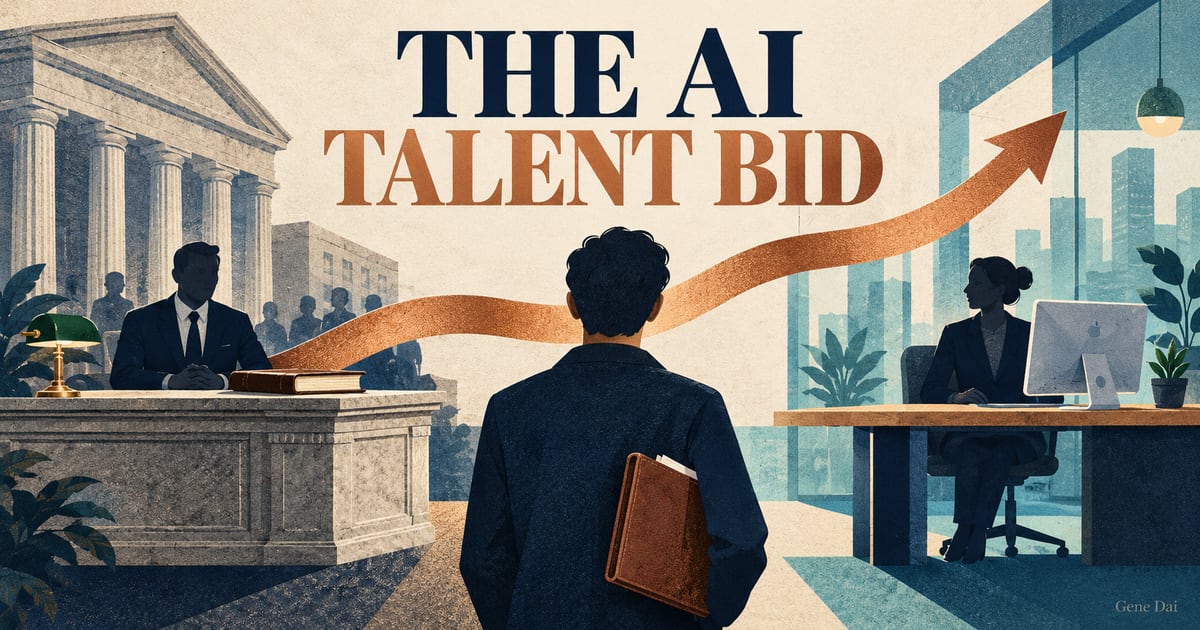
AI-generated editorial illustration.
On October 28, HSBC posted an associate-director engineering job in Guangzhou for its AI-powered Productivity Suite. The bank’s job description says the workspace is used by 250,000 colleagues and the engineering team has about 50 people across the United Kingdom, India, Poland and China. It asks for a senior individual contributor who can write code, support production incidents and mentor engineers. The title sounds managerial. The work is hands-on, and the posting says explicitly that it is not a formal people-management role. It does not disclose salary or prove the position has been filled.
A day later, staffing company Randstad published a pay comparison with a consequence for banks seeking that kind of engineer: its research says banking pays software engineers a median 13% premium and health care and life sciences pay 17% more than traditional technology employers. In the same release, 86% of surveyed organizations said they were growing tech headcount. A hiring manager has to set an offer. A finance leader has to decide whether that offer buys a filled, durable role.
Randstad surveyed 1,100 senior business and technology decision-makers in 11 markets in August 2026, and says its separate market analysis covers more than 20 million job postings and about 100 million candidate profiles. Those are three different populations. The premium describes a market comparison; the 86% figure describes survey respondents’ organizations; the postings describe advertised demand. Neither a signed offer nor a completed project follows automatically from any of them. The published release does not break out how many bank engineers received an AI-specific premium or show the salary distributions behind the median comparison. Randstad’s October 29 release is useful precisely when its limits are kept attached.
A bank cannot postpone software work until technology companies stop hiring. It needs people to connect systems, secure data, test models and explain failures to supervisors and customers. Yet paying a premium for a scarce engineer competes with training an existing employee and buying specialist time for a short project. Those choices change the payroll base, where knowledge stays, and who can challenge a bad output six months later. Randstad calls the options buying, building and borrowing. Their value depends on the work each person will own and the evidence that the work lasts.
A survey of plans meets a slower hiring market
Start with the verb in the headline number. Randstad says 86% of organizations are growing tech headcount; the release does not specify the comparison period or provide a filled-role count for that claim. It is based on a survey of senior decision-makers responsible for workforce planning and digital talent strategy. The sample gives a window into intentions and self-reported organizational direction across Australia, Belgium, France, Germany, India, Italy, Japan, the Netherlands, Spain, the United Kingdom and the United States. It is not a census of every employer in those economies.
The same research says 55% of non-tech organizations are recruiting talent after technology-sector layoffs. That is a statement about recruiting activity among a surveyed group, not the number of laid-off engineers who were hired by banks or hospitals. A posting may remain open. A company may interview while it waits for a budget approval. A former technology employee may move to a non-tech firm without taking an AI role. Treating the 55% as a placement rate would erase each of those steps.
Independent labor measures put the expansion narrative in context. LinkedIn’s September U.S. workforce report measured its hiring rate, hires divided by its membership, as 6.5% below August 2025 in August 2026. It rose 1.9% from July, and hiring in technology, information and media rose 8.1% month to month. Financial services rose 2.9% on that platform in the same month, but was still 6.8% below a year earlier. Those figures are not a rebuttal to Randstad’s cross-market survey. They show that a plan to grow a scarce specialist team can coexist with slower total hiring.
The U.S. Bureau of Labor Statistics reported only 29,000 additional nonfarm payroll jobs in September, with the unemployment rate at 4.2%. Its October 2 release said employment changed little in major industries, including information and professional and business services. The BLS survey measures employed people and payroll jobs; it does not label a bank’s new engineer as an AI hire. The U.S. month also cannot stand in for Randstad’s eleven-market August research. It is a check against converting a global intention into a general U.S. hiring boom.
A candidate experiences these categories differently. A director can approve a requisition and still delay the offer after a project is reprioritized. A staffing firm can see rising demand for a particular skill while the median worker sees fewer interviews. A company can hire the specialist and stop hiring elsewhere. The numbers describe different layers of a market in motion. No single layer proves the others.
What a bank’s premium buys, and what it does not
Randstad reports the 13% median premium for software engineers in banking and 17% in health care and life sciences relative to the technology-firm comparison used in its release. The research note publicized with the announcement does not show a matched-role, geography, seniority and total-compensation model. Without that detail, readers should not treat the percentages as a quote for every bank, hospital or applicant. A higher median could reflect where those employers hire, which specialties they need, how experience is distributed, or what compensation is included.
Even so, the comparison identifies a real budgeting problem. Non-tech employers compete for engineers who can work inside regulated, fragmented systems. A bank’s software engineer might spend more time on access controls, data lineage, reconciliation and incident review than on a model demo. A health-care employer might need interoperability and clinical workflow knowledge. Those responsibilities can be harder to buy as a short generic coding task. They also make the worker more valuable if the organization can give them the authority, data access and partners needed to finish the work.
HSBC’s current posting shows why an employer may pay for depth. It asks one engineer to take requirements through coding, testing, release and production operation. The person would work on integrations and intelligent agents for a product already used across the bank, and take part in incident reviews. Python, retrieval-augmented generation, evaluation, observability, security and communication appear together in the qualifications. The ad does not show that every candidate must already master each item, but it draws a much wider responsibility boundary than “write prompts.” It also says candidates with an immediate local right to work will be prioritized because of an urgent need. That constraint can make a global talent pool feel much smaller to the hiring team.
Another Bank of America software-engineer posting offers a second example, without establishing a market rate. The Addison role describes a hands-on individual contributor building reusable GenAI services, APIs and applications. Testing, integration, compliance, monitoring and mentoring sit alongside model work. It is a live employer request, not proof of a hire or a salary. It does show that the bank wants a person who can make AI work inside a service with existing customers and controls.
The pay comparison is not an AI wage premium. Randstad’s wording concerns software engineers by industry. Its separate finding that AI-related posting requirements grew more than fivefold in a year does not connect individual salaries to individual AI skills. The analyst who reads the two percentages as “AI increased bank engineers’ wages by 13%” would be combining two unrelated denominators. A finance team should ask for matched role descriptions and total compensation before turning the reported premium into a compensation policy.
There is a longer horizon. A permanent specialist can learn why a particular customer record is structured the way it is, why a control exists, and which exception triggered an incident. That knowledge reduces future coordination cost if the person stays and has room to document and teach. The same role can become an expensive bottleneck if every AI project queues behind one expert. A premium makes sense when the work is durable enough to justify the salary and the organization can retain the capability, rather than buying a label that briefly satisfies an investor deck.
JPMorganChase puts a larger number around the bank-side investment, though it cannot be divided into a per-engineer salary. In its 2026 company update transcript, the firm projected about $19.8 billion in technology spending for the year, up 10%. It described additional technology headcount for new products, approximately $1.2 billion more on major projects and about $600 million in efficiencies, some AI-related. The $19.8 billion covers the entire technology budget, not AI payroll; the efficiencies are not a net AI return. Management said its internal LLM Suite was moving from summarization into business-aligned applications. A budget, an application and an engineering hire sit at different points in that sequence.
Randstad’s own demand figures imply a wider contest for such workers. It says postings requiring AI capabilities rose more than fivefold over the prior year, while employer demand for AI-agent skills rose 1,300% in its associated report overview. These are changes within the firm’s posting dataset, not a count of engineers hired or a market-wide wage forecast. A small initial category can produce a large percentage increase. The company has not published a fully accessible series in the overview that would allow a reader to reconstruct the exact base, geographic mix and duplicate-posting treatment. The direction deserves attention; the precise scale needs that context.
Contracting solves a deadline, then creates an ownership question
Randstad says 63% of surveyed organizations put flexible talent models first when asked how to close AI skills gaps. It includes contingent, freelance, contract and fractional work under that umbrella. It also reports 92% use digital talent marketplaces for recruitment and 42% use them as their primary channel. These are survey answers about sourcing approaches. They are not shares of engineering hours delivered by contractors, and marketplace use need not mean the final worker has a contingent contract.
There is a good operational reason to borrow expertise. A bank may need a specialist to run an eight-week model evaluation, map a legacy interface or assess a security design before it commits to a permanent team. An experienced contractor can bring a repeatable method from earlier projects and arrive faster than a search for a rare full-time employee. A fractional expert can help a small employer avoid carrying a senior salary while it tests whether there is enough work to justify one.
Consider the HSBC job as a test case. A contractor might accelerate one integration between the Productivity Suite and an existing service. The bank would still need a permanent owner for production access, incident response and the next change to that service. A specialist firm could bring a reusable evaluation harness, but it cannot by itself decide which internal data source is authoritative or who may act on the answer. Those are buyer decisions. The job posting’s requirements for observability, resilience and mentorship indicate that HSBC is asking the employee to own the service after the first shipment, though it reports no outcome yet.
The bill has more lines than the day rate. Someone must grant access, explain the existing system, review deliverables, decide which parts may be reused, and take ownership after the contract ends. A high hourly price may still cost less than an unfilled role that delays a launch. A low hourly price grows expensive when internal staff spend weeks repairing or integrating the work. Compare the accepted output over a defined period, including the buyer’s own time.

AI-generated editorial illustration. Three staffing routes converge on work that still needs an owner.
A short engagement can leave a long dependency. If the only person who understands a model’s training data, prompts, evaluation and rollback path leaves at the end of the engagement, the buyer may retain an artifact without retaining an operating capability. A contractor can produce excellent work while the organization fails to learn from it. Contract terms can require handover materials, tests and named internal owners, but those provisions help only if an employee has time to use them.
The contingent route also changes the worker’s calculation. Flexibility can let a specialist sell hard-won expertise to more than one client. It can also mean gaps between engagements, fewer benefits, shifting access rules and little credit for a system that works months later. Randstad’s survey does not measure the net earnings or career progression of the contractors in its flexible-talent category. A hiring plan that counts more marketplace activity as more opportunity should be tested against those worker outcomes.
The first rung cannot be a senior job in smaller type
“Build” has a less immediate return than paying a premium or signing a contract. A junior engineer needs reviewed work, a mentor, safe access, feedback and a route from tasks to judgment. AI can remove some repetitive tasks that once gave a new employee a low-risk place to learn. If an employer then asks that same person to supervise an agent, make a risk call and persuade a skeptical business owner on day one, the entry-level label has lost its training content.
Randstad reports that postings for entry-level tech jobs requiring AI skills rose fivefold since 2025. It also says 61% of surveyed employers find communication and stakeholder-management capabilities harder to source than technical skills alone. Those claims should sit together. A job ad can ask a junior candidate to use AI tools. It cannot give them the organizational experience needed to know which answer a customer, auditor or manager will accept. An employer has to create supervised exposure to those decisions.
A separate Gartner survey released July 27 found that 22% of 110 HR chiefs said at least one business leader in their organization had stopped hiring for entry-level roles because of AI automation. That is a different sample and question from Randstad’s posting analysis. It does not show that 22% of all entry-level positions disappeared. It does show the logic of a manager removing the old training tasks before designing the new ones.
Another recent survey points the other way. AMS, now part of Korn Ferry, said on October 20 that 81% of more than 500 employer respondents planned to increase early-career hiring over the next two years. The company also surveyed more than 5,000 candidates in thirteen countries. An intention to hire in 2027 or 2028 is not a filled 2026 job. The reports can both be true if some leaders close old junior roles while other employers plan new ones, or if a single organization changes its requirements before it expands headcount.
JPMorganChase’s software-engineering internship page offers a more specific version of “build.” It describes a technology induction, a peer mentor, senior speakers and work on payment systems, applications and platform reliability. It says interns will use internal AI tools, and that the experience may lead to a full-time role or return internship for top performers. The page is a program offer, not a count of participants or conversions. Its value as evidence is in the work design: an early-career engineer gets an assigned team and feedback instead of being asked to arrive as a fully formed AI lead.
For a worker, the relevant question is what the first year looks like. Will a new hire get production access with a reviewer? Who signs off on an AI-generated answer? Is there a set of tasks where errors are inexpensive enough to teach from? Can a junior see how a senior colleague handles an exception? This site’s earlier junior-role analysis argued that a career ladder needs paid practice, not a skills list. The new Randstad figures make the budget choice sharper: firms that pay a premium for seniors but do not build juniors may be bidding again for the same scarce pool in two years.
A recruiter also needs to distinguish an AI tool requirement from an AI role. A service team’s analyst may use a model to summarize cases. A software engineer may integrate it into a product. A risk specialist may test a system they did not build. Those jobs call for different training, salary and accountability. The October 19 Cognizant role plan offered named technical and business categories, but a market-wide posting count cannot tell whether every employer has made its roles equally concrete.
A decision table that starts with the work
A budget meeting should start with the work that must persist after the next release and the person who owns its failure. A buyer can compare permanent hiring, internal development and a fixed specialist engagement against the same deliverable. The table is an editorial decision aid, not a cost estimate from Randstad.
| Choice | Best initial test | Cost that is easy to miss | Evidence before expanding |
|---|---|---|---|
| Hire a permanent specialist | Work repeats across products or years; domain knowledge and accountability must stay inside | Search time, compensation premium, management capacity and retention | Accepted outputs over several cycles, review burden, documented handoffs and ability to teach a second owner |
| Develop an existing or junior employee | Work has a bounded learning path and a qualified reviewer can spare time | Mentor hours, safe practice data, slower early delivery and the cost of mistakes caught in review | Progression from assisted tasks to independently reviewed decisions, retention and quality |
| Bring in a contractor or fractional expert | A deadline or specialist question is clear, with an internal owner already named | Onboarding, access, integration, rework and knowledge transfer | Accepted deliverable, reproducible tests, handover and internal ability to maintain it |
| Combine the models | The firm needs immediate expertise and a durable internal capability | Paying twice if the outside specialist never transfers knowledge | A working artifact plus an internal employee who can explain and change it |
The rows should not be treated as a universal ranking. A bank with a six-month regulatory deadline might need a contractor before it can hire. A hospital with a stable integration backlog might pay more for a permanent engineer because its data and workflow knowledge compound. A startup with uncertain revenue might train a generalist first. The useful comparison is made over the same horizon and with the same quality standard. The first month’s invoice hides a year’s ownership cost.
An organization can make the table operational by assigning one deliverable and one internal owner before opening a requisition. It can estimate the cost of search, salary and benefits; the cost of mentors and review; or the contract, onboarding and handover bill. Then it can decide what would count as a successful output: a system shipped with tests, a reliable analysis used in a decision, or a workflow maintained after the outside expert leaves. The calculation remains a local budget exercise. Randstad’s percentages are evidence that buyers face pressure, not inputs that produce a precise return on investment.
The different surveys should not be added. A share of leaders who intend to grow is not a share of roles filled. A premium for one occupation does not apply to every AI skill. A rise in postings does not guarantee a first job. A contractor platform account does not equal paid work. Each metric can guide a separate question; none completes the decision alone.
Count the roles that stay filled
Randstad CEO Sander van ‘t Noordende argues in the company’s release that employers will need to buy, borrow and build skills. He has a commercial reason to emphasize all three; Randstad sells talent services. Readers can use the survey while keeping its commercial framing separate from outcomes an employer can verify.
A filled role with a clear scope and compensation would tell us more than a posting that asks for “AI.” So would a contractor’s system that an internal employee can maintain after handover. For early-career hiring, the test is a worker moving from supervised tasks toward independent responsibility. A two-year hiring plan cannot stand in for that progression. Each outcome can be checked without pretending the entire labor market moved in one direction.
The equity warning is also concrete. Randstad says women represented 31% of profiles with emerging AI skills in its candidate data, compared with 36% for established tech skills. The report does not show a causal account of the difference or prove that a single employer’s hiring process created it. It does warn that a search strategy focused on a narrow visible pool may make an already costly market tighter. Internal training, return pathways and fair access to assignments can change who becomes qualified to apply, but the results must be counted rather than assumed.
A year from now, the bank that paid the reported premium can ask whether its engineer built capacity that survived the first project. The organization that hired a contractor can ask who owns the work after the invoice stops. The junior candidate can ask whether “AI skills required” came with a paid route to learn judgment. Randstad’s October figures put those questions on the same page. The answers will come from payroll, accepted work and career movement, not from another round of adjectives in job ads.