
Uber Opens ChatGPT Work to 30,000 After a 10% Cut
On this page 7 sections
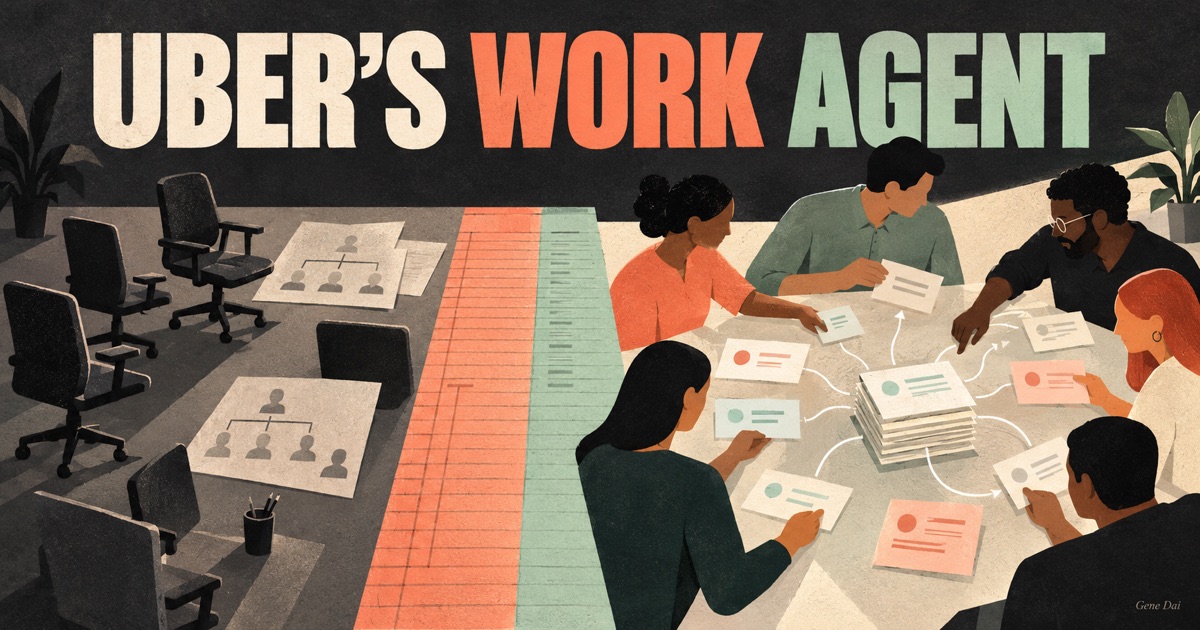
AI-generated editorial illustration.
On October 22, Uber said it would make ChatGPT Work available to more than 30,000 employees. The company had tested it with 1,000 people. Seven weeks earlier, CEO Dara Khosrowshahi told staff Uber was reducing its team by about 10%, removing management layers and combining operations teams. The dates invite a simple story: fewer workers, more agents. Uber’s rollout notice and Khosrowshahi’s September 2 memo do not establish it.
The memo attributes the cut to organizational complexity, fragmented ownership, team structure and location strategy. It does not say ChatGPT Work replaced the affected roles. Uber had also discussed AI-related productivity in its August 5 investor remarks, but that statement concerned moderation of planned hiring and an earlier period of AI spending. It cannot be retrofitted into a causal account of September’s layoffs or October’s new deployment.
The scale changes the work of judging the tool. A pilot affecting roughly one in thirty of the newly eligible population is becoming an offer across finance, operations, marketing and product. Uber and OpenAI say the agent can work across Google Drive, Gmail, Calendar and Slack; Uber says it will support the expansion with a skills library, approved integrations and training. Yet the announcement reports no accepted-work rate, employee time saved after checking errors, purchase price or change in staffing linked to this rollout. The companies say they will share adoption and outcome data later. October 22 opened a much larger measurement test.
An employee receiving access may now have a new way to prepare a brief or analyze a file. A manager also has to decide who can connect which systems, how work will be checked, and what a completed agent task should count for. A finance team needs a cost per accepted result, not merely an account count. A worker whose job was affected in September deserves a more careful explanation than a convenient chronology. These are separate questions with separate evidence.
Access grows faster than the public result sheet
Uber’s October 22 announcement uses a precise verb: the rollout will make ChatGPT Work available to more than 30,000 people. Eligibility says nothing yet about how many activated it, completed a task or shifted their work hours. The initial pilot numbered 1,000. Even if every pilot participant had used the tool every day, the public account would still lack the output and cost data needed to judge a company-wide expansion.
OpenAI launched ChatGPT Work in July as an agent inside ChatGPT that can gather context from apps and files and produce documents, spreadsheets, slides and other deliverables. Its product description says people can review progress, change direction and approve important actions. That is the vendor’s account of product capability.
Uber has not published its own permission map, approved workflow list or a company-wide audit of completed work. The October joint announcement names integrations and training, but gives no evidence that every employee can connect every named application. Enterprise access normally differs by role, geography and data sensitivity. The details of Uber’s configuration have not been disclosed.
The company describes this as its first company-wide agentic platform for knowledge work. Its engineering teams will continue to use Codex for software development, according to the same notice. An operations employee preparing a country brief and an engineer changing production code therefore sit in different workflows even if both involve OpenAI technology. Counting them together as a single agent adoption number would conceal the review standards and risks in each. A production code change may need tests and a reviewer. A financial analysis needs source reconciliation. A marketing translation needs a local reader. “The agent did it” is not a common acceptance criterion.
Uber CTO Praveen Neppalli Naga framed the rollout in the joint announcement as a way to give employees tools to build and solve problems. That ambition gives the company a reason to offer access before it has a polished list of proven use cases. It also creates a reporting choice: present early experimentation as learning, or present it as already realized productivity. The release does the former when it promises future outcome details. Outside readers should preserve the same distinction.
Uber’s release lists possible tasks: research, meeting briefs, presentations, data analysis and work across applications. The range is a reason to classify use cases before measuring them. A summary drafted in five minutes might save an hour of assembly, or it might require thirty minutes of correction and still miss a decision-critical line in a source document. A presentation built quickly may be a useful first pass while the human team owns every fact. If the task does not reach the point where someone can safely use it, speed at creation is an incomplete gain.
Training a thousand early adopters, many of whom volunteered or were selected for a pilot, is different from making a tool available to all offices and job types. Teams need examples of permitted data, escalation routes when an agent acts on the wrong file, and a way to record where manual work increased. Uber says it has an internal skills library and approved integrations. It has not yet shown how those controls performed in practice. The next disclosure could show whether the library helped workers finish more useful work with less total effort.
September’s cut had a different stated rationale
Khosrowshahi’s September 2 message to employees described a reduction of about 10% of Uber’s team. He said affected employees had been notified, except where local process was required. The company had grown and acquired complexity, his account went: too many layers, too much coordination, divided ownership and teams arranged for an earlier scale. The message was unusually specific about the organizational levers. It did not identify ChatGPT Work, the then-running pilot, or agents as a reason for the reduction.
Uber reported reducing the number of employees seven or more layers below the CEO by 20% and cutting the number of one- or two-report “micro-teams” by nearly half. Those are changes to organizational structure, not additional percentages of the total workforce to add to the 10% reduction. It combined three Delivery Operations teams, across Restaurants, Retail and Direct, under common owners at global, regional and country levels. It also merged Core Services Engineering and Science. A budget decision, a reporting-line decision and an AI purchase could all happen at the same company without being the same decision.
The memo did name people whose jobs largely involved coordination and described wider manager scopes. That creates a real question about workload after the cut. A manager with more direct reports may use an agent to assemble material, but the manager still has to resolve disagreements, coach people and make decisions. The public documents do not show whether employees were given more time or fewer requests after reorganization, nor whether AI tools compensated for work the removed roles had done. The answer could vary across teams. A single headcount percentage cannot settle it.
The location strategy adds another dimension. Uber said it would concentrate global teams in New York and San Francisco, regional teams in regional hubs and local teams in country hubs. It asked most remote employees to move to an office and expected only about 1% of employees to remain remote. That policy can reshape who stays, who moves and how coordination happens independently of AI. It can also change the baseline for any productivity comparison: a team moving office and changing manager at the same time as an agent rollout is not a clean experiment in software alone.
The memo promised that savings would support growth, innovation and capabilities for future years. It did not disclose a dollar figure for saved payroll or the amount earmarked for ChatGPT Work. Comparing the cut to the software purchase therefore requires figures the public record lacks: total severance and transition cost, continuing compensation, license or usage fees, training hours, integration work, and output quality. The timing of the announcements makes these costs relevant to investors and workers. It does not prove that the agent was the reason jobs disappeared.
One way to test a causal claim would be to identify which tasks departed with affected roles, when an agent assumed them, whether the task volume changed, and whether the work still met the same standard. Uber has released no such role-to-task mapping. Analysts should resist filling that gap with the vendor’s demonstration or with a workforce number. The first is about what the tool can attempt; the second is about how Uber chose to organize. Neither is a measured replacement rate.
A pilot with examples but no denominator for savings
In an October 22 interview with TechCrunch, Uber engineering vice president Sumanth Sukumar said roughly 80% of early pilot adopters were non-engineers. He described uses including analysis of operations data, localization of training materials and personalized dashboards. The interview supplies a helpful clue about where the company found initial interest. It does not say 80% of all Uber employees used the agent or that the described outputs passed a formal quality review. It refers to early adopters in the 1,000-person pilot, not the 30,000-plus rollout.
Sukumar also described a separate effort in which 30 AI engineers paired with teams for two weeks to automate parts of their jobs. That arrangement may matter as much as the software. An engineer and an operations specialist working side by side can choose a narrower workflow, clean up access and test it against real exceptions. Scaling that support to an entire company would carry an implementation cost and require local expertise. The interview did not give a company-wide staffing plan for such support, so the two-week effort should not be assumed to be the model for all 30,000 employees.
Three pilot examples deserve different tests. If an agent analyzes operations data, a reviewer needs to know the period covered, missing records and whether a trend holds after market-specific factors are accounted for. If it localizes training material, someone must check meaning against local rules and the intended audience. If it builds an interactive dashboard, the owner has to validate sources, definitions, refresh behavior and access rights. The same product may be helpful in all three. A count of generated artifacts would still mix draft quality, approval burden and user value.
Uber declined to disclose the spend on the rollout in the interview. Sukumar said the company would examine patterns of use, workflows people develop and how effectively those workflows help them work. That is a reasonable starting list, but the public explanation stops before the hard comparison. How much time does a worker spend describing a task, checking the result and correcting mistakes? Does a reviewed output cause a better decision or just move a document through a pipeline faster? Does a department use freed time to serve more customers, absorb new work, or reduce external spend? “Effective” needs an agreed unit before its numerator can be reported.
Pilot selection makes the comparison harder. Early adopters tend to have high interest, a suitable problem and enough slack to try a new tool. A company-wide offer reaches people with very different tasks, access levels and confidence. A successful pilot could show that a selected workflow works under close attention while saying little about the average employee’s first month. Conversely, a slow initial uptake could reflect training and permissions rather than poor agent capability. The two groups should be reported separately instead of blending the pilot’s experience into a general claim.
There is no public control group or before-and-after task ledger for the pilot. That does not invalidate Uber’s decision to expand access; firms often deploy a tool while still learning where it helps. It limits the external claim that can be made. The most concrete published result today is organizational: 1,000 people in an initial pilot, then availability for more than 30,000. The useful question is what Uber will publish after those new accounts have had time to do comparable work.
There is a serious case for broad access even before a clean return-on-investment number exists. A platform restricted to a few specialists may never reveal the odd, high-value use case in a local finance or operations team. People need time and permission to find it. The cost of early experimentation might be justified by better decisions, employee capability and options the company cannot pre-specify. That argument is strongest when the company calls the rollout an experiment and pays attention to failed attempts as well as successes. It weakens if availability is later counted as a saving or if a low-quality output is treated as finished simply because the agent produced it.
The earlier token budget belongs to an earlier quarter
Uber spoke more directly about AI and labor in its August 5 prepared remarks. Finance leaders said hiring had been moderated relative to original 2026 plans, partly because of organizational effectiveness and AI-related productivity. That is an explicit management claim about planned hiring, before the September reduction. It does not quantify jobs avoided by AI and does not attribute the later cut to ChatGPT Work. The distinction matters because a role never opened, a role removed from payroll and an employee given access to a new tool are different events.
The same remarks said cost per token had declined over the preceding months as Uber adjusted model defaults, shifted some tasks to lower-cost or open-weight models and made spend more visible to employees. Management said total AI spend was broadly stable despite rising adoption. Those words describe the AI portfolio through the second quarter, which ended June 30. They are not a price quote for the October ChatGPT Work contract.
The joint rollout announcement named GPT-6.1 Sol as a default capability and described a broad enterprise agent, but neither company published the contract price or expected token volume. A reader cannot combine Q2’s stable spending sentence with October’s 30,000 eligible workers and calculate a zero incremental cost.
Uber’s second-quarter earnings release filed with the SEC put revenue at $14.2 billion, up 12% from a year earlier, and adjusted EBITDA at $2.8 billion, up 33%. Trips rose 18% to about 3.9 billion. Those figures show a growing business able to fund investment; they do not isolate a return from workplace AI. They also precede the September reorganization. A favorable company margin cannot be assigned to an agent rolled out the following quarter.
For CFO Balaji Krishnamurthy, the August remarks put token pricing and hiring plans inside the same operating discussion. That is useful context for October, but the unit of analysis has changed. Q2’s lower cost per token reflects model routing across Uber’s earlier AI use. The new company-wide agent introduces a larger eligible population and a set of workflows whose actual use has not been reported. A finance review would have to bridge those two periods before any savings claim could be tested.
The expense side has at least four ledgers: model or software usage, human time, integration and training, and correction or risk cost. An agent may lower the unit price of producing a draft while increasing the number of drafts a team requests. It may raise compute spend while shrinking paid external services. Or it may save no money but let a team carry an extra assignment without a new hire. All three would appear differently in a department budget. A single “AI spend” line, especially one from an earlier quarter, cannot tell which occurred.
Uber’s size makes the distinction more consequential. If a tool is offered to 30,000 people, even a small average recurring charge or a short training session per person can become material in aggregate. Equally, a small true saving repeated across high-volume tasks can matter. Neither inference is a reported Uber result. The numbers needed are prices, use by task, accepted outputs, human review time and what the team did with any capacity released. Without them, the apparent tension between a 10% staff reduction and a 30,000-person software offer is an editorial question, not an ROI calculation.
Human acceptance sets the unit
A dashboard can look finished while its numbers are wrong. For a workplace agent, the most defensible productivity unit is often an accepted task, with the acceptance standard stated in advance. That might be a brief approved for a meeting, a reconciled dataset that an analyst can reproduce, or a localized training module signed off in the relevant market. A named owner must check the sources and be able to use the result for the next decision. The unit has to be specific to a workflow; a dashboard and a presentation should not be combined simply because both came from ChatGPT Work.
The measurement file should follow each task from request to acceptance. It would record the original input and scope, the agent’s actions, human interventions, rework, final disposition and elapsed time. If the agent reaches into Gmail or Drive, the file should record permission changes and exceptional access. If an employee rejects an output, the failed attempt belongs in the denominator. Removing rejections creates a flattering completion rate that cannot guide procurement or staffing. A good measure also watches whether the work returns later as a correction, complaint or compliance problem.

AI-generated editorial illustration. The handoff shows why a generated artifact and an accepted result need separate counts.
Suppose a team previously spent 90 minutes preparing a weekly country brief. The agent produces a draft in ten minutes, but the analyst spends 45 minutes checking references and another 20 correcting a date. The task might still be a net improvement, assuming the brief is accepted and the earlier 90 minutes included similar review. It is not an 80-minute saving simply because the first draft appeared after ten minutes. The numbers in this example are hypothetical; Uber has not published a measured task-time study for this rollout.
People may send the easy briefs to an agent and keep the difficult exceptions themselves. Average time for “agent tasks” could fall even while the human queue becomes harder. A department comparing before and after periods needs to track task complexity, demand and the proportion of cases escalated. That can be done with a small, well-defined sample before attempting an enterprise-wide headline. Uber has not said it is running this comparison.
The difference between assistance and action matters as well. A draft brief read by a manager can be corrected before anything changes. An agent with access to multiple applications may move information or start a workflow. OpenAI says users can approve important actions, but the product page does not describe Uber’s actual policy for every function. A public outcome report should identify which actions require approval, what happened when an agent proposed an incorrect action, and whether a reviewer had enough context to catch it. That is part of useful work, not overhead to subtract from the story.
One reason this accounting is awkward is that it crosses budgets. The software may sit in a central IT agreement; review time sits in a department; training may be paid by a learning team; data cleanup lands with analysts. A narrow price-per-seat view could make one manager’s budget look efficient while moving work to someone else. The unit cost of an accepted, auditable task forces those costs back into the same conversation. Uber has not disclosed the necessary figures, but its scale makes the unit more useful than an access total.
Workers carry the learning and correction work
Training takes time from the work already assigned. Someone has to test a prompt against a real file, learn the limits of an integration, identify a source the agent misread and explain the correction to colleagues. If a manager uses agent output to ask for faster turnaround, a worker may gain speed in drafting and lose it while checking a larger volume of requests. An individual’s “minutes saved” will miss that change in demand.
The September reorganization makes that labor especially visible. Uber said it removed some coordination roles and broadened manager scopes. The October release says teams across operations, finance, marketing and product will get the agent and training. Those two documents do not say the same people or tasks are involved. But any company making both changes needs to find who owns the new review, data and escalation work. A role that once convened teams may disappear from a chart while the underlying need to resolve conflicting numbers remains. An agent can assemble the numbers; a person still has to decide which definition governs a budget or a market.
Consider the choice facing a hypothetical regional operations lead after the restructuring. Three delivery businesses now share an owner in Uber’s stated organization design. An agent can assemble a country report from several files; the lead still needs to decide whether each business used the same definition of an active merchant and whether a local exception changes the plan. The scenario is an illustration, not a reported Uber workflow. It shows why access to files and authority to reconcile them are different forms of work. The person who approves the report is accountable for the second.
Employee trust is a practical variable, not a slogan. Workers who watched colleagues leave may read a company-wide AI rollout as a signal about future jobs, even without a causal statement from management. If leadership wants reliable adoption data, it has to specify what the tool is for, which decisions remain human, what usage data will be collected and how that data will be used in performance conversations. An employee may otherwise avoid a useful experiment or overstate a weak one. Public documents do not provide Uber’s internal answers, so these are questions for the implementation, not reported failings.
There are plausible benefits beyond time savings. A worker who can assemble a cross-market brief may make a better decision with colleagues. A small local team may get access to analysis it could not previously afford. Training material could reach a new language faster if a local expert checks it. Those gains would matter even if no position were eliminated. The countercase is equally concrete: an agent could produce confident summaries from stale files, generate more material than anyone has time to review, or shift accountability onto the employee who clicked approve. Reporting both sides requires following tasks after the first output.
Workers outside the corporate employee population must also stay out of the denominator. Uber said more than 30,000 employees will be eligible. Its millions of drivers and couriers are a separate platform workforce, with different tools, contracts and economics. The Q2 prepared remarks said a record 10.2 million drivers and couriers earned on the platform that quarter. This rollout is not an offer to those 10.2 million people. Mixing corporate productivity with platform labor would make the headline sound larger while saying less about either group.
The same boundary applies to geography. A company-wide offer spans countries with different languages, data rules, local processes and labor relationships. A training module that works for a U.S. office may need translation and legal review elsewhere. Uber has not published country-by-country access or outcomes. A valid enterprise total should be built from comparable local units or clearly show where the unit changes. Otherwise a strong result in one function could mask a weak one in another.
A task ledger after rollout
Uber and OpenAI have promised further detail on adoption, use cases and measurable outcomes as the rollout progresses. Begin with the accounts: how many employees became eligible, activated access and used it for a real work task? Then follow the work. How many tasks reached a stated acceptance point, by function and complexity? What human time, vendor cost and rework went into each accepted result? What changed in team output, service, hiring or external spending after accounting for the September reorganization and other business changes? A rising login count answers the opening question alone.
| Public question | Useful denominator | What October’s disclosure supplies | What is still missing |
|---|---|---|---|
| Who can use the agent? | Eligible corporate employees by role and market | More than 30,000 planned availability | Activated users and permissions by function |
| Does the pilot generalize? | Comparable tasks and users beyond the 1,000-person pilot | Pilot size and examples of use | Pilot selection, accepted-output and rework rates |
| Does work improve? | Accepted tasks of the same type and complexity | Proposed use cases, not task outcomes | Time to acceptance, corrections and downstream quality |
| Does the budget work? | Full cost per accepted task | No rollout price; Q2 AI portfolio spend predates it | Contract, integration, training and human review costs |
| Did staffing change because of this tool? | Roles and tasks with a documented before/after comparison | September cut and October rollout as separate announcements | Role-level causal evidence and alternative explanations |
Uber has not claimed to track every item in this proposed disclosure file. A financial workflow and a local marketing workflow will have different acceptance standards. Both still need a dated sequence of events and a denominator. The September 2 cut was a management decision with a stated organizational rationale; the October 22 announcement made an agent broadly available. Any later claim that one caused the other needs a trail of tasks, people, costs and decisions that the public record does not yet contain.
An investor could use that trail to compare the software commitment with actual capacity. An employee could see whether the tool reduced drudgery or raised the expected volume of work. Another employer could separate an attractive pilot from a repeatable deployment. Uber has already given the size of the offer. The next line worth publishing is a count of work a human owner accepted, with the hours and cost beside it.