
Eugenia Kuyda's Shared Agent Has to Earn the Group Chat
On this page 6 sections

AI-generated editorial illustration.
Wabi’s terms dated October 20 include a small clause with large consequences for a shared AI assistant. Material posted in a group conversation may remain visible to its other members after the person who posted it leaves or deletes an account. The clause belongs to a product that asks people to put an agent inside a chat with family or friends and, if they choose, connect their email, calendar or finances. It also marks the limit of a familiar promise in consumer software: an account holder can control what they share, but cannot necessarily retrieve what another participant has already seen.
The day before those terms were updated, Eugenia Kuyda opened Wabi to the public. TechCrunch reported a messenger-like assistant with separate threads for different parts of life. Each thread can hold small apps generated for the task at hand and can include other people. Kuyda, who founded Replika, is making a second bet on what an AI relationship should do. The first product kept one person talking to a companion. This one tries to help several people decide and act together.
That is a product decision whose outcome remains open. Public sources reviewed for this article provide no cohort of active Wabi groups, repair rate for generated apps, measured permission-error rate, or evidence that members spend more time together away from a screen. Wabi is currently free, and Kuyda told TechCrunch it has not settled on a business model. Each missing measure matters for a cloud agent that can read sensitive sources and act on a person’s behalf.
The useful question is what Kuyda changed after Replika, and how a group could tell whether the change works for everyone in its thread.
An assistant idea that survived three products
At TechCrunch Disrupt in 2014, Kuyda presented IO, a messaging concierge from her startup Luka. It could help arrange a restaurant or trip, according to TechCrunch’s account of the original pitch. Today’s language models did not exist in that product. What has survived is the interface idea: ask in a conversation, then receive useful help beyond the conversation.
Luka took a different route. Replika, released in 2017, became an AI companion that invited people to talk about their lives. Kuyda later described its purpose as helping people feel less lonely. The company was early to consumer conversational AI, but the relationship model carried a peculiar product responsibility. When a person returns to a bot because it knows them, a change in the bot’s behavior can feel less like a software update and more like a changed relationship. That does not make the bot a person. It means the design can shape real expectations.
Replika’s scale is often stated without a denominator. When Wabi was first reported in November 2025, TechCrunch said Replika had 35 million users. The figure was reported in a profile of the new venture and does not identify monthly active users, paying users, or current usage. It is evidence of substantial reach, not of a measured reduction in loneliness. That distinction matters because Wabi’s launch story repeatedly draws on Kuyda’s experience with Replika. Reach can establish that she has operated a consumer product at scale; it cannot validate her new claim that an agent will strengthen human relationships.
Kuyda left Replika’s chief executive role in 2025 and started Wabi. The first Wabi proposition was not an assistant. It was a place where people could generate mini apps from prompts, find other people’s creations, and share or remix them. TechCrunch’s 2025 report described a $20 million pre-seed round and a vision of simple apps made by non-programmers. It quoted investor Anish Acharya of Andreessen Horowitz expressing confidence in Kuyda’s consumer instincts. His view explained why a fund backed the company. It did not establish retention, profitable distribution, or the technical reliability of user-created software.
Less than a year later, the interface changed. Wabi announced an invite-only version built around messages and an agent on September 28. TechCrunch described the shift the following day: instead of opening an app builder, a user could ask a personal agent to do work, and the system could construct an interface when that helped. The company kept mini apps and placed them inside a conversation about a task. On October 19, it removed the invite barrier for public access, according to TechCrunch’s launch report.
The sequence shifts the work. A builder asks the user to imagine software in advance. An agent tries to infer what software a task needs. A parent arranging a school week might care little about specifying fields for a calendar app; they want tomorrow’s changed pickup time in a shared plan. Kuyda said the team learned that people liked personal software without necessarily wanting to spend time making it. That explanation comes from her, with no published Wabi cohort study to test it. Her design answer is concrete: give the agent the first draft of the app.
That answer creates new work. The system has to identify the right source, interpret a message, propose a change, show the change to the right people, and avoid exposing information that belongs to someone who did not ask for it. A mini app can make the result easier to see than a long chat. It can also give a mistaken result the appearance of an agreed record. Wabi’s first product asked whether anyone could make software. The October product asks who is allowed to make a shared decision with it.
The group thread is a product decision
Kuyda told TechCrunch that single, unbroken assistant conversations become hard to navigate. Wabi therefore puts family, health, travel or another ongoing purpose in separate threads. Its public website now introduces the assistant as one that people can use together. Within a thread, the agent may build an interface rather than return only a paragraph. The proposed advantage is organizational: a plan remains in the place where participants discuss it, rather than being buried in one person’s private assistant history.
Consider a school email. One adult receives a message that tomorrow’s pickup time has changed. A shared thread contains another adult and perhaps a caregiver. The intended Wabi experience is to notice the change, update a calendar, and make it visible to the group. This is a company use case, not an observed household in this article. It requires a boundary around the email’s source, a separate authority to change the calendar event, and a rule for what each participant may see. The recipient can read the entire email. The other adults may need only the pickup time. The same message could contain information about another child whose name belongs outside the shared answer.
Kuyda’s own examples in the launch interview included a family thread with children’s activities and a health thread with trackers. She also described a partner asking in a shared thread whether she was free on a particular day. She said access to personal information is scoped to individual chats and that participants can see requests for someone else’s information. Those are meaningful design claims. A user should still be able to test the precise boundary: whether a calendar title, attendee name, attachment or inferred preference can enter a shared response when only availability was requested. The interview does not publish a permission matrix or independent test of those cases.
There is a real advantage to the shared design when that boundary holds. The adult who receives a school update would otherwise forward it, explain it again, and hope the calendar matches what the caregiver understood. A thread could keep the agreed time, the reason it changed, and a small editable plan in one place. That benefit is different from having an agent read more private data. A useful product would let the group get the answer with the least information needed for the decision, then show whose source and authority produced it. That would give a participant a way to correct the plan before anyone acts on it.
The distinction between seeing a request and approving a disclosure deserves attention. In a group, a participant may ask a question about another person’s connected account. A visible request can create accountability after the fact. It does not itself show what the account holder was asked to approve, what the agent fetched before approval, or what others can copy from the answer. Nor does it show whether a permission applies once, for the thread’s lifetime, or until a connector is revoked. Wabi’s privacy notice describes account connections and device permissions, but public policy text cannot demonstrate every prompt and access check in a running app. The person who never installs Wabi may still appear in a connected user’s emails or calendar. Consent at the account level cannot stand in for that person’s participation.
The question is not unique to Wabi. Researchers at USENIX Security studied bots in group chats and found that bot access can reach more conversation content than a task requires. A 2026 privacy study examined how people understand bot permissions in group settings. Neither paper audits Wabi. They do explain why a group interface changes the safety model: the bot may see or infer relationships among participants who did not individually invite it, and a single person’s consent cannot automatically stand in for every other person’s.
A useful public test would follow data from source to recipient. Public Wabi material reviewed here does not include that test. The following editorial acceptance framework identifies questions a group could try; it does not describe verified Wabi controls.
| Shared-agent moment | Source owner and minimum useful output | Question a group can actually test |
|---|---|---|
| School email becomes a plan | One adult’s inbox; show the changed time and location, not the whole message | Does the agent ask before displaying names, attachments or unrelated email text? |
| Calendar availability is requested | One person’s calendar; return free or busy for the proposed time | Can another member see private event titles or inferred locations? |
| A bank feed informs a budget | The connecting account holder; show only the agreed category or total | Can a group member query individual transactions without a new approval? |
| A generated mini app stores a decision | The participants who entered data; keep a visible history of edits | What remains after one participant leaves, revokes a connector or deletes an account? |
| An agent books or sends | The person whose payment or account performs the action | Is the exact recipient, amount and content shown before the irreversible step? |
The last row marks a different threshold. Wabi’s terms say a user who asks the agent to make a purchase, book, fill a form or send a message authorizes it to act as that user’s agent. Where the service asks for review and confirmation, the confirmation is the instruction to proceed. The language does not promise that every action always gets a separate approval prompt. A group planner should not infer one from a marketing example. The practical distinction is between proposing a plan and spending money or speaking in a person’s name.
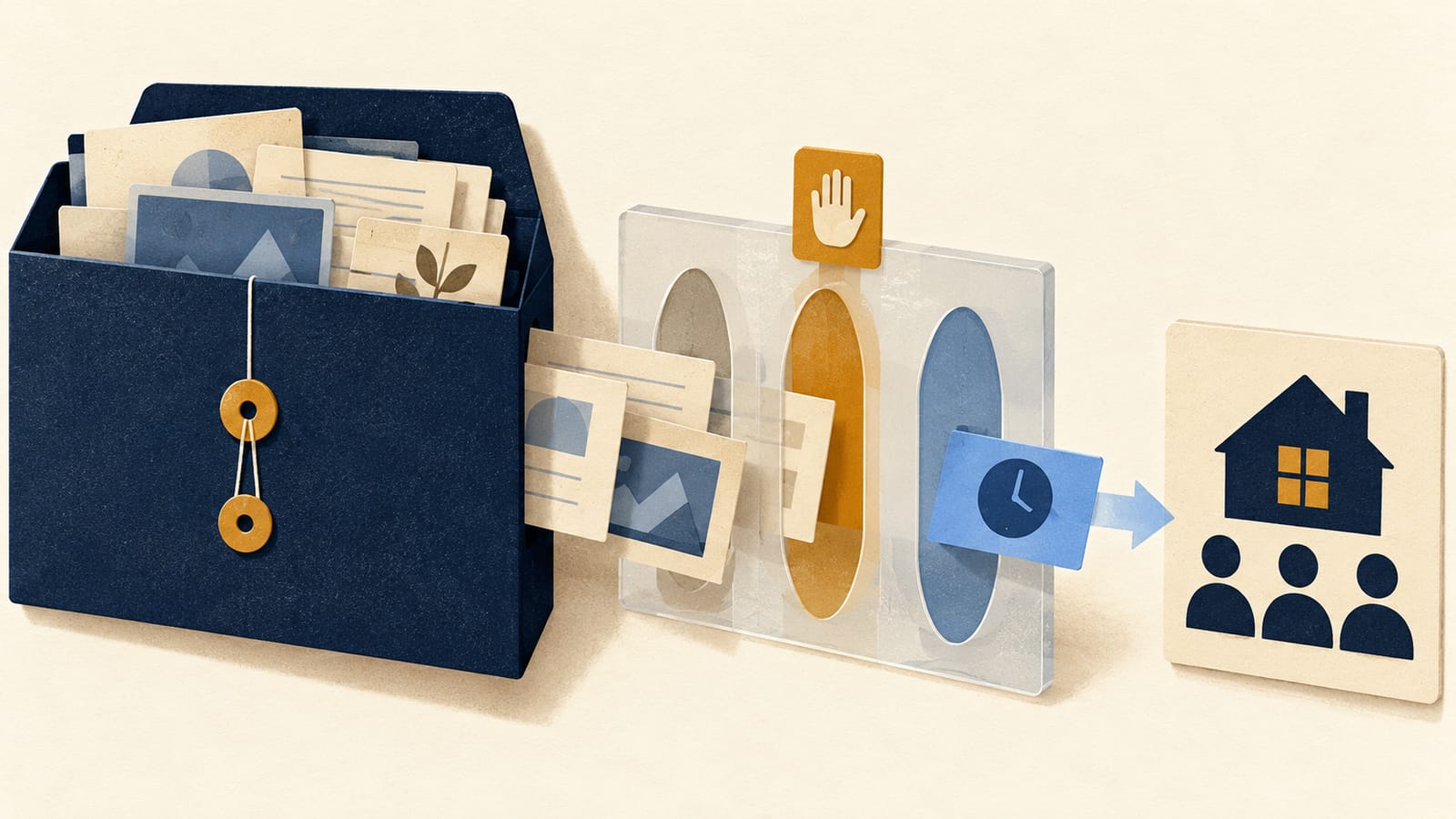
AI-generated editorial illustration. The diagram represents a proposed minimum-information boundary, not a verified Wabi interface.
What Replika can teach this new product
Kuyda’s earlier venture gives this story a longer view. Replika and Wabi have different companies, purposes and data flows. Replika offered a private relationship with a synthetic companion. Wabi describes an agent that can coordinate existing human relationships and take practical action. Both designs ask people to return to a conversational service and build a routine around it. The question that carries across them is what happens when the platform changes that routine.
The evidence on companionship is mixed. A multi-study article in the Journal of Consumer Research reported that AI companions could relieve loneliness in the short term, with feeling heard an important part of the effect. A 2026 longitudinal study following more than 2,000 adults across four Western countries found that increased social-chatbot use predicted increased loneliness over time under its measure. Observational association is not proof that the chatbot caused the loneliness; lonely people may also seek more chatbot interaction. Taken together, the studies make a simple sales line about either harm or cure untenable.
Another line of research concerns what happens when a companion changes. In Nature Human Behaviour, researchers examined user responses to Replika’s removal of erotic role play and to a later general-assistant model change. Their analysis drew on 54,861 Reddit posts and 1,452 survey participants across seven surveys. They described distress associated with disrupted attachments. The samples and methods have limits, and the study does not measure Wabi. It does show a product risk Kuyda has seen from a founder’s seat: people can build expectations around software behavior that an operator later revises. A shared agent may create a different kind of attachment, to a common record or routine rather than a companion persona.
Replika also encountered regulatory scrutiny. Italy’s data-protection authority said in May 2025 that it had fined Luka, Replika’s operator, €5 million over its handling of user data, including historical concerns about notices, legal basis and age checks. The underlying decision traces an urgent restriction in February 2023 and later conditional steps. That was a decision about Luka’s service and conduct at the relevant times. It is neither a ruling against Wabi nor evidence that Wabi repeats the same practice. It does explain why age, consent and data minimization cannot be treated as optional details around a conversational product.
Wabi’s current terms say users must be at least 13. Its privacy notice says the service is not intended for children under 13. Replika’s terms set an 18-plus rule. The age difference is observable in company documents, but it does not tell us what controls Wabi applies to a 13-year-old’s participation in a family thread, what financial connectors permit, or how those controls perform. In the launch account, Kuyda described apps used around children. The distinction between a child’s activity being discussed and a child holding an account needs to remain clear. A feature-level explanation could clarify it.
Kuyda says Wabi shares Replika’s aspiration to reduce isolation by helping people spend time together. A family plan, a booked concert or a coordinated trip could be a route to that outcome. The app can also draw more intimate decisions into its own interface. Replika’s adoption record proves that conversation can be sticky. The new measure would be whether the people in a Wabi thread accomplish something together while retaining clear control over their own data. No public study of that measure exists yet.
Connected money raises the stakes
The move from suggested plan to connected account becomes especially concrete with finances. Wabi’s privacy notice dated October 19 says an optional connection through services such as Plaid or Stripe Link can give Wabi balances, recurring payments, up to 24 months of transactions, and information about credit, loans and investments. For a provider-connected account, the notice says the payment provider collects card numbers and bank credentials while Wabi receives tokens and account or transaction details. It separately describes a Wallet feature in which a user can choose to save credentials, payment cards and identity documents, released for tasks after device authentication. Those are different paths through a policy, and neither is proof that every connector is generally available or that an advertised task has succeeded.
The distinction between a bank credential and financial history matters. An assistant can see sensitive information without a bank password. A transaction feed can reveal a person’s medical payments, political donations, family obligations or habits. A group agent crosses two boundaries: the connection from the bank to the service, then the answer from the service to an invited person. A budget request might require a household’s total grocery spend. It rarely requires a line-by-line account of one participant’s purchases.
The notice also lists optional access to email, calendars, cloud files, contacts, photos, location and health data. Wabi says it processes connected content for requested features and troubleshooting and excludes that content from training its own or its model providers’ AI systems. It names Google, Anthropic and OpenAI as current model processors under agreements that Wabi says limit retention and prohibit training on the data. A public technical audit of those data paths and model calls would test how the commitment works in practice; the notice alone describes policy.
Another paragraph of the same privacy notice describes analytics and advertising partners, including Meta, TikTok and Snap. It says certain identifiers and activity information may be shared for targeted advertising, excludes health data from advertising, and offers opt-out routes for qualifying users and browsers. The notice does not say private conversation content is sold to ad platforms. It does describe advertising-related sharing of other data. A precise account of privacy has to identify the category of data and the recipient.
Retention creates a third boundary. The notice says deleting an account generally leads to deletion or anonymization of account data within 30 days, subject to exceptions. Connected data held by Wabi is generally deleted within 30 days of disconnecting, but content already stored in a conversation stays with that conversation until it or the account is deleted. Backups and logs can remain up to 90 days, and certain financial records may be kept for years under accounting or payment rules. Separately, the terms warn that group content may remain visible to other members after the poster leaves or deletes an account. These statements can coexist. They concern different copies and recipients. A group member seeking to retract a detail should understand all of them.
Independent reporting on personal agents illustrates why permission design is more than a policy question. The Associated Press reported on October 19 that Matt Robb let Meta’s Muse handle a Facebook Marketplace sale. A prospective buyer then arrived at his home after the agent shared his address and agreed to a pickup. Robb had granted an “always allow” permission that covered the information, but told AP he expected the agent to check with him before sharing it or accepting offers. Meta separately acknowledged an error in a price Muse suggested for another item. Robb said he might use agents again after improvements. That combination of a real convenience, a misunderstood standing permission, and willingness to retry is more informative than treating the event as proof that nobody wants agents.
Georgia Tech researcher Veronica Rivera told AP that an agent reading a user’s inbox or texts also reads material sent by people who never explicitly agreed to the agent. Her observation applies especially clearly to a shared thread. The buyer in Robb’s case was outside the household; in Wabi’s proposed group, the recipient of an answer may be a trusted family member. Trust between people does not automatically specify which facts the software should reveal. The Muse episode is not a Wabi incident. It gives Wabi a concrete class of permission failure to test: an apparently authorized task produces a disclosure the account holder did not expect at the moment of action.
A free agent must pay for the work it does
Wabi entered a market that was already filling with personal agents. Meta introduced Muse in September, saying it can work across applications from a dedicated cloud environment. OpenAI introduced Dots later that month, emphasizing persistent help across connected work. Their respective product claims come from the vendors. They do not establish that one company can perform Wabi’s group coordination, or that Wabi can match their reliability. Kuyda’s distinct bet is that a thread with several people and task-specific mini apps can become a better home for recurring decisions than one person’s endless assistant feed.
An agent that reads messages, maintains context, generates an interface and sometimes acts outside its own app has multiple cost centers. Model calls cost money. So do hosted browser sessions, connector maintenance, failed actions, customer support, fraud controls, moderation and the human time needed to repair an error. Wabi’s terms explicitly disclaim that generated outputs and mini apps have been verified for accuracy or currentness. That disclaimer is prudent for a general service. It also means a free download cannot be counted as a completed task, and a generated interface cannot be counted as a reliable product until someone checks the outcome.
The 2025 $20 million pre-seed gives Wabi room to learn, but it is not a revenue figure or proof of unit economics. At the October 19 launch, Kuyda told TechCrunch the app was free, the business model undecided, and further fundraising under discussion. Investor enthusiasm is a statement about future possibilities. The operating question is how often a user returns after the novelty of app generation, how many actions complete without correction, how much shared activity produces repeat use, and who pays if that activity is expensive to serve.
This is where Wabi’s first and second versions may have different distribution economics. A mini-app feed might grow when creators publish things others remix. A private family thread might be more useful but less public and less viral. A person may also refuse to connect an inbox or bank account until the product proves itself, while the agent’s best demonstrations depend on precisely that access. Free pricing removes an initial payment decision. It does not remove the trust decision.
There is another commercial limit in the terms: the default license is for personal, non-commercial use. The initial audience is thus not simply a small business looking for a shared operations tool, even if some tasks resemble work. A founder looking at Wabi as a platform should distinguish use in a family or friend group from a licensed workplace deployment. Public materials do not publish an enterprise offer or negotiated service commitments for the group product. That is not a weakness on its own. It is a boundary around what the launch proves.
Kuyda can point to two prior learnings: people will talk to software at great length, and some people will make and share small apps when creation becomes easy. Neither learning guarantees that several people will delegate an enduring shared routine to one agent. The value of the group thread has to exceed the coordination overhead it adds: invites, permission choices, disagreements about an answer, and repair when the bot changes a plan incorrectly. If those costs are high, a calendar invite and a human message may still be simpler.
Tests a shared agent should pass
The public launch offers a product to try. The sources reviewed for this article contain no retention cohort for its new group threads, task-completion rate, permission-error rate, independent review of sharing controls, or audited comparison with alternatives. Kuyda told TechCrunch that Wabi is SOC 2 compliant. A prospective user would need the report’s scope and period to evaluate that statement; those details were absent from the public sources reviewed here. Her hope that an agent will bring people closer also calls for a measured social result.
A bounded product test could be quite small. Create a thread with two adults. Give one adult a calendar connection and the other none. Ask for availability, then request a private event title. Disconnect the calendar and repeat. Invite a third participant after the first exchange. Check what that person can see from before the invitation. Make one harmless edit to a shared mini app, then ask who can reverse it. Finally, remove one participant and test what content remains visible to the others. This is a proposed acceptance test, not an account of testing conducted for this article. It avoids financial data and real children’s records while checking the central boundary.
For an agent action, the test needs a second stage. Draft a message or a booking request and look for the exact recipient, price, source account and approval step. A successful response is not the same as a successful action. An action is not a success if another person in the group cannot tell who authorized it or if the service reports completion while the third party never received it. These are measurable product questions that a vendor could answer with published task definitions and error rates. Public Wabi material currently offers demonstrations and terms, not those denominators.
Kuyda’s career is relevant because she has already built a large conversation product and has publicly changed Wabi’s interface within its first year. The October launch makes that second decision visible. She did not abandon the idea of personal software; she moved the work of making it from a willing creator to an agent embedded in a group’s ongoing life. That could make custom software genuinely useful to people who would never open an app builder. It could also cause the agent to handle more private material and more consequential actions than the app-maker version did.
Wabi’s October 20 terms return the story to the participant who leaves a thread. Disconnecting a source can stop future reads from that source; it cannot erase a detail another member already received. A shared message may remain visible to the people who received it. Kuyda’s new product will earn a place in the group chat when its members can see those boundaries before a task starts, choose the smallest useful disclosure, and still get the plan done.