
HubSpot Plans Nearly 660 Cuts and an Outcome-Led Product Org
On this page 7 sections
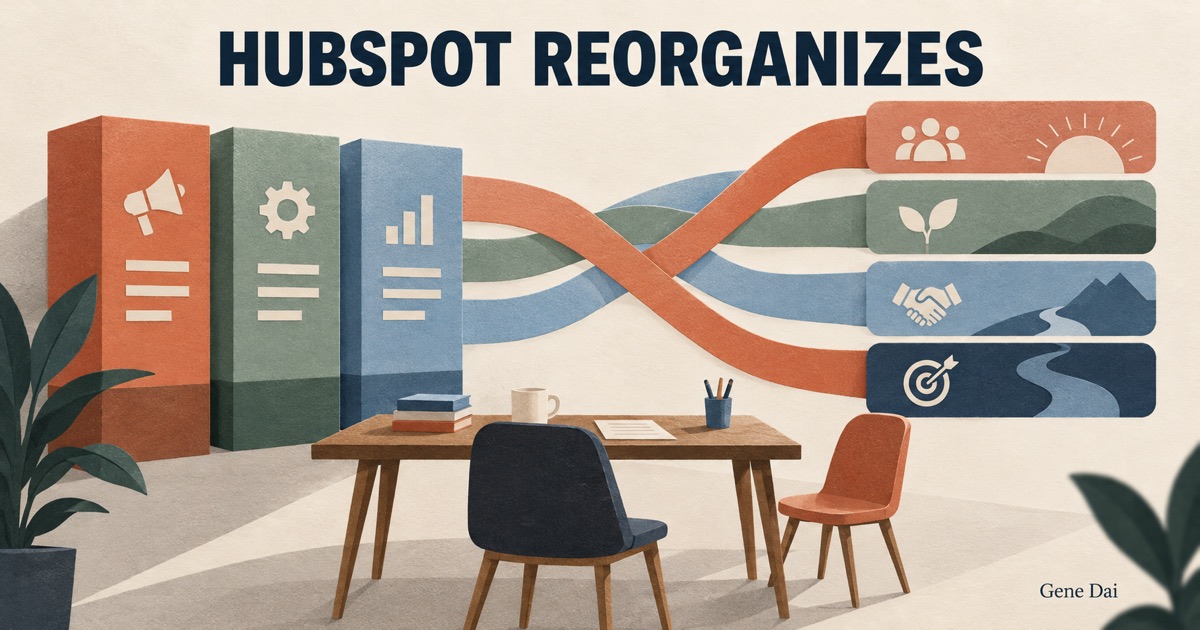
AI-generated editorial illustration.
On October 6, HubSpot chief executive Yamini Rangan told employees that the company would part with nearly 660 people, about 7% of its workforce. U.S. employees affected by the plan were to receive an email within 15 minutes. Employees elsewhere would hear what came next under local procedures. The memo put the immediate human consequence beside an organizational decision: product teams would stop being organized primarily around software hubs and instead own customer outcomes such as generating demand, winning deals and resolving customer problems.
The board had authorized the plan on October 1. In an October 6 filing, HubSpot estimated $65 million to $75 million in related charges, mostly for severance, notice periods, employee transition and benefits. It expected most charges in the fourth quarter and the eliminations to be substantially complete by the end of the first quarter of 2027. The filing describes a planned restructuring and its expected cost. It does not show that 660 people had already left on announcement day.
HubSpot is putting three decisions on one calendar: who builds the product, what a customer pays for an AI agent, and how success is counted. Its April pricing change charges for a resolved customer conversation or a recommended sales lead. Its September product release makes AI and an automatically updated CRM central to the pitch. Now it is redrawing the teams that must deliver those promises. The public announcements do not show who will own a failed agent handoff, how many support specialists remain or whether a buyer’s paid event stays resolved. A departing employee can see a role end. A customer can see a charge. Neither fact proves that the new team can carry the work.
Rangan explicitly said the reduction was not driven by AI-related efficiencies. The released documents describe a choice to reorganize around a product and commercial strategy, with role eliminations inside that plan. Whether AI later lets HubSpot operate with fewer people, improves customer results or creates different jobs requires evidence that the memo and filing do not yet provide.
The cut followed an org-chart decision
HubSpot’s existing product names divide work into Marketing, Sales, Service and other hubs. Rangan’s memo says customers do not buy a feature map for its own sake. They want to generate demand, win deals, delight customers and scale growth. Product teams, she wrote, will be organized around those outcomes, own the full customer journey and be accountable for the result. She also called for fewer management layers and less fragmented ownership. These are commitments about a future operating structure, not a published chart showing every team and manager after the change.
The order matters. The SEC filing dates board approval to October 1; Rangan’s employee message appeared on October 6. Management first defined the structure, roles and capabilities it wanted, then assessed every role, according to the memo. The six criteria were strategic need, management layers and spans, revenue capacity, capability, capacity at the required scale and leadership. The company did not publish scores by function or the number of roles eliminated in each team. A claim that a particular category of employees bore the cut would outrun the disclosed evidence.
An AI company announced job cuts. That sequence alone does not show AI replacing those jobs. Rangan specifically rejects that account. She says HubSpot is still investing in AI and wants to put resources behind its largest opportunities. Her explanation is a management account, not an independent audit of causation. No role-by-role automation map or measured productivity saving accompanies the announcement.
Changing a team’s remit from one feature to a customer’s completed journey changes the work, even if no machine takes a colleague’s tasks. Product management, engineering, design, support, customer success and revenue operations may all need to agree on where that journey begins and ends. Removing layers could shorten one decision path while increasing the span of a remaining manager. HubSpot has announced the intended structure, but it has not published a post-change measure of handoff time, manager span or customer retention.
The distinction also matters for affected employees. Someone whose role was built around a hub cannot infer from the memo which capability the new organization values, which team might need it or whether there is a funded internal opening. The six criteria describe how leadership says it reviewed positions. They are not a public transfer plan for the people leaving.
Growth did not protect every role
The cut came after a quarter in which HubSpot was growing. Its second-quarter release reported $911.7 million in revenue, up 20% from the same quarter a year earlier on an as-reported basis. The company ended June with 306,446 customers, up 14% year over year. GAAP operating income was $43.3 million, compared with a loss in the prior-year quarter. Non-GAAP operating margin was 20.3%, up from 17.0%. Those are company-wide figures for a period before the restructuring decision, not proof that every product line or team was healthy.
The same release reported $1.4 billion in cash and investments at June 30 and $531.9 million spent repurchasing shares during the second quarter. In August, the board authorized an additional repurchase program of up to $1 billion over as long as 24 months. A repurchase authorization is a ceiling and option, not a promise that all the money has already been spent. These figures do show that the reduction was made amid a set of capital-allocation choices, not because the company disclosed an inability to meet next week’s payroll. They do not establish that repurchase dollars could be redirected to preserve the same roles under a different strategy.
The growth figure also has a less comfortable companion. On the Q2 earnings call, management said HubSpot added about 7,000 net new customers, below its 9,000 to 10,000 expectation, as conversion weakened and buyers hesitated. Net revenue retention was 102%, down one percentage point year over year, with budget optimization among the pressures. Those are management’s quarter-specific explanations. They do not show that the 660 planned cuts will reverse slower customer additions. They do explain why a company could report strong revenue and still question how its teams, pricing and sales process fit the next period.
HubSpot’s October filing reaffirmed the revenue and non-GAAP earnings guidance it had issued in August for the third quarter and full year. It also said the restructuring charges would enter GAAP results but be excluded from the applicable non-GAAP measures and guidance. That accounting distinction is material for anyone comparing the announced cut with future profitability. A later non-GAAP margin can rise while GAAP results absorb the cash cost of severance. Neither figure by itself tells a worker whether their team has more capacity to ship or a customer whether service improved.
The planned $65 million to $75 million is an estimate, not a measured productivity saving. HubSpot expected most of the charge in the fourth quarter of 2026, job eliminations substantially finished by the end of the first quarter of 2027, and related cash payments substantially made by June 30, 2027. Local law and consultation can change timing. The filing also warns that the plan might disrupt operations, customer relationships or retention of remaining employees. Those risks sit on the same page as the margin target.
HubSpot’s investor site listed 9,016 employees as of June 30, while the October announcement described nearly 660 affected roles and approximately 7%. Dividing one number by the other would mix dates and definitions. The company may have hired, lost or reclassified employees between June and October. The public record here does not provide a clean before-and-after headcount bridge. The immediate scale of the cut is clear; the precise post-restructuring workforce mix is not.
A new bill arrives at the customer outcome
In April, HubSpot changed how two Breeze agents are priced. Its pricing announcement says Customer Agent moved from $1 per conversation to $0.50 per resolved conversation, and Prospecting Agent moved from a recurring contact-enrollment charge to $1 per lead recommended for outreach. The charges are paid through HubSpot Credits, at 50 credits per resolution and 100 credits per recommended lead. A 28-day trial was offered to eligible Pro and Enterprise customers.
That makes the invoice easier to relate to a task than a token meter. It does not settle what a customer means by an outcome. A support conversation may be marked resolved inside the software and reopened when a customer discovers the answer was incomplete. A recommended lead may never reply, agree to a meeting or become a sale. HubSpot’s announcement describes a resolved conversation and a lead recommended for outreach as billable events. It does not publish a contract-level test connecting each event to customer retention, revenue or the cost of the human work that follows.
HubSpot said Customer Agent resolved 65% of conversations and cut resolution time by 39% across more than 8,000 customers who had activated it. Those are the vendor’s aggregate claims. The release does not give the distribution by customer, issue difficulty, support channel or time period in a form that would let a buyer predict their own result. An activated customer is not necessarily a paying customer with the same case mix as the next one. A shorter conversation might reflect a good answer; it could also reflect a customer giving up. Resolution quality needs a follow-up measure.
Chief customer officer Jon Dick presented the pricing change as a way for buyers to pay when the agent works. His claim is understandable from a software vendor’s side: a visible unit is easier to defend in a budget review than an opaque token allowance. The buyer’s side is less tidy. A finance lead needs the credit schedule, a support lead needs the definition of resolution, and an account owner needs a way to dispute a case that reopened. If those three people read different reports, the move from seats to outcomes has shifted the reconciliation work to the customer.
Consider a buyer who receives 10,000 service contacts in a month. If software closes 6,500 of them and bills at $0.50, that line would be $3,250 before other HubSpot costs. The calculation is an illustration, not HubSpot customer data. The buyer still needs to count reopened cases, escalations, human handling time, refunds and any contact that ended without an answer. Only then can it compare the agent with its previous service cost and customer experience. A procurement team that buys on a reported resolution rate without defining a durable resolution is buying a number whose meaning can change at the boundary between software and support.
The same issue follows a sales lead. The $1 charge arrives when the agent recommends someone for outreach. A salesperson still decides whether to make contact. The lead has to respond. A deal requires budget and approval. If recommendations rise while accepted opportunities stay flat, the product is generating more billed events without a corresponding business result. That is a useful signal for the buyer and for the new outcome-owned HubSpot team, provided both can see the whole journey.

AI-generated editorial illustration. The split path represents billable software events and human follow-up, not a recorded customer case.
Product teams inherit the whole journey
The September Fall Spotlight release presented a rebuilt Breeze Assistant, a self-updating Smart CRM and a layer it calls Growth Context. Chief product and technology officer Duncan Lennox framed these products around customers asking for results instead of deciding which AI tool to use. The announcement claimed that customers using AI with high-quality context could create 3.6 times more marketing-qualified leads, win 3.2 times more deals and close more than twice as many tickets. The release gives vendor-selected comparisons; it does not establish that the new product structure produced those multiples or that they apply to every customer.
Moving from hub ownership to outcome ownership is one response to a real product problem. A customer trying to win a deal moves through marketing, sales, data quality and account history. An agent asked to recommend a next action needs context from more than one screen. If each team optimizes its own feature adoption, nobody may own the customer’s full path from a first inquiry to a signed contract. HubSpot’s proposed organization assigns that path to a team. The challenge is to give the team authority over the dependencies it can actually change.
An outcome team could improve the handoff between Marketing and Sales without adding another agent. It could shorten the interval between an agent’s recommendation and a salesperson’s response. It could discover that the CRM’s automatic update put stale or incorrect context into a decision. It could also be held responsible for a lost deal it did not control, because the buyer’s budget disappeared or a competitor cut its price. The team needs a measurement rule that distinguishes its own contribution from factors outside the product.
HubSpot has already described a broad internal AI program. In a May account of its operating changes, Rangan said 94% of employees used AI weekly and had created more than 3,900 agents. She described 20 company-wide AI learning days in 2025 and a move to six-week planning sprints. Those figures are self-reported usage and activity. They do not tell us how many agents stayed in use, how much productive time was saved, whether customer outcomes improved, or whether the October job plan was caused by the May usage pattern.
The difference between activity and result is easy to lose when a company reorganizes quickly. A team can ship more agent actions, send more recommendations and run shorter sprints. It can also leave a customer waiting at the handoff, create duplicate contacts or move complex work to an overextended human queue. An outcome owner needs to look at the adverse path as closely as the successful one. Otherwise the new chart may change which manager receives the report while leaving the customer’s problem in the same place.
Employees need a place in the new map
Rangan put numbers on the departure package in the CEO memo. HubSpot said support would generally include 20 weeks of base pay plus one week per year of service, capped at 30 weeks; five months of U.S. COBRA coverage paid as a lump sum or five months of Modern Health globally; and six months of career transition support. Departing employees could keep company laptops after data was removed and retain home-office equipment. Regional law and consultation affect the package and timetable. These are announced terms, not evidence that every employee has already received them.
The memo also promised a chance for departing employees to speak with a manager. That conversation matters because the organization has not published a job-family map explaining what becomes of work previously divided among hubs. An affected product manager might have deep knowledge of a feature that still matters to customer outcomes. A support specialist might understand the cases an agent fails. A manager might know where teams were duplicating work. The value of that knowledge does not guarantee a role in the new structure, but losing it could make the intended customer journey harder to deliver.
HubSpot’s criteria include capability and capacity. The company has not disclosed whether it offered internal transfers, retraining or temporary bridge roles to people whose old job did not match the new design. That is a gap in the public record, not proof that no such options exist. A leader evaluating a comparable reorganization should ask how long a person can search for a new role, whether open requisitions are funded, who can release someone from their current team and how success will be counted after a transfer. A skills inventory without an approved job is a directory, not mobility.
An October 8 edX Enterprise survey gives context, though it does not measure HubSpot. NewtonX surveyed 507 learning and workforce-strategy leaders at organizations with at least 500 employees from June to July. 83% called AI capability an active priority, yet 29% said their organizations had mature AI capabilities; 26% were highly confident their learning function could deliver the skills needed. The survey describes leaders’ assessments, not a causal test of training or a census of workers. It is useful because it exposes the distance between declaring a priority and financing the time, leadership and work needed to make it real.
NewtonX research director Chris Kelly argued in the release that choosing whether HR, learning or IT owns upskilling does little on its own; an executive mandate, capacity and measures matter more. That is an outside perspective on organization design, with an important limit: it studies a selected survey sample, not HubSpot’s restructuring. Still, it asks a useful question of the new outcome teams. Do they receive enough people, time and authority to change a customer journey, or only a new name and a target?
For employees who stay, a flatter structure can mean fewer approvals and more authority. It can also mean a wider span for managers, less coaching and more unresolved cases per specialist. HubSpot has not given baseline or target figures for those conditions. The next meaningful workforce disclosure would be more than an AI adoption rate: team capacity, internal moves, manager spans, regretted attrition and the customer work still waiting at the edge of the new team. None of those should be inferred from the announced 7% cut.
Where the measurement stops
An outcome-led org chart requires a set of measures that crosses the same boundaries as the customer journey. The table below is an editorial measurement design for buyers and operators, not a description of HubSpot’s internal scorecard. It keeps the vendor’s billable event separate from the customer’s durable result and names the human work that can disappear from a product dashboard.
| Journey | Observable software event | Customer result to test | Human work and cost to retain |
|---|---|---|---|
| Service inquiry | Agent marks a conversation resolved and a credit charge is recorded | No reopen for the same issue within an agreed period; customer confirms the answer worked | Escalation time, specialist follow-up, refunds and quality review |
| Sales prospecting | Agent recommends a lead for outreach | Qualified contact replies, meets and progresses through a funded opportunity | Seller research, outreach, rejection handling and CRM correction |
| Marketing demand | Campaign or agent generates a marketing-qualified lead | Accepted opportunity and revenue from a clearly defined cohort | Segmentation, creative review, consent and sales follow-up |
| Product delivery | Outcome team ships a cross-hub change | Adoption and durable customer result compared with a suitable baseline | Integration maintenance, support load and rework after release |
| Workforce redesign | Role closes or employee transfers to a new team | Customer capacity and employee retention after the transition | Severance, onboarding, manager coaching and lost domain knowledge |
The first two rows start with a charge. A buyer and vendor can agree on the event and still disagree about the result. The service buyer may want a 30-day no-reopen window; a sales leader may care about accepted opportunities rather than recommended names. Those definitions are illustrative. The actual contract and instrumentation would have to specify them, along with who can audit errors and reverse a charge.
The last row returns to the October decision. A planned reduction has a visible numerator: nearly 660 jobs. The claimed business benefit has no published denominator yet. HubSpot has not disclosed a before-and-after measure of customer outcomes per team, delivery time, escalated case load or post-change employee capacity. The SEC filing explicitly lists possible disruption to customers and retention as risks. Those are the questions the next quarters can answer.
A restructuring will not produce a clean productivity statistic on announcement day. Product teams need time to change dependencies and ownership. A 2026 revenue result will mix old and new organization, market conditions and customer budgets. A rising non-GAAP margin would not prove a better service experience; a lower near-term margin could accompany investment in a durable product. Compare consistent cohorts, event definitions and time windows.
A deadline for the new map
HubSpot’s October announcement offers a plan with dates. Most of the charge is expected in the fourth quarter. Role eliminations are expected to be substantially complete by the end of the first quarter of 2027. By then, a customer should be able to ask who owns a journey that crosses marketing, sales and service; an employee should know where decisions sit in the flatter organization; and investors should be able to compare the restructuring’s cash cost with the company’s stated operating targets. Those are tests of execution, not promises already met.
HubSpot is trying to align product teams, AI pricing and customer measurement under one unit of work. A resolved conversation and a recommended lead put a price on an event that used to be buried inside software use. Giving a team responsibility for the whole journey might reveal whether that event deserves its price. Yet the journey crosses budgets, people and choices outside HubSpot’s control. More accountability on paper can become more pressure on the same humans who receive the escalations.
The October memo ended with a promise to discuss the new organization with the people staying. For those leaving, the next step was an email and a conversation with a manager. A customer will meet the new structure in quieter ways: a support case that stays closed, a salesperson who follows up, or a deal that does not fall between two product teams. HubSpot has put a deadline on the cuts. It has yet to show whether the new handoffs work.