
Harver Bought Symphony Talent to Link Job Ads With Hiring Tests
On this page 7 sections
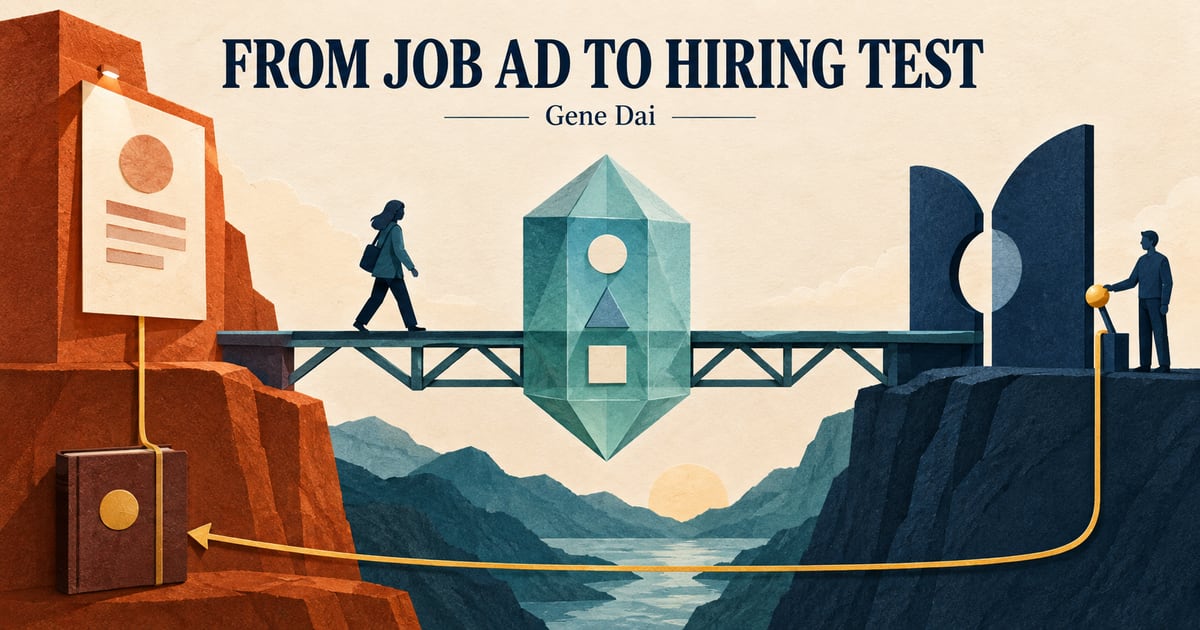
AI-generated editorial illustration.
On September 17, Harver announced that it had acquired Symphony Talent. The corporate combination places programmatic job advertising, career sites, employer branding and candidate relationship management beside assessments, reference checks, skills matching and fraud detection. Harver said the companies together serve more than 1,500 clients with more than 300 employees. It also said its assessment platform has been applied to more than 65 million candidates and produced more than 100 million skills insights.
The announcement did not disclose a purchase price, financing terms, a product-integration schedule or a customer migration plan. Symphony Talent became a Harver company. Ownership is the only outcome that the announcement proves. Whether an employer can already follow one person from an advertisement to a validated assessment and then to job performance remains unanswered.
The deal targets a gap that appears whenever a hiring budget is reviewed. Recruitment marketing teams decide where to spend. Recruiters decide whom to advance. Assessment teams decide what evidence counts. Hiring managers decide whom to select. HR and finance learn much later whether the hire worked. A connected vendor can reduce the technical gaps between those decisions. It can also let an early score travel farther through the funnel and shape who sees the next advertisement.
Harver is buying into a specific operating problem. AI-assisted applications have increased the amount of polished material recruiters must sort, employers are watching software costs, and candidates often move through several tools before meeting a person. Buying the upstream platform gives Harver a route to use skills information before the formal application. It also creates a larger surface on which to measure time, cost and quality.
Buyers still have to prove that joined data means what the dashboard says it means. High assessment scores may show that a campaign found capable people. They may instead reflect a narrow group already familiar with the test, the exclusion of people who need an accommodation, or a denominator limited to candidates who tolerated every step. A fast screen can lower recruiter workload while shifting time and uncertainty onto applicants.
This article examines public evidence available as of September 27, 2026. Company figures and executive forecasts are labeled as such. No customer contract, technical architecture or post-acquisition outcome dataset is public. The five-part buyer test below is an editorial operating framework, not a product review, validated assessment or legal opinion.
September 17 joined the ad budget to the assessment score
Symphony Talent sits near the beginning of the recruiting journey. Its products cover career sites, talent communities, candidate relationship management, employer-brand work and programmatic media. Harver sits closer to selection, with assessments, reference checking, skills matching and fraud controls. The acquisition puts both groups under one owner and gives Harver a commercial reason to connect the data.
The Harver announcement describes a span from workforce planning and job advertising through on-the-job performance. It says skills insights can move toward the start of the journey so employers target people who fit before discovering a mismatch later. Those are intended capabilities and benefits. The release does not show which products share an identity model today, whether assessment or post-hire data will change media bidding, or which employers have tested the combined loop.
An independent Dutch trade publication made the same distinction. Its September 18 analysis said the deal could connect campaign and contact data with skills, suitability and eventual performance. It also noted that the price, product roadmap, contract effects and technical integration remained unclear, and that no independent customer results had been published.
Symphony Talent’s own research shows why that promise has an audience. Its 2026 Talent Acquisition Outlook, based on more than 250 talent-acquisition leaders and practitioners, says 89% rated visibility across the funnel as average or worse. Only 31% said they actively adjusted media spend using performance data. The survey was produced by the company selling full-funnel visibility, and its sample does not represent every employer. The gap still identifies a recognizable budget problem: teams can buy clicks and applications more easily than they can explain which spend led to a person who succeeded at work.
Advertising platforms optimize quickly because their early events arrive quickly. A view, click or started application appears within hours. A completed application may arrive in a day. Assessment results and interview decisions follow later. A quality-of-hire measure may wait 30, 60 or 90 days after a start. Retention, safety, sales or service outcomes can take longer. The closer the metric gets to work, the fewer people remain in the sample and the more other factors have influenced the result.
Because downstream answers arrive slowly, early proxies gain authority. Cost per application becomes cost per qualified applicant. An assessment pass becomes predicted quality. A hiring-manager rating becomes evidence that the advertising channel worked. Each metric can help, but each answers a different question.
Appcast’s public page for its 2026 Recruitment Marketing Benchmark says the report adds click-to-hire disposition data so employers can judge channels by downstream quality instead of top-of-funnel volume. It also says recruiting costs increased during a softer labor market. The landing page does not publish every denominator, so it cannot supply a universal benchmark for this deal. It does reinforce the buying logic: media costs become easier to defend when the channel can be connected to a later decision.
A connection without its denominator does not answer the budget question. Finance needs to know whether the base is every click, every person, every completed application or only people with an assessment result. A talent leader needs to know who disappeared between those points. A candidate needs to know what evaluation is taking place and whether another route exists. The joined dashboard earns trust when it exposes those questions. A smooth conversion line can bury them.
A full funnel still has separate owners
Recruiting software diagrams often draw a funnel as one narrowing shape. Operating work looks more like a relay with different clocks.
The talent-marketing team buys audiences and creative. Its unit may be a campaign, impression, click or lead. The career site team manages content and conversion. The CRM team manages profiles, consent and messages. The applicant-tracking system holds requisitions, applications and dispositions. An assessment team or industrial-organizational psychologist defines instruments and validation. Recruiters move candidates. Hiring managers conduct interviews. HR operations creates the employee record. A business leader later judges performance. Procurement manages the vendor relationship, while privacy, legal and security teams set boundaries around data.
One invoice may reduce API work, identity reconciliation and duplicated support tickets. Decision ownership stays with the employer. The customer still has to determine whether a test is job related, whether a manager used the result as intended and whether an advertising audience was too narrow, even when the vendor recommends a configuration.
The identity problem appears before analytics. One person may click an advertisement on a phone, join a talent community with a personal email address, return through a job board, apply with another address, complete an assessment through a link and later enter the HR system under a legal name. Joining those events incorrectly can over-credit a channel or attach assessment data to the wrong profile. Refusing to join them can leave the funnel incomplete.
Consent and purpose travel poorly across that sequence. A person may agree to receive job alerts without expecting a marketing profile to absorb assessment scores. A candidate may complete a test for one role without expecting the result to influence which future roles or advertisements they see. The same data can support a helpful invitation, an automated ranking or an exclusion. The employer needs a purpose for each move, not a general belief that connected data is useful.
The metric owners also face incompatible incentives. A media manager can lower cost per application by expanding reach. A recruiter can reduce workload by raising an early threshold. A hiring manager can protect time by interviewing fewer people. Finance can seek fewer vendors. A candidate can want a short process, enough information to decide and a fair chance to show relevant ability. A local improvement can create a cost for the next owner.
Consider a campaign for warehouse supervisors. Marketing finds a source that delivers applications at half the former cost. The assessment pass rate is lower, so recruiters see no workload benefit. The team responds by changing the audience and adding a realistic job preview. Completion drops, but early turnover also drops. Which version won?
The answer depends on the decision agreed before the campaign. If the employer needed more eligible applicants, the first source may still be valuable. If it needed people who understood the shift and stayed, the revised path may be better. If the assessment screen excluded experienced candidates with limited English in a role where English was not essential, neither result is acceptable. A full-funnel product cannot choose the objective after seeing the data.
Candidates experience these handoffs as one employer. They do not care that the career site, chatbot, assessment and scheduler came from separate modules or acquired companies. A repeated question feels like organizational disorganization. An inaccessible test feels like the employer’s test. A rejection without an explanation belongs to the employer’s brand. Consolidation may remove seams in the experience, but ownership has to survive the removal.
Harver arrived through a chain of acquisitions
The September transaction adds another layer to two companies already built through combinations.
In 2019, Symphony Talent acquired SmashFly, an enterprise recruitment-marketing and candidate-relationship-management platform. The announcement said the companies supported nearly 750 customers and that financial terms were undisclosed. Symphony Talent brought employer-brand and creative services; SmashFly brought CRM and recruitment-marketing technology.
Seven months later, Symphony Talent launched SmashFlyX. Its product release said the company had unified CRM, career sites, talent mobility, programmatic advertising and analytics on one data structure. More than 150 companies were using the platform at the time. The release is company evidence of a prior integration effort. It does not show how each current customer is configured six years later.
Harver’s route was similar. Outmatch acquired the company called Harver in May 2021 and adopted the Harver name that November. The rebrand announcement said the unified platform would combine Outmatch’s science and product capabilities with Harver’s volume-hiring workflows. The current product menu also carries Checkster reference checking and LaunchPad interviewing, products brought together during that earlier period.
In August 2022, Harver acquired pymetrics, adding game-based behavioral assessments and another AI methodology. The public announcement presented a broader assessment portfolio and responsible-AI ambition. It did not turn every validation claim across the portfolio into independent evidence. A buyer still has to identify the instrument used for a particular role, the population on which it was validated and the version that produced a decision.
Acquisition history matters because the latest deal is sometimes described as if two clean databases will simply be connected. In practice, both sides can contain older products, customer-specific integrations, regional hosting, services work, acquired data models and contracts signed at different times. A shared logo and sales story can arrive before a shared event schema.
Both companies have completed integration work before. Symphony Talent moved from a combination to a unified product, and Harver has operated acquired assessment brands together. Those precedents do not supply today’s architecture or migration sequence. Buyers should not infer either from the phrase “single, connected solution.”
Ask for a roadmap that names the system of record at each stage. It should show how a campaign ID becomes a candidate source, how duplicate people are resolved, which assessment version is stored, how overrides are logged and how post-hire outcomes return to analytics. It should also name the stages that will remain separate. An honest boundary can be safer than a hurried integration that lets data travel without its original context.
The commercial structure deserves the same precision. Harver said the combined company is backed by Rubicon Technology Partners. It did not disclose the purchase price, financing structure, revenue, margins or expected savings. No public evidence shows whether jobs will be removed, teams combined or customer prices changed. Those facts should remain blank until the companies, customers or reliable reporting provide them.
More signal can produce a tighter feedback loop
Harver’s most credible near-term benefit is prosaic: fewer identifiers lost between systems and less custom integration work. A single provider can show recruiters what happened before a person applied. Skills data can help a marketer distinguish a source that produces completed forms from one that reaches people capable of the job. Candidate behavior on the career site can help a recruiter understand interest. Post-hire results can expose a selection process that is fast but weak.
Sean Barry, Harver’s chief executive, described a more aggressive version in a September 22 WorkTech interview. The discussion placed small assessments and realistic information before the formal application, with the aim of helping people self-select and giving employers signal before AI-polished resumes reach the applicant-tracking system. It also framed return on talent investment around quality, time, cost and ease of hire. These are the buyer’s stated strategy and the interview host’s summary, not measured post-deal results.
A short work sample may tell both sides more than another cover letter. A realistic job preview can reveal schedule or task conditions before a candidate spends an hour applying. A recruiter can spend time on people who have seen the work and still want it. The employer can learn which message attracts people who complete the relevant evidence step.
The loop becomes risky when the early signal controls its own future population. Suppose one advertising source sends people who score well on an assessment. The system shifts more money to that source. Fewer people from other sources take the assessment, so the employer learns less about them. The score and the media optimizer appear to confirm each other. They may have found a productive channel. They may have created a narrower sample.

AI-generated editorial illustration. The folded route separates attraction, evidence, human selection and outcome while the audit ribbon returns to the budget.
Post-hire data introduces another attribution problem. Performance ratings reflect onboarding, manager quality, schedule, team assignment and opportunity as well as selection. Early turnover can indicate a poor match, an inaccurate job preview, low pay, unstable hours or a bad supervisor. Feeding the result back into advertising without separating those causes can teach the system to avoid groups who entered harder working conditions.
The design needs a comparison that the optimizer cannot erase. An employer can hold a portion of spend steady, keep source-level denominators, and examine qualified, interviewed, hired and retained cohorts by role and location. It can review false negatives from below a threshold and candidates advanced through an override. It can compare assessment versions instead of blending them into one score. Those practices cost money. They preserve uncertainty long enough to learn.
Lower-volume employers face a harder limit. A regional hospital or specialist engineering team may not hire enough people in one role to estimate a stable local relationship between source, score and job outcome. Vendor-wide data can offer a reference point, but the provider must show why evidence drawn from other customers, jobs and labor markets transfers to this use. A large total candidate count does not repair a small relevant sample.
Consistent IDs and event definitions make the analysis easier. The feedback loop becomes harder to challenge when the scoring, attribution and recommendation logic all arrive in one dashboard. Buyers need enough raw events to reconstruct the path. A conclusion generated by the platform is insufficient.
Count the people who never entered the measured path. Some saw an advertisement but could not use the application. Others started and abandoned the test, requested an accommodation, failed identity verification, declined a recording or withdrew after learning the schedule. A conversion rate without those exits can reward a process that is efficient because candidates absorbed the friction.
Fraud makes early filtering tempting
Application volume and trust problems create pressure to screen sooner. In Greenhouse’s 2025 AI in Hiring survey, 91% of recruiters said they had spotted candidate deception, and 34% said they spent as much as half their week filtering spam and junk applications. Only 8% of surveyed candidates said AI made hiring fairer. The study covered 4,136 job seekers, recruiters and hiring managers across four countries. Those are reported experiences in a vendor survey, not a measured fraud rate for all applications.
Greenhouse chief executive and co-founder Daniel Chait described the pattern as a loop: candidates use AI to apply more widely, while employers add AI to filter them back out. His diagnosis comes from a company that sells hiring software, but it captures a cost neither side can remove by adding another automated step. More filtering can increase the value of appearing polished or gaming the next filter.
iCIMS provides a different current view. Its September workforce report says August 2026 openings on its platform were 13% above the prior-year baseline while hires were up 2%. Applicants per opening fell to 30, and time to fill reached 40 days. The population covers more than 3.1 million users and 691 million candidate profiles, according to iCIMS. It is not the entire labor market.
The numbers describe different parts of recruiting, and they need not move together. A recruiter may see fewer applicants for one hard-to-fill role and more low-signal material for another. Spam, deception, mass application, strong candidates and labor scarcity can all vary by occupation, location and platform. A universal “candidate flood” story is too simple for product design.
Early assessments and identity checks can protect recruiter time. They can also ask candidates to pay a larger cost before a human has reviewed the role or resume. A ten-minute micro-assessment repeated across ten employers is 100 minutes of unpaid work. A camera, typing pattern, device check or identity document can create privacy and accessibility questions. A realistic job preview can save everyone time; a hidden ranking step can make the same stage feel like a trap.
Fraud controls need separate labels. Identity verification asks whether the person is who they claim to be. Assessment security asks whether the person completed the exercise under stated conditions. Job validation asks whether the exercise predicts relevant performance. Candidate communication asks whether the person understood the process. One control cannot stand in for the other three.
A correction path needs its own owner. An identity mismatch, inaccessible interaction or suspicious-behavior flag may look decisive inside a product and still be wrong for the person affected. The candidate should know how to supply evidence, how quickly a human will respond and who can pause or reverse the disposition. Sending the person through the same automated flow again is not an appeal.
The employer remains responsible for the use. New York City’s automated employment decision tool rules require a recent bias audit, a public summary and notice when the law applies. The scope turns on the actual tool and how it substantially assists or replaces a decision. Buying a platform with an audit feature does not establish that a particular employer’s configuration, data and use comply.
California’s employment regulations concerning automated decision systems took effect on October 1, 2025. The Civil Rights Department summary states that discrimination law applies when automated systems facilitate recruiting, hiring and other employment decisions. It also describes a four-year employment-record retention requirement that includes automated-decision data and highlights disability risks in assessments. Exact duties depend on the employer, decision and jurisdiction.
Those rules turn integration details into evidence questions. Which version of a model or assessment affected the candidate? Which features were used? What recommendation appeared? Who reviewed it? Was an accommodation offered? Can the employer retrieve the record after a product migration? A full-funnel provider may hold more of the answers. The contract still has to ensure the employer can obtain them.
A five-part test for the combined stack
Buyers can ask for proof before every roadmap item ships. Treat the acquisition as five handoffs and demand an evidence packet for each one.
| Buyer test | Evidence to name before integration | Failure signal |
|---|---|---|
| 1. Map spend to a fixed denominator | Name the metric owner; preserve impressions, unique people, starts, completions, qualified candidates, interviews, hires and post-hire observations by source, role, location and time window. | The denominator changes between dashboards, duplicates disappear without a rule, or cost per qualified candidate excludes abandoned assessments. |
| 2. Assign every consequential action | Name the human decision owner; distinguish a suggestion, rank, threshold, auto-reject and media-budget change; log overrides and the evidence available at the time. | The vendor is described as the decision-maker, reviewers cannot reconstruct an action, or an override exists only as a free-text note. |
| 3. Preserve the candidate route | Show the notice, purpose, expected time, data collected, accommodation route, human contact, correction path and retention period for each assessment, verification or automated evaluation. | A person learns about scoring after submission, no equivalent route exists, or completion improves because people with access needs leave. |
| 4. Validate the instrument and the loop | Identify the assessment and version, target job, validation cohort, sample size, criterion, subgroup results, false-negative review and downstream outcome owner. Test media optimization separately from assessment validity. | One global score crosses roles, vendor averages replace employer evidence, or the same optimized sample is used to prove the optimizer worked. |
| 5. Make renewal and exit reproducible | Export candidate events, source IDs, notices, scores, versions, decisions, overrides and outcome links in documented formats. Agree on renewal measures, support duties, deletion and migration timing. | Only summary dashboards are portable, historical logic changes after an update, or savings are claimed without implementation and review labor. |
Start with the denominator and give it jointly to talent acquisition and finance. The team should write that denominator next to every cost. Media spend divided by applications is different from media spend divided by distinct eligible candidates. Assessment cost per completion ignores people who abandon. Cost per hire says nothing about whether the person stayed or performed. No single denominator is always correct. Silent movement between them is the problem.
Then record who owns each action. A recommendation can order a recruiter’s queue without formally rejecting anyone. A programmatic system can stop buying an audience without touching an applicant record. Both actions affect opportunity. The log should record the action and its owner even when a human retains the final click.
The candidate route is an operating requirement rather than a footer. Put the expected duration before the test. State whether video, audio, identity documents or behavioral signals are collected. Give the person a reachable contact and a usable accommodation and correction path. Record withdrawals separately from failures. Otherwise the system may learn that the people least willing or able to accept friction are the least qualified.
Validation has to follow the actual job and instrument. “Science based” is a category claim. A buyer needs the test version, job family, criterion and population. When advertising and assessment become connected, the buyer also needs to check whether the marketing loop changes the population on which the assessment is judged. A stable pass rate can conceal a shrinking range of candidates.
The exit test makes the other four credible. A customer should be able to reproduce a material decision after a vendor update or acquisition. That requires events and versions, not screenshots. It also gives procurement a way to compare the cost of one broader vendor with the integration, review and migration labor it replaces.
The packet creates a common object for the recruiter, assessment expert, hiring manager, privacy team, finance partner and candidate-support owner. Each can see where their decision enters the same funnel and where evidence stops. It cannot make every hiring choice correct; it makes the chain inspectable.
Renewal season will reveal whether the handoffs disappeared
Corporate consolidation can create real buyer value. Fewer vendors can mean fewer security reviews, contracts, connectors and account teams. Shared identifiers can reduce spreadsheet reconciliation. A career site and assessment can present one coherent route instead of sending candidates across unfamiliar domains. A broader support team can own problems that previously bounced between suppliers.
Separate tools do not guarantee buyer control. They can leave the employer operating brittle custom integrations and arguing over which vendor lost a status. A carefully integrated suite may be easier to inspect than a patchwork. The relevant comparison is the current operating system and its labor, not an abstract preference for suites or specialists.
The acquisition becomes measurable when customers reach a renewal with enough post-integration history. Procurement can then ask whether connector and support work fell. Finance can ask whether cost per eligible, interviewed and successful hire changed at fixed role and location. Recruiting can ask whether review time and time in stage moved. Assessment owners can inspect validation and false negatives. Candidate-experience teams can examine completion, withdrawal, accommodation and complaint data. Hiring managers can compare early performance without treating their own ratings as ground truth.
Harver and Symphony Talent may publish integration milestones or customer outcomes before then. Buyers should preserve the starting state now: contracts, product versions, event definitions, staffing hours, source mix, conversion, assessment completion, overrides, candidate support and post-hire measures. Without that baseline, a future dashboard can show movement but not what changed.
Renewal evidence should also count the cost of combination. Data mapping, new consent language, retraining, parallel runs, validation and candidate communication require work. A vendor may absorb some of it. The employer will still spend time deciding how the joined system should behave. Lower subscription count can coexist with higher implementation effort.
The September 17 deal gives Harver the components to connect a job advertisement with a hiring test. That connection could help employers spend against evidence closer to the work. It could also let one assessment shape the audiences from which its future proof is drawn.
The acquisition announcement cannot show the difference. Renewal evidence can: a fixed denominator, a named decision owner, a candidate route, a validation cohort and an exportable record. If those survive the integration and reach the meeting, the full-funnel claim will have something stronger than a new logo behind it.